Keys
Best keyboards for kids
One specification separates a keyboard a child can learn on from one that teaches them the wrong hand, and it is the one budget listings never mention.
By Sawyer V. · Published · Last updated
Keyboards are the easiest instrument for a young child to start on and the easiest category in which to buy the wrong thing, because the specification that matters most is invisible in a photograph and rarely printed in a listing.
Both picks state their Starter Path band, and we have not played them — our method is on how we pick.
A child needs 61 full-size touch-sensitive keys. Full-size because narrow mini keys teach a hand span that is wrong on every other keyboard they will ever touch, and touch-sensitive because a keyboard that plays every note at one volume cannot teach dynamics at all.
Why mini keys are the disqualifier
A standard white key is about 23 mm across. Mini keys are narrower, and a keyboard using them will describe itself as compact or space-saving rather than printing the number.
Here is why it matters more for a child than an adult. A student learns the distance of an octave through their hand, not their eyes — the span becomes automatic, the same way a touch typist stops looking at the keys. Learn that span on narrow keys and it is wrong everywhere else: at school, at a lesson, at a friend’s house, on any real piano.
Recalibrating a distance you learned by feel is genuinely harder than learning it correctly once. Buying small keys for small hands is the intuitive move and the wrong one.
Why touch response is non-negotiable
A touch-sensitive keyboard gets louder when you press harder. A non-touch one does not, no matter what the child does.
That removes an entire category of musical skill. Playing a melody louder than the accompaniment, shaping a phrase, playing something gently — on a non-touch keyboard none of it can be practiced, because the instrument does not respond. The child is not doing it wrong; there is nothing to do.
Both picks here are touch-sensitive. If you shop elsewhere, this is the first specification to check and it is frequently omitted for the obvious reason.
The two picks
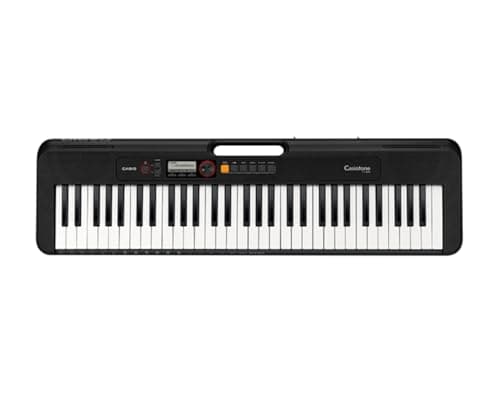
The Casio Casiotone CT-S200#ad is the simpler answer: 61 full-size keys, 48-note polyphony, a clean panel, and crucially a power supply and music rest in the box. It is light enough that a child sets it up themselves, which matters more than it sounds — an instrument a child cannot set up alone gets played when an adult is free.
The Yamaha PSR-E383#ad costs more and adds the thing that justifies it: 125 lesson songs with hands-separate practice and automatic scoring. For a child without a teacher, that structure is the difference between practice and noodling.
Take the Casio if there is a teacher already. Take the Yamaha if the keyboard is doing the teaching.
What to skip
Anything with mini keys, covered above. This rules out most of the keyboards marketed specifically at children, which is unfortunate and true.
49-key instruments. Four octaves runs out fast, and they almost always come with mini keys and no touch response as well — three problems in one box.
Keyboards sold without a power adapter. Some run on batteries only, or list the adapter separately. A keyboard with a flat set of batteries on a Wednesday evening is a keyboard that does not get played.
Light-up-key keyboards, as the main criterion. They are genuinely fun and they teach a child to follow lights rather than read music or listen. Fine as a feature on an otherwise good instrument; a bad reason to accept mini keys.
What you still need
A stand at the right height and an adjustable bench, because a child at a keyboard on a dining table is at completely the wrong height and the posture sets early. Then headphones, which decide whether evening practice is possible.
Full list and the reasoning in what you need to start piano, and the headphone question specifically in our headphones guide.
Quick picks
Simplest and lightest
61 full-size keys with a power supply in the box, at the price point where mini keys are still the norm. A child can carry and set it up alone.
| # | Product | Best for | Score | Price |
|---|---|---|---|---|
| 1 | Casio Casiotone CT-S20061 full-size keys, 400 tones and a power supply in the box, at the price where most keyboards still ship with narrow mini keys. | Kids, full-size keysThe honest floor | 7.4 | $144.99 · View on Amazon #ad How we’re funded |
If you want guided lessons built in
Touch-sensitive keys plus 125 lesson songs with hands-separate practice and scoring. The lesson mode is genuinely useful rather than decorative.
| # | Product | Best for | Score | Price |
|---|---|---|---|---|
| 1 | 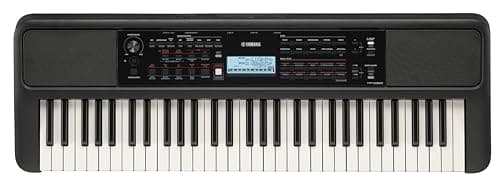 Yamaha PSR-E38361 touch-sensitive keys and 125 lesson songs with hand-separate practice and scoring. | Learning tools, 61 keysThe honest floor | 7.6 | $199.99 · View on Amazon #ad How we’re funded |
The picks in full
Casio Casiotone CT-S200
CasioBest for: Kids, full-size keys
61 full-size keys, 400 tones and a power supply in the box, at the price where most keyboards still ship with narrow mini keys. That one specification is why it is here.
Published specifications
- Keys:
- 61, full-size
- Polyphony:
- 48 notes
- Tones:
- 400
- Rhythms:
- 77
- Display:
- LCD
- Connectivity:
- USB-MIDI
- In the box:
- Power supply, music rest
What it gets right
- Full-size keys at a price where mini keys are the norm — this is the specification that decides whether a child learns a hand span they can keep
- Power supply included, which is not a given and turns a cheap keyboard into an expensive paperweight when it is missing
- Light and simple enough that a child can set it up themselves, which means it gets used
Where it gives ground
- Unweighted keys, so it will not build the finger strength an acoustic piano needs
- 400 tones is a lot of browsing for a child who is meant to be practicing
What it is not good at
Preparing anyone for a real piano. It is a first keyboard for a young child, not a piano substitute — read our weighted-versus-unweighted comparison before assuming otherwise.
How the specs score against a beginner’s needs
Scores are our reading of the published specifications above against what a beginner physically needs. They are not test results — we have not played this instrument.
Specifications from Casio Casiotone CT-S200 published specifications.
Yamaha PSR-E383
YamahaBest for: Learning tools, 61 keys
61 touch-sensitive keys and 125 lesson songs with hand-separate practice and scoring. The touch response is the spec that matters; the 650 tones are the spec that sells it.
Published specifications
- Keys:
- 61, organ-style (unweighted), touch-sensitive
- Touch response:
- Soft / medium / hard / off
- Polyphony:
- 48 notes
- Tones:
- 650 (258 panel, 25 drum/SFX, 20 arpeggio, 347 XGlite)
- Lessons:
- 125 lesson songs, right/left/both-hand practice with evaluation
- In the box:
- Music rest, PA130 power adapter
What it gets right
- Touch-sensitive keys — playing harder makes it louder, which is the thing a beginner has to learn early and a non-touch keyboard cannot teach
- The lesson mode with hand-separate practice and scoring is genuinely useful, not a gimmick
- Power adapter included, which is not a given at this tier
Where it gives ground
- Unweighted organ-style keys — this will not build the finger strength a piano needs
- 61 keys, so a method book that assumes 88 will eventually run out of instrument
What it is not good at
Preparing anyone for an acoustic piano. If there is a real piano in the child's future, the unweighted action is a habit to unlearn later. Read our 61-versus-88 comparison before deciding.
How the specs score against a beginner’s needs
Scores are our reading of the published specifications above against what a beginner physically needs. They are not test results — we have not played this instrument.
Specifications from Yamaha — PSR-E383 specifications.
Questions people actually ask
What age can a child start keyboard?
About five for most children. Keys have the lowest physical barrier of any instrument we cover: press a key, get the correct note, with no finger strength, no intonation and no tuning involved.
Are mini keys bad for children?
Yes, and specifically worse for children than for adults. A student learns how far apart an octave is by feel rather than measurement. On narrow keys they learn the wrong distance, and recalibrating a learned-by-feel span later is harder than learning it right the first time.
How many keys does a child need?
61 full-size keys. That is five octaves, which comfortably covers first- and second-year method book material. 49 keys runs out as soon as both hands play with any separation, and 49-key instruments usually have mini keys as well.
Should a child start on weighted keys?
Usually not before about nine or ten. A young child does not have the hand strength to drive a hammer action, and every note costs effort that competes with the music for their attention. Start light and touch-sensitive, move to weighted when their hands can drive it.
Sources
Still deciding?
Every recommendation on this site is built the same way, and the method is published in full — including what we do not do and what would get a pick dropped.
Read next
- Best beginner keyboards: 61 keys that suit real lessons
Touch response over tone count, segmented for children and adult learners, with the 61-key ceiling stated plainly.
- 61 vs 88 key keyboard
When 61 keys stops being enough, what 88 actually costs in money and floor space, and buy paths for both answers.
- Weighted vs unweighted keys
Hammer, semi-weighted and synth action explained by effect on the hands, with the one question that settles the choice.
- The best first instrument for a child
Instrument by instrument, the real starting age set by hand size and reach, with a pick for each and the noise column filled in.
- What you actually need to start piano
The complete accessory list in priority order, with what each one is for and which ones can genuinely wait.