Drums
Drum set sizes by age
The bass drum diameter sets where the pedal sits, which sets whether a child's leg can reach it. That one number decides the purchase.
By Sawyer V. · Published · Last updated

A 16 inch bass drum suits roughly ages 3 to 6, an 18 to 20 inch bass drum suits roughly 6 to 10, and a full-size 22 inch kit suits about 11 and up. The bass drum diameter is the number that matters because it sets how far forward the pedal sits. Reach beats age every time.
The chart
| Bass drum | Typical age | Typical config | Notes |
|---|---|---|---|
| 16" | 3–6 | 3-piece | Smallest real tunable kit. Outgrown in 2 to 3 years |
| 18–20" | 6–10 | 4 or 5-piece | The junior sweet spot. Many adults use 20" too |
| 22" | 11 and up | 5-piece | Full size. The standard adult configuration |
| Electronic, junior | 5–9 | 4 pads + 3 cymbals | Small pad geometry, adjustable rack. Quiet |
| Electronic, full | 10 and up | 4 pads + 3 cymbals | Rack adjusts down; usable younger than an acoustic 22" |
Real examples for calibration: Mendini’s 16 inch junior kit uses an 11 by 16 inch bass drum; the Pearl Roadshow uses a 22 by 16 inch bass drum; and Alesis states its Debut kit is for ages 5 to 9.
Why the bass drum diameter is the number
The pedal sits in front of the bass drum, so the drum’s diameter sets how far forward the pedal is from the throne. A 22 inch drum puts the pedal six inches further away than a 16 inch drum does, and six inches is a great deal of leg on a six-year-old.
Everything else on a kit is adjustable. Cymbal stands go up and down, tom mounts angle, the throne adjusts, the snare stand adjusts. The pedal-to-throne distance is fixed by the bass drum, and it is the one dimension that cannot be worked around.
The reach test
Sit the child at the kit and check three things at the same time. All three have to be true simultaneously — that is the whole test.
Feet. Both feet flat on the pedals, with the knees at roughly a right angle or slightly more open. Not stretched, not tucked underneath.
Hands. Both hands able to reach the snare and the hi-hat with the elbows relaxed and slightly away from the body. The snare should be at around waist height when seated.
Back. Sitting upright without leaning forward to reach anything.
The reason all three have to hold at once is that this is exactly what drumming requires. An oversized kit lets a child satisfy any two of the three and never all three, which is why it is unplayable rather than merely awkward.
The throne trap
The most common attempted fix and it does not work.
Drop the throne so their feet reach the pedals comfortably, and their hands are now below the snare, so they hit it at an upward angle with no power and no control. Raise the throne so their hands sit correctly, and their feet no longer reach the pedals with any weight behind them.
There is no height that resolves both, because the throne adjusts one dimension and the problem is a different one. If the reach test fails, the kit is too big. This is the same conclusion as guitar sizing, arrived at by a different route.
What to do about outgrowing it
A child on a 16 inch kit will outgrow it in two to three years, which is a real cost and worth planning for.
Junior kits resell well. Every family with a young drummer needs one and then does not, so demand is steady.
An 18 to 20 inch kit lasts longer than a 16 inch one. If the child is six or seven and reasonably tall, skipping straight to a 20 inch kick may cover them through to adult size, because 20 inch bass drums are a normal adult configuration too.
An electronic kit’s rack adjusts across a much wider range than any acoustic kit’s fixed geometry, so it grows with a child in a way an acoustic kit cannot. That is a genuine argument for electronic on top of the noise one.
What we would buy
Mendini by Cecilio 16" Junior Kit
Mendini by CecilioBest for: Ages roughly 3-6, acoustic
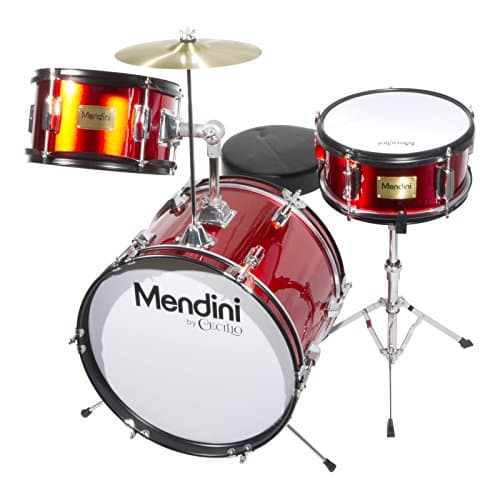
A three-piece with an 11x16 bass drum, real hardwood shells and triple-flanged hoops. It is the smallest acoustic kit where the pedal is actually where a small child's foot is.
Published specifications
- Configuration:
- 3-piece: 11"x16" bass with pedal, 6"x10" mounted tom, 5"x10" snare
- Cymbal:
- 9.5" with mounting arm
- Shells:
- Hardwood, triple-flanged hoops
- In the box:
- Wooden sticks, round padded adjustable throne
What it gets right
- A 16 inch bass drum puts the pedal within reach of a three- or four-year-old's leg, which no full-size kit does
- Triple-flanged hoops and hardwood shells, so it can genuinely be tuned rather than just hit
- Adjustable throne included, and at this age that is the part that has to move most
Where it gives ground
- Three pieces and one cymbal — this is a starting point, not a kit
- The included cymbal and pedal are the cheapest components and behave like it
What it is not good at
Anyone over about seven. Growth out of this kit is measured in a couple of years, and paying for it twice is worse than starting a six-year-old on a proper junior five-piece.
How the specs score against a beginner’s needs
Scores are our reading of the published specifications above against what a beginner physically needs. They are not test results — we have not played this instrument.
Specifications from Cecilio Music — Mendini kids drum set, 3-piece 16".
Alesis Debut Kit
AlesisBest for: Ages roughly 5-9
Four 6 inch mesh pads sized and spaced for a small child, with headphones, a throne and sticks in the box. Alesis states it is designed for ages 5 to 9 and the geometry backs that up.
Published specifications
- Pads:
- Four 6" mesh pads (snare and three toms)
- Cymbals:
- Three 10" pads — hi-hat, crash, ride
- Pedals:
- Hi-hat and bass drum pedals included
- Module:
- DM-Lite: 120 sounds, 10 kits, 30 play-along tracks, drum coach
- Age guidance:
- Manufacturer states ages 5-9
- In the box:
- Metal rack, height-adjustable throne, sticks, headphones, cables, Melodics lessons
What it gets right
- Purpose-built small geometry — the pads are within a small child's reach rather than an adult kit with the legs shortened
- Headphones included, which for a kids' drum kit is the difference between practicing and being asked to stop
- Height-adjustable throne, so it tracks a growing child for a couple of years
Where it gives ground
- 6 inch pads are small enough that an older child will feel boxed in quickly
- The DM-Lite module is basic; 120 sounds and no real editing
What it is not good at
Lasting. Alesis's own 5-to-9 guidance is honest, and a 10-year-old should start on the Nitro Max instead. Buying this for an older child to save money buys a kit they will resent in a year.
How the specs score against a beginner’s needs
Scores are our reading of the published specifications above against what a beginner physically needs. They are not test results — we have not played this instrument.
Specifications from Alesis Drums — Debut Kit.
Pearl Roadshow RS525SC
PearlBest for: Complete acoustic kit, teen and up
A full 22 inch kick, five drums, four stands, a pedal, a throne and cymbals, on 9-ply poplar shells with hand-cut bearing edges. Nothing else needs buying to play it.
Published specifications
- Configuration:
- 5-piece: 22x16 bass, 14x5.5 snare, 10x8 and 12x9 rack toms, 16x16 floor tom
- Shells:
- 9-ply poplar, 7 mm, hand-cut 45-degree bearing edges
- Hoops:
- 1.6 mm triple-flanged steel
- Hardware included:
- H-50 hi-hat, C-50 cymbal, S-50 snare stand, P-50 pedal, D-50 throne
- Cymbals included:
- 16" brass crash/ride, 14" hybrid hi-hats
- Also included:
- Two pairs of maple sticks, stick bag
What it gets right
- Genuinely complete — stands, pedal, throne, cymbals and sticks are all in the box, which almost never happens at this price
- Hand-cut 45-degree bearing edges on poplar shells; the edge is what lets a drum be tuned at all
- Triple-flanged steel hoops rather than the pressed hoops on the tier below
Where it gives ground
- The included brass cymbals are the weak point and the first thing anyone replaces
- A 22 inch kick is a full-size kit and needs the floor space of one
What it is not good at
Being quiet, or fitting a child. This is a loud acoustic kit at adult dimensions — a 22 inch bass drum puts the pedal where an eight-year-old's leg does not reach. For that buyer, see the kids' kits and the electronic options.
How the specs score against a beginner’s needs
Scores are our reading of the published specifications above against what a beginner physically needs. They are not test results — we have not played this instrument.
Specifications from Pearl Roadshow RS525SC published specifications (Percussion Source).
Questions people actually ask
What age is a kids drum set for ages 3 to 5?
A junior kit with a 16 inch bass drum, typically three pieces. Mendini’s 16 inch junior kit uses an 11 by 16 inch bass with a 10 inch snare and a 10 inch tom, which is about the smallest configuration that is still a real tunable drum kit.
What size drum set for a 6 to 8 year old?
An 18 to 20 inch bass drum, or a purpose-built electronic kit — Alesis states its Debut kit is designed for ages 5 to 9. A 16 inch junior kit will already feel small at eight, and a full-size 22 inch kit is still out of reach.
When can a child use a full-size drum kit?
Around eleven or twelve for most children, and the test is reach rather than age: they need to sit with both feet flat on the pedals and both hands comfortably on the drums at the same time. A tall ten-year-old may manage a 20 inch kick well before a small twelve-year-old does.
Does throne height fix an oversized kit?
No, and this is the common mistake. Lowering the throne so their feet reach the pedals drops their hands below the snare. Raising it so their hands work lifts their feet off the pedals. There is no setting that solves both, because the problem is the distance to the pedal, not the height of the seat.
Sources
Still deciding?
Every recommendation on this site is built the same way, and the method is published in full — including what we do not do and what would get a pick dropped.
Read next
- Best drum sets for kids
Picks by age band with real shell dimensions, plus the electronic option that makes a kids kit possible in an apartment.
- What size guitar does a child need?
Age and height chart with real scale lengths, the ten-second fit check, and why height beats age every time.
- How loud are drums?
Measured decibel levels against the NIOSH limit, what travels through walls and floors, and which quieting options actually work.
- The best first instrument for a child
Instrument by instrument, the real starting age set by hand size and reach, with a pick for each and the noise column filled in.
- Best beginner drum sets: complete kits for teens and adults
Complete acoustic and electronic kits for adult players, with the total-purchase problem and the noise question both addressed.