Strings
Best violin books for beginners
The two standard violin methods disagree about whether a beginner should read music. That disagreement is the whole decision.
By Sawyer V. · Published · Last updated
Two books dominate beginner violin, they are both excellent, and they disagree fundamentally about how a child should start. One teaches notation from page one. The other deliberately refuses to for the first few years. Picking between them is not a quality judgment; it is a judgment about the teacher you have and the route the child is going to take.
Every pick below states its Starter Path band, and we have not worked through any of them cover to cover — the method is on how we pick. Authors, page counts and contents come from the publishers’ own catalog entries, cited at the bottom.
Buy whichever book the teacher uses. With a school orchestra that means Essential Elements for Strings, Violin Book 1; with a Suzuki teacher it means Suzuki Violin School, Volume 1 with the CD. With no teacher at all, buy Essential Elements, because it teaches note reading and that transfers to every setting the player will later be in. If you are going the Suzuki route, add I Can Read Music early — the reading gap is real and it is easier to fill at six than at twelve.
Two methods, two theories of how children learn
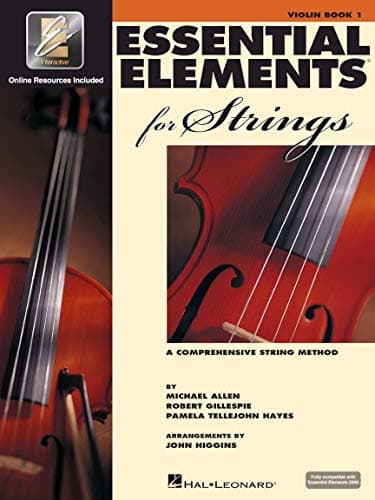
Essential Elements for Strings is the American school standard, written by Robert Gillespie, Pamela Tellejohn Hayes and Michael Allen, 48 pages. It is a notation-first classroom method: the student reads from the beginning, the violin book lines up with the viola, cello and bass books so a whole orchestra can work through it together, and the online EE Interactive content provides accompaniment to play against.
Suzuki Violin School is the opposite approach. Shinichi Suzuki’s mother-tongue principle observes that children speak fluently years before they read, and argues music should work the same way. The student listens to the recording daily, learns by imitation, and reading is introduced much later. Volume 1 is 48 pages and the current International Edition ships with a recording performed by Hilary Hahn, accompanied by Natalie Zhu.
Both work. They produce different players at the two-year mark: the Suzuki student usually sounds better and the Essential Elements student can usually read. Which matters more depends entirely on where the child is heading.
The gap Suzuki leaves, and the book that fills it
This is the single most useful thing to know before committing to the Suzuki route. The reading gap is not a rumour and it is not a criticism of the method — it is a designed consequence of it, and it has a standard fix.
Joanne Martin’s I Can Read Music, Volume 1#ad exists for exactly this. Alfred describes it as a first note-reading book for string students who learned to play using an aural approach such as the Suzuki method, or for traditionally taught students who need extra reading practice.
Its method is the clever part. Rhythm and pitch are taught separately, so the student is only ever decoding one new thing at a time, and the progression is small enough that Alfred explicitly describes it as usable daily at home by quite young children and their parents. It is published for viola and cello too, which matters in a family with more than one string player.
Start it early. A child who has been playing by ear for three years has a much harder time accepting a reading book than one who has been doing a page a week since the beginning.
What a violin book cannot do
Worth saying plainly, because it changes what you should spend money on. Violin is the instrument on this site where self-teaching from a book works least well, and there are two specific reasons.
There are no frets. Every note is produced by placing a finger on an unmarked string, and correct placement is a matter of a millimeter or two. A beginner cannot hear their own intonation reliably, because the ear that judges it is the same ear being trained. A teacher hears it instantly.
The bow arm fails invisibly. A locked wrist, a collapsed thumb or a bow drifting toward the fingerboard all produce a scratchy sound, and a beginner reading a book has no way to connect the sound to the cause. These habits also become physically entrenched quickly and are genuinely unpleasant to undo.
None of which means do not buy a book. It means the book is the cheap part of a violin education, and the honest allocation of a budget puts a teacher first. Our page on whether violin is hard to learn is blunter about this than most, and how to hold a violin and bow covers what a book will not show you.
What we did not list, and why
All For Strings is the other common American school method and a perfectly good book. It is not listed because it is a direct substitute for Essential Elements rather than a different kind of thing, and the deciding factor between them is which one the program uses — a decision no roundup can make for you.
Wohlfahrt and the classic etude books are the right next step after a first method and are not beginner books. They assume a left hand that already places reliably and a bow arm that already draws straight.
Violin For Dummies and similar broad guides were left off for the reason above: the parts of violin a prose book can teach are the parts that matter least, and the parts that matter most cannot be taught in prose at all.
Suzuki Volume 1 without the CD is sold separately and cheaper, and we would avoid it. In the Suzuki method the recording is not supplementary material; daily listening is the mechanism by which the method works. Buying the book alone is buying half the product.
What to buy alongside the book
A violin that fits, before anything else. Violin is the one family where size is set by arm length rather than age, and a violin one size too large cannot be played correctly by anybody — our violin sizing guide has the measurement to take first.
Then a shoulder rest and a tuner, which almost never come in the outfit and both of which are covered on violin accessories you actually need.
Theory can wait, and when it stops waiting it is not violin-specific. Intervals, keys and rhythm notation are the same subject on every instrument, and a general workbook is cheaper and better organized than anything string-specific — our music theory books roundup covers that.
Quick picks
If there is a school orchestra
The most widely used school strings method in the United States, and probably the book the program already assigned. 48 pages, written for group teaching, with online play-along content.
| # | Product | Best for | Score | Price |
|---|---|---|---|---|
| 1 | Essential Elements for Strings, Violin Book 148 pages and the most widely used school strings method in the United States. | The school orchestra studentThe honest floor | 8.0 | $12.60 · View on Amazon #ad How we’re funded |
If there is a Suzuki teacher
The standard first volume, with a recording by Hilary Hahn. It teaches by listening and imitation before reading, which is extraordinarily effective with a trained teacher and a parent in the room.
| # | Product | Best for | Score | Price |
|---|---|---|---|---|
| 1 | 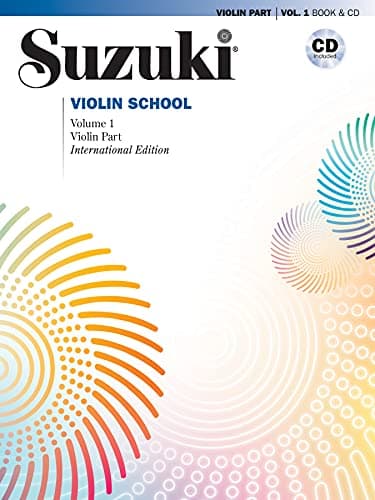 Suzuki Violin School, Volume 1 (Book & CD)48 pages with a recording by Hilary Hahn, accompanied by Natalie Zhu. | A young child learning by ear with a teacherEnough | 7.8 | $24.99 · View on Amazon #ad How we’re funded |
The book that fills the Suzuki gap
A note-reading book written specifically for string students taught by ear. Rhythm and pitch are separated so a five-year-old can do a page a day with a parent rather than a teacher.
| # | Product | Best for | Score | Price |
|---|---|---|---|---|
| 1 | 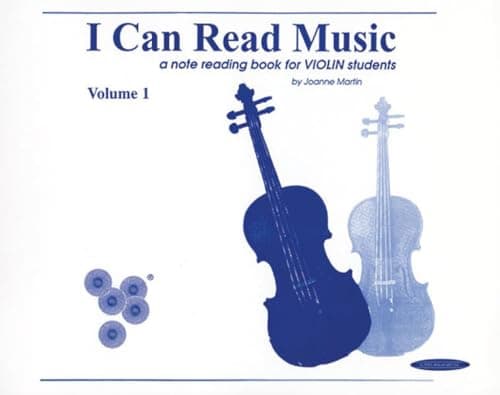 I Can Read Music, Volume 1: ViolinJoanne Martin's note-reading book, written specifically for string students who learned by ear and for traditionally taught students who need more reading practice. | The note-reading gap Suzuki leavesEnough | 7.6 | $11.39 · View on Amazon #ad How we’re funded |
The picks in full
Essential Elements for Strings, Violin Book 1
Hal LeonardBest for: The school orchestra student
48 pages and the most widely used school strings method in the United States. If a child has joined an orchestra program, there is a good chance this is already the assigned book - and buying it independently means arriving in week one on the same page as everyone else.
Published specifications
- Authors:
- Robert Gillespie, Pamela Tellejohn Hayes and Michael Allen
- Pages:
- 48
- Format:
- Softcover with online media (EE Interactive)
- Designed for:
- Group and classroom instruction as well as private study
- Publisher inventory:
- HL 00875055 / 00868049
What it gets right
- Written for group teaching, so the parts line up with viola, cello and bass books and a family can learn together
- The online EE Interactive content gives play-along accompaniment, which is what makes practice bearable in month one
- 48 pages at the lowest price of the three violin books here
- Standard notation from the first page, which is what a school program will assess
Where it gives ground
- Paced for a class meeting several times a week; a solo learner will find it moves slowly
- Assumes a teacher is handling bow hold and posture - almost nothing about physical setup is in the book
- The early repertoire is functional rather than memorable
- Online media needs a code and an internet connection
What it is not good at
Teaching a violin to anyone on their own. It is a classroom method, and the two things a beginner violinist most needs help with - how to hold the instrument and how to draw the bow - are the teacher's job in this book's design.
How the specs score against a beginner’s needs
Scores are our reading of the published specifications above against what a beginner physically needs. They are not test results — we have not played this instrument.
Specifications from Hal Leonard — Essential Elements for Strings, Violin Book 1 with EE Interactive: Gillespie, Tellejohn Hayes and Allen, 48 pages.
Suzuki Violin School, Volume 1 (Book & CD)
Alfred MusicBest for: A young child learning by ear with a teacher
48 pages with a recording by Hilary Hahn, accompanied by Natalie Zhu. The Suzuki method teaches by listening before reading, which works beautifully with a trained Suzuki teacher and leaves a gap - note reading - that has to be filled separately.
Published specifications
- Author:
- Shinichi Suzuki
- Recording:
- Violin performed by Hilary Hahn, accompaniment by Natalie Zhu
- Pages:
- 48
- Edition:
- International Edition, Book and CD
- Approach:
- Mother-tongue method: listening and imitation before reading
- ISBN:
- 978-1-4706-4413-0
What it gets right
- The included recording is by a major concert violinist, so the sound the child copies is the right one
- The repertoire is the standard Suzuki sequence, so group classes, recitals and teachers everywhere use the same pieces
- Listening-first genuinely suits a four to seven year old, who can imitate long before they can decode notation
- The same volume number means anything in the Suzuki world (summer schools, group lessons) slots straight in
Where it gives ground
- Does not teach note reading, by design, and a child can reach Volume 3 unable to read music
- Built around a trained Suzuki teacher and a parent attending lessons; bought alone it is a book of tunes
- Twice the price of the Essential Elements book
- The CD is a disc, which in 2026 means ripping it before it is useful
What it is not good at
Producing a reader. Suzuki is explicit that reading comes later, which is correct within the method and a problem if the child later joins a school orchestra that assumes reading from day one.
How the specs score against a beginner’s needs
Scores are our reading of the published specifications above against what a beginner physically needs. They are not test results — we have not played this instrument.
Specifications from Alfred Music — Suzuki Violin School, Volume 1: Violin Book & CD, International Edition (item 00-48722): 48 pages, Hilary Hahn and Natalie Zhu recording, ISBN 978-1-4706-4413-0.
I Can Read Music, Volume 1: Violin
Alfred MusicBest for: The note-reading gap Suzuki leaves
Joanne Martin's note-reading book, written specifically for string students who learned by ear and for traditionally taught students who need more reading practice. Rhythm and pitch are taught separately, one at a time, which is why it works at home with a parent.
Published specifications
- Author:
- Joanne Martin
- Purpose:
- First note-reading book for string students taught by an aural method, or extra reading practice
- Method:
- Rhythm and pitch taught separately so only one new thing is being decoded at a time
- Designed for:
- Daily use at home by young children and a parent, with a teacher checking every week or two
- Publisher item:
- Alfred 00-0439
- Also published for:
- Viola and cello, so siblings can use matching books
What it gets right
- It is the specific fix for the specific hole Suzuki leaves, and Alfred says so in the product description
- Separating rhythm from pitch is the reason a five-year-old can do a page a day without help
- Explicitly designed for a parent to run at home rather than a teacher to deliver
- Matching viola and cello volumes exist, which matters in a family or a school program
Where it gives ground
- It is a reading drill book: there is no repertoire and nothing that sounds like music
- Pointless on its own - it assumes the child is already playing from somewhere else
- Costs more than the Essential Elements method that teaches playing and reading together
- Progress is slow by design, which frustrates an adult learner
What it is not good at
Teaching violin. It teaches reading. A student who owns only this book will be able to read a line of music and will not have been shown how to produce a note on the instrument.
How the specs score against a beginner’s needs
Scores are our reading of the published specifications above against what a beginner physically needs. They are not test results — we have not played this instrument.
Specifications from Alfred Music — I Can Read Music, Volume 1: Violin Book (item 00-0439): Joanne Martin, purpose and method as published.
Questions people actually ask
Suzuki or Essential Elements for a beginner violinist?
Follow the teacher. If the child is in a school orchestra program, it is almost certainly Essential Elements#ad and arriving with a different book is a problem rather than an advantage. If the teacher is Suzuki-trained, it is Suzuki Volume 1#ad. If there is no teacher yet, Essential Elements is the safer purchase because it teaches reading, which transfers anywhere.
Does Suzuki teach you to read music?
Not in Volume 1, and that is deliberate rather than an oversight. Suzuki’s mother-tongue principle is that children learn to speak long before they read, and music should follow the same order. It works — and it means a child can reach Volume 3 playing beautifully and unable to read a line of music, which becomes a real problem the moment they join an ensemble that hands out parts.
Can I teach my child violin from a book?
Less than with any other instrument on this site. Violin has no frets, so every note is placed by a hand position the player cannot see, and the bow arm is a technique that goes wrong invisibly and is painful to correct later. Books plus a teacher works. Books alone produces a child who sounds bad for reasons neither of you can diagnose, and that is the fastest route to quitting.
What is I Can Read Music for?
It is the standard fix for the gap Suzuki leaves. Joanne Martin’s book is a first note-reading book for string students who learned by ear, and its method is to separate rhythm from pitch so only one new thing is being decoded at a time. Alfred states it is designed for daily use at home by young children and a parent, with the teacher checking every week or two — which is exactly how it gets used.
Do violin books come with recordings?
The two methods do and the reading book does not. Essential Elements includes online EE Interactive content with play-along accompaniment; the Suzuki Book & CD edition includes a recording performed by Hilary Hahn with Natalie Zhu, and the recording is not a bonus in Suzuki — listening to it daily is part of the method.
Should an adult beginner use a children's method?
Essential Elements works fine for an adult — it is paced for a class, not for a child specifically, and the material is neutral. Suzuki Volume 1 is harder to recommend to an adult learning alone, because the method depends on a teacher and a parent-style practice partner. Our page on string instruments for adult beginners covers the wider question.
Sources
- Hal Leonard — Essential Elements for Strings, Violin Book 1 with EE Interactive: Gillespie, Tellejohn Hayes and Allen, 48 pages, softcover with online media
- Alfred Music — Suzuki Violin School, Volume 1: Violin Book & CD, International Edition (item 00-48722): 48 pages, Hilary Hahn and Natalie Zhu recording, ISBN 978-1-4706-4413-0
- Alfred Music — I Can Read Music, Volume 1: Violin Book (item 00-0439): Joanne Martin, stated purpose and method
Still deciding?
Every recommendation on this site is built the same way, and the method is published in full — including what we do not do and what would get a pick dropped.
Read next
- Best beginner violins: measure first, then buy
Arm-length sizing chart, why workshop setup is the spec that matters most, and one pick available in five sizes.
- Violin sizes by age and arm length
The full fractional chart by arm length, how to measure, and why a violin one size too big cannot be played correctly.
- How to hold a violin and bow
Instrument position, the shoulder rest question, a bow hold that stays relaxed, and why the bow must stay parallel to the bridge.
- Violin accessories you actually need
The shoulder rest and tuner that outfits leave out, what to upgrade first, and which popular accessories to skip.
- Is the violin hard to learn?
The two skills that have to be built simultaneously, a realistic stage-by-stage timeline, and the four things that make it easier.
- Best music theory books for beginners
Workbook or prose, and how much theory you actually need. Four books with published page counts and contents, including the one that costs double for two CDs nobody can play.