Keys
Keyboard or guitar to start on?
One of these produces a correct note the first time you touch it. The other takes six weeks and is far more likely to end up in a band.
By Sawyer V. · Published · Last updated
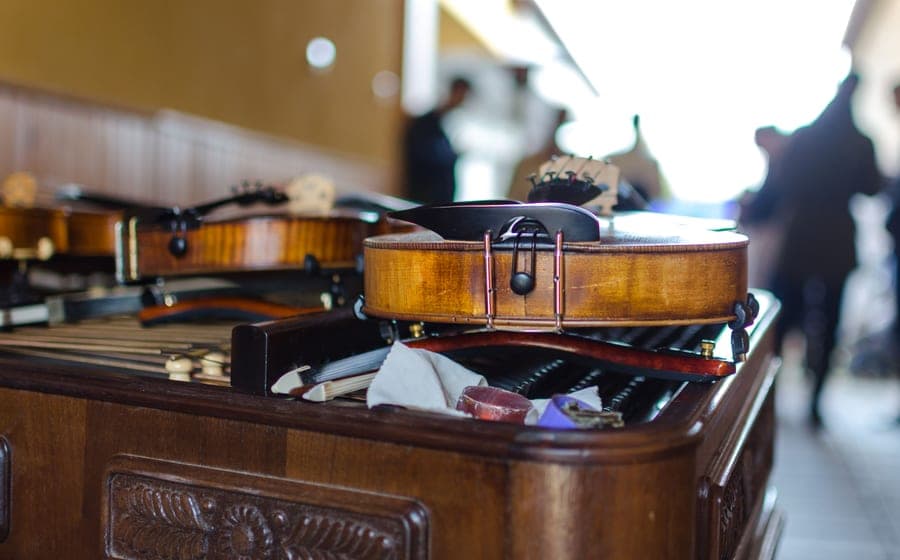
These are the two instruments most adults are actually choosing between, and the advice usually reduces to a personality quiz. There are more concrete differences than that, and they mostly concern the first six weeks.
Choose keyboard if you want to sound correct immediately, if you want to understand how music works, or if the player is a young child. Choose guitar if you want to carry it somewhere, play with other people, or spend less to get started. Keyboard is easier early; neither is easier later.
The first month is not close
Press a key on a Casio Casiotone CT-S1#ad and you get a correct, in-tune, clean note. That is the entire physical barrier: none.
A guitar has to be earned. A beginner presses a string, gets a buzz or a dead thud, discovers their fingertips hurt, and needs two to four weeks of callus formation before the instrument reliably produces a clean sound. Chord changes take longer than that again. The detail is in why the guitar hurts your fingers.
This matters because the failure point for most beginners is week three, not year three. An instrument that sounds like music sooner has a genuine retention advantage, and that is the strongest single argument for keys.
Then it evens out
Keyboard’s early advantage does not persist, and it is worth being honest about that so nobody feels misled at month four.
Piano asks for two hands doing different things simultaneously, which is genuinely hard and arrives quickly. It also assumes reading music from a fairly early stage.
Guitar, once the calluses exist and three chords are secure, gives you a very large amount of popular music quickly — and most of it never requires reading a note.
So the curves cross. Keys is easier for the first month or two; guitar is arguably easier for months three to twelve; after that they are both simply instruments.
Total cost
| What you need | Keyboard | Guitar |
|---|---|---|
| Instrument | 61 full-size touch-sensitive keys | Acoustic, or electric plus amp |
| Essential extras | Stand, adjustable bench, sustain pedal | Tuner, spare strings |
| For quiet practice | Headphones — genuinely silent | Nothing for acoustic; headphone amp for electric |
| Ongoing | Nothing | Strings every few months, yearly setup |
An acoustic like the Yamaha FG800#ad plus a clip-on tuner is a complete setup. A keyboard is not complete without a stand and a bench, because playing at dining-table height bends the wrists upward and hurts. That surprises people and it is covered in keyboard accessories you actually need.
Noise, which decides it for some people
A keyboard with headphones is completely silent to everyone else. Nothing else in this category can say that.
An acoustic guitar cannot be turned down. It is not loud — roughly conversation level — and it is not silent either. An unplugged electric like the Squier Sonic Stratocaster#ad is very quiet indeed and, plugged into a headphone amp, silent.
If practice has to happen after nine at night in a shared building, keys or an electric guitar with headphones are the two workable answers. The whole noise question is in best instruments for an apartment.
Where each one takes you
Keys teaches you music. The keyboard lays out pitch in a straight line with a visible pattern of black and white. Intervals, chords and scales are shapes you can see. Nearly everyone who writes or arranges music works at a keyboard for this reason, including guitarists.
Guitar gets you into rooms. It is portable, it is social, and there are orders of magnitude more amateur guitar players to play with than pianists. A guitar goes to a friend’s house; a keyboard needs a car and a stand.
Both accompany singing. This is the single most useful amateur musical skill and both instruments do it well, which is worth saying because it is often presented as a guitar advantage.
For a child specifically
Under about seven, keyboard, and the reason is physical. A five-year-old can press keys. A five-year-old cannot press a steel guitar string down to a fret, and concluding they are not musical because of hand strength is exactly the failure to avoid.
From six or seven, guitar becomes practical with a correctly sized instrument — guitar sizes for kids covers the mapping. And there is a third answer for that age group entirely, which is the ukulele: nylon strings, low tension, real chords in week one. That comparison is in ukulele versus guitar.
The tie-breaker
When someone genuinely cannot decide, we ask what they picture themselves playing.
If the image is sitting at an instrument, reading music, playing pieces — that is keys. If the image is holding an instrument, singing along, playing with other people — that is guitar.
Neither answer is a commitment. Skills transfer far more than beginners expect, and a lot of people end up with both. If you want to work through the whole field rather than these two, start at which instrument should you learn.
What we would buy
Casio Casiotone CT-S1
CasioBest for: 61 keys, piano sound first
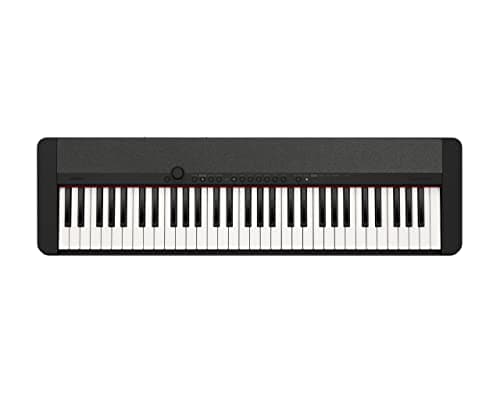
61 full-size touch-sensitive keys, 61 tones and no arranger clutter. It is the 61-key board for someone who wants to play piano rather than operate a keyboard.
Published specifications
- Keys:
- 61, full-size, touch-sensitive
- Polyphony:
- 64 notes
- Tones:
- 61, including a stereo grand piano
- Weight:
- 9.9 lb
- Dimensions:
- 36.61" W x 10.15" D x 3.30" H
- Connectivity:
- USB-MIDI
What it gets right
- Deliberately few sounds and a clean panel, which removes the single biggest distraction from actual practice
- 9.9 pounds and 3.3 inches tall — it can live on a shelf between sessions, and an instrument that lives out of the way gets played less
- 64-note polyphony, higher than the PSR-E383's 48
Where it gives ground
- No lesson mode at all, unlike the PSR-E383
- Unweighted keys, same fundamental limit as any 61-key board
What it is not good at
Entertaining a young child. There is no light-up key guidance, no play-along scoring and only 61 sounds. That restraint is the point for an adult beginner and a drawback for a seven-year-old.
How the specs score against a beginner’s needs
Scores are our reading of the published specifications above against what a beginner physically needs. They are not test results — we have not played this instrument.
Specifications from Casio — CT-S1 product page.
Squier Sonic Stratocaster
Squier by FenderBest for: The honest floor, electric
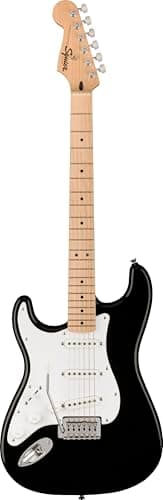
The cheapest electric that still has full-scale geometry, sealed tuners and a real 9.5 inch fingerboard radius. Nothing about it will make a beginner's first year harder.
Published specifications
- Scale length:
- 25.5" (647.7 mm) — full size
- Body / neck:
- Poplar body, maple neck, "C" profile
- Fingerboard:
- Maple or Indian laurel, 9.5" (241 mm) radius
- Frets:
- 21, narrow tall
- Nut width:
- 1.650" (42 mm), synthetic bone
- Pickups:
- Three ceramic single-coils (SSS)
- Bridge:
- 6-saddle vintage-style synchronized tremolo
What it gets right
- Full 25.5 inch scale, so nothing learned here has to be relearned later
- Synthetic bone nut rather than a soft plastic one — the part that decides whether a cheap guitar stays in tune
- Sealed-gear tuners, which is the single most important spec on a first electric
Where it gives ground
- Poplar body and ceramic pickups are exactly what you would expect at this tier
- The tremolo bridge will pull the guitar out of tune if a beginner uses it, and beginners always use it
What it is not good at
Staying in tune if you use the whammy bar. If that matters, buy the hardtail (HT) version of the same guitar instead — it is the identical instrument with the tremolo deleted.
How the specs score against a beginner’s needs
Scores are our reading of the published specifications above against what a beginner physically needs. They are not test results — we have not played this instrument.
Specifications from Squier Wiki — Sonic Stratocaster specifications.
Yamaha FG800
YamahaBest for: Buy once, acoustic
A solid Sitka spruce top with scalloped bracing at the entry price. Solid-versus-laminate is the one acoustic spec that changes what the instrument does over years, and this is the cheapest place to get it done right.
Published specifications
- Top:
- Solid Sitka spruce
- Back / sides:
- Nato / okume
- Neck / fingerboard:
- Nato neck, rosewood fingerboard, R400 mm (23-5/8") radius
- Scale length:
- 650 mm (25-9/16")
- Nut width:
- 43 mm (1-11/16")
- Bracing:
- Scalloped
- Body:
- Traditional Western (dreadnought), 412 mm (16-1/4") wide, 100-118 mm deep
- Hardware:
- Die-cast chrome tuners, urea nut and saddle
What it gets right
- A solid top, not a laminate — the only acoustic spec at this price that genuinely changes over time
- Scalloped bracing and die-cast tuners are specifications you normally pay considerably more for
- Yamaha's most-copied entry acoustic; parts, setups and advice are everywhere
Where it gives ground
- A full dreadnought body is a big box — 412 mm across and up to 118 mm deep
- Nato and okume back and sides are the cost saving; the top is where the money went
What it is not good at
Fitting a smaller player. The dreadnought body is wide and deep enough that a young teenager can struggle to get their arm over it comfortably. If that is the buyer, look at the JR1 or a concert-size body instead.
How the specs score against a beginner’s needs
Scores are our reading of the published specifications above against what a beginner physically needs. They are not test results — we have not played this instrument.
Specifications from Yamaha Europe — FG/FS800 series specifications.
Questions people actually ask
Is keyboard easier to learn than guitar?
In the first month, clearly. Pressing a key produces the correct note immediately, with no finger strength, no tuning and no buzzing. Guitar makes you earn a clean sound before you can play anything at all.
Which is better for a child, keyboard or guitar?
Keyboard for a child under about seven, because it has no physical barrier — small fingers can press keys. Guitar becomes practical around six or seven with a correctly sized instrument.
Which is cheaper to start?
Guitar, usually, once you count everything. An acoustic guitar needs nothing but a tuner. A keyboard needs a stand and a bench to be played at the right height, which adds meaningfully to the total.
Which is more useful long term?
Keyboard for understanding music — the layout makes theory visible in a way the guitar fretboard does not. Guitar for playing with other people and for carrying somewhere. Both accompany singing well.
Sources
Still deciding?
Every recommendation on this site is built the same way, and the method is published in full — including what we do not do and what would get a pick dropped.
Read next
- What instrument should I learn?
Four practical constraints instead of a personality quiz, each one routing straight to the instrument that fits.
- Best beginner keyboards: 61 keys that suit real lessons
Touch response over tone count, segmented for children and adult learners, with the 61-key ceiling stated plainly.
- Best beginner guitars: one pick each for adults, teens and kids
Acoustic and electric in one place, segmented by player rather than price, with a single clear pick for each situation.
- Ukulele vs guitar for beginners
Why the ukulele is genuinely easier, exactly which skills transfer to guitar, and when the stepping-stone plan is a detour.
- The easiest instruments to learn
Ranked by time to a first real song, with the ceiling each one trades away, and a pick for the top three.