Keys
Keyboard accessories you actually need
A keyboard arrives as most of an instrument. The four items below are the rest of it, and two of them affect your hands rather than the sound.
By Sawyer V. · Published · Last updated
A keyboard is unusual among instruments in arriving almost complete. There is nothing to tune, no strings to replace and no consumables. What it does need is a small number of items that decide the two things a beginner cannot easily assess: whether their body is in a sensible position, and whether they can practice at the times they actually have.
Four things: a stand at the right height, an adjustable bench, a sustain pedal, and headphones. The stand and bench protect your wrists, the pedal is required by written piano music within months, and the headphones determine whether you can practice in the evening. Everything else is optional.
1. A stand, because the table is the wrong height
The default place a new keyboard ends up is a dining table, and a dining table is roughly four inches too high for playing.
The consequence is not comfort, it is mechanics. To reach keys that are too high, the wrists bend upward and the shoulders lift. Held for twenty minutes at a stretch, several times a week, that is how a beginner acquires wrist ache and concludes that the piano hurts — when the actual problem is furniture.
A folding X-stand is inexpensive, adjusts through the range you need and packs flat. A Z or table stand is sturdier and less portable. Either is fine; the height being adjustable is what matters. The detail is in our stand and bench guide.
2. An adjustable bench, for the same reason
Seat height and keyboard height are one problem, not two. The target is forearms roughly parallel to the floor with the hands over the keys, and thighs roughly level.
A dining chair is typically too low, which makes the player reach upward and rotates the whole arm into a worse position. A chair with arms is worse still, because the elbows cannot sit where they need to.
Adjustable is the word doing the work here. Fixed-height benches are only correct for the person they happen to fit, which is a poor bet in a household where a child and an adult both play. This is the cheapest item on this page that measurably changes how playing feels.
3. A sustain pedal, sooner than you think
The sustain pedal is not an effect. On an acoustic piano it lifts the dampers off every string, so notes continue after the key is released and the whole instrument resonates sympathetically. Digital pianos model that behavior, and written piano music assumes it exists.
Beginners often skip it for months and hit a specific problem when they stop: pieces have pedal markings, and without a pedal the only way to sustain a chord while the hand moves is to hold the keys, which teaches a hand position that has to be undone.
Two practical notes. Buy a piano-style pedal rather than the small plastic footswitch that ships with some boards — the footswitch slides across the floor and gives no feel. And check the polarity switch: if the pedal behaves backwards, sustaining when released, the switch on the pedal is set for a different manufacturer. That is not a fault, and it catches nearly everyone once.
Half-pedalling, where partial depression gives partial sustain, needs a continuous pedal rather than a switch. That is an intermediate concern rather than a beginner one.
4. Headphones, which decide when you can practice
The keyboard is the only instrument in this whole category that can be made genuinely silent to everyone else. Plugging headphones in cuts the internal speakers — not quieter, off.
That converts “I can practice when the house is empty” into “I can practice,” which for most adult beginners is the difference between progress and a stalled year.
The Audio-Technica ATH-M20x#ad is a closed-back monitoring headphone with a fixed 3 meter cable. Closed-back matters because an open design leaks sound back into the room, which defeats the point. The cable length matters more than it sounds: the short cable on consumer headphones tethers you to the board in a way that makes reaching for music awkward.
Two cautions. Check whether your board has a full-size quarter-inch socket or a 3.5mm one, because an adapter is a trivially cheap item that is deeply annoying to discover you need at 10pm. And keep the volume moderate — headphone practice makes it easy to sit at a level you would never tolerate from a speaker. Alternatives are in headphones for a digital piano.
Worth having, not essential
A music stand or tablet holder. Many keyboards have a slot for a music rest. If yours does not, reading from a surface below eye level pulls the head down and produces neck ache that gets blamed on practice length.
A dust cover. Genuinely useful if the board lives out permanently, because dust in the key mechanism is one of the few things that goes wrong with a digital instrument.
A padded case. Only if the board travels. A portable keyboard that gets carried without one accumulates damage at the corners and around the sockets, which are exactly the parts that fail. Our keyboard gig bag roundup covers which one, and why you have to measure the board rather than trust the key count on the label.
What to skip
The plastic footswitch pedal. Covered above — it slides and it teaches nothing about pedal control.
Fixed-height benches. The adjustment is the feature.
Key stickers. They work for two weeks and then become the thing the player reads instead of the keyboard. Learning where middle C is takes an hour; learning to stop looking at stickers takes months.
Expensive cables and power conditioners. A keyboard is a digital instrument with a low-current supply. The cable that came with it is fine.
If you are still assembling the whole setup, the room-level version of this list is in setting up a practice space, and the instrument-level version is in what you actually need to start piano.
What we would buy
Audio-Technica ATH-M20x
Audio-TechnicaBest for: Practice headphones
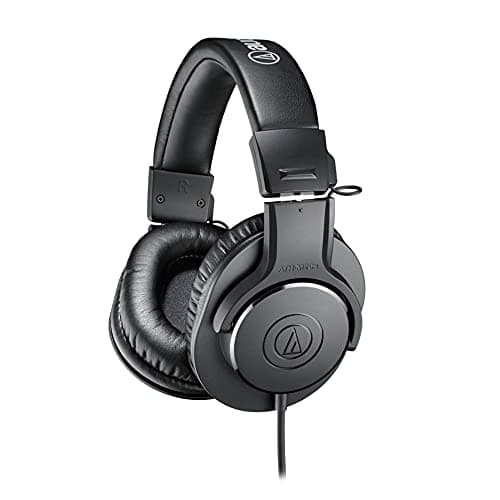
Closed-back 40 mm drivers with a 1/4 inch adapter included, which is the socket most digital pianos actually have. The cheapest headphones we would put on a practicing student.
Published specifications
- Type:
- Closed-back, circumaural (over-ear)
- Drivers:
- 40 mm, copper-clad aluminum voice coils
- Frequency response:
- 15 Hz - 20,000 Hz
- Cable:
- 9.8 ft (3.0 m), single-sided, straight
- Weight:
- 6.7 oz (190 g) without cable
- In the box:
- 6.3 mm (1/4") snap-on adapter
What it gets right
- Closed-back, so the sound stays in and the room stays out — the whole point of practice headphones
- The 1/4 inch adapter is included, and that is the socket most digital pianos have rather than the 1/8 inch a phone uses
- Under 200 grams, which matters over an hour of practice on a child's head
Where it gives ground
- The cable is fixed, not detachable, so a damaged cable means new headphones
- A 3 meter cable is generous at a piano and a trip hazard anywhere else
What it is not good at
Portability. They do not fold flat and there is no case. These live at the instrument.
How the specs score against a beginner’s needs
Scores are our reading of the published specifications above against what a beginner physically needs. They are not test results — we have not played this instrument.
Specifications from Audio-Technica ATH-M20x published specifications.
Questions people actually ask
What accessories do I need with a new keyboard?
A stand, an adjustable bench, a sustain pedal and headphones. That is the complete list for a beginner. The stand and bench are about your wrists, the pedal is required by real piano music, and the headphones decide when you are allowed to practice.
Do I need a sustain pedal as a beginner?
Within the first few months, yes. Written piano music assumes a sustain pedal from a fairly early stage, and playing without one means either ignoring markings or developing a habit of holding notes with the fingers that has to be undone later.
Is a keyboard bench necessary or can I use a chair?
A dining chair is usually two to three inches too low and often has arms, both of which change the angle of the forearm. An adjustable bench is one of the cheapest purchases here and one of the two that affect your body rather than the sound.
What is in a keyboard bundle and is it worth it?
Typically a stand, a bench, headphones and sometimes a pedal. The stand is usually fine, the bench is usually thin and non-adjustable, and the headphones are usually replaced. Judge the bundle on the board and treat the extras as a small discount.
Sources
Still deciding?
Every recommendation on this site is built the same way, and the method is published in full — including what we do not do and what would get a pick dropped.
Read next
- Best keyboard gig bags and cases
Published interior lengths for 88-key bags run from 53 to 59 inches, so the label tells you nothing. How to measure, when wheels earn their 22 pounds, and four bags on real dimensions.
- Best gifts for piano players
The bundled plastic footswitch is the weakest part of most beginner keyboards, and a real sustain pedal fixes it. Four gifts that fit any keyboard, and why a bench is riskier than it looks.
- Keyboard stands and benches
How to set the correct playing height, X-stand versus Z-stand, and why the adjustable bench is the item to buy first.
- What you actually need to start piano
The complete accessory list in priority order, with what each one is for and which ones can genuinely wait.
- Best headphones for a digital piano
Closed-back over-ear picks, the quarter-inch adapter problem, and why open-back headphones are the wrong tool here.
- Best portable keyboards
The three specs that decide whether a keyboard actually travels, and the boards that get all three right at a beginner price.
- Setting up a practice space that gets used
Why the instrument should never live in its case, the seat height that prevents wrist problems, and the two cheap accessories that matter most.