Keys
Keyboard stands and benches
The least interesting purchase in the category and the one with the longest-lasting effect on how the player's hands develop.
By Sawyer V. · Published · Last updated
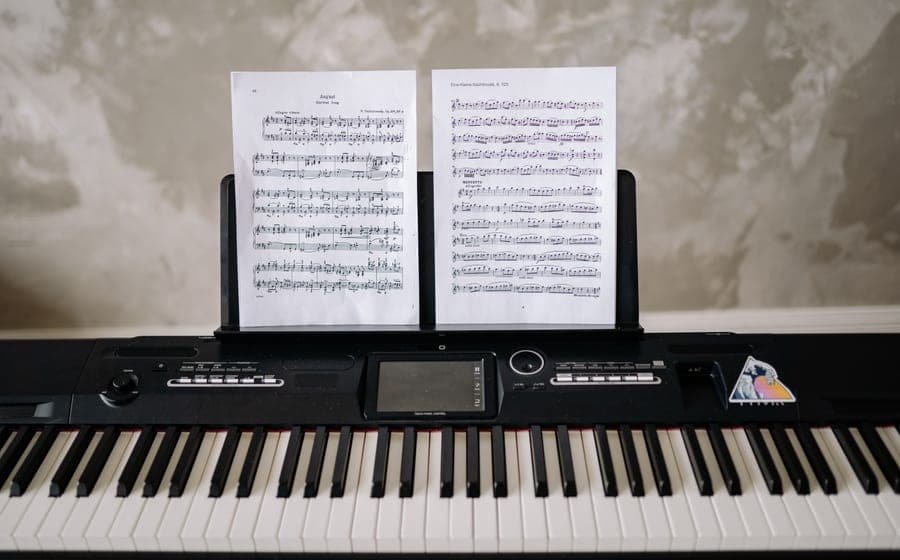
Nobody is excited about a stand and a bench, which is exactly why they get skipped. They are also the two items that decide the angle a player’s wrists sit at for every hour they practice, which makes them worth ten minutes of attention.
Set the height from the player’s body, not from a number: forearms roughly level with the keys when seated, elbows at about a right angle, wrists neutral and not bent upward. Adjust the bench first, then set the stand to match.
Why the height matters more than it sounds
Piano technique starts from a posture. From forearms-level, the fingers hang naturally over the keys, the wrist can stay loose, and the weight of the arm is available to control volume. That last part is how a pianist plays loudly without tension.
Sit too low — which is what a dining chair does to nearly everyone — and the wrists tilt upward to reach the keys. The fingers flatten, the arm weight is no longer above the keys, and the player compensates by pressing with the fingers alone. That is more effort for less control, and over years it causes strain.
Sit too high and the opposite happens: the wrists drop, the fingers curl too far under, and fast passages get cramped.
A child is the extreme case. An adult chair puts a seven-year-old’s shoulders near the level of the keys, and their feet do not reach the floor. Both are worth fixing.
Getting it right, in two minutes
Sit the player at the instrument. Adjust the bench until their forearms are roughly parallel with the floor and level with the key surface, with elbows at about a right angle and slightly ahead of the body.
Then check the feet. They should be flat on the floor. If they dangle — which for a child they will — put a box or a footstool under them. Dangling feet mean the player has no base, so they brace with their back instead.
Only then set the stand height so the keys meet the forearms. Doing it in the other order means adjusting both several times.
Which stand
X-stands are the folding scissor design. Cheap, light, adjust in seconds, fold flat for storage. They wobble slightly under a heavy instrument and they get in the way of your knees at the narrowest settings. Right for a light 61-key board#ad that moves or gets put away.
Z-stands have a fixed rear upright and an open front. Much more stable, no knee interference, considerably more floor space. Right for an 88-key instrument like the Yamaha P-145#ad that lives in one place — 24 pounds on a wobbling X-stand is unpleasant to play.
Double-braced versions of either are worth the small premium if the instrument is heavy. Single-braced X-stands are rated for light keyboards and it shows.
Which bench
Adjustable, and that is the whole specification. A fixed-height bench is a dining chair with better marketing.
Beyond that: a wide seat is more comfortable than a narrow one over an hour, and a padded top matters more than people expect. Screw-adjust benches hold their setting better than the folding X-style ones, which drift. If the instrument is shared between an adult and a child, an easily adjustable mechanism stops being a nicety.
What to skip
The stand-and-bench pair inside a cheap accessory bundle. Both are usually the lightest possible versions, and the bench is frequently fixed-height, which defeats the point. Buying them separately costs a little more and gets two items that work.
A stand rated below your instrument’s weight. Check the number. A 24-pound digital piano on a stand rated for a 10-pound keyboard is a bad evening waiting to happen.
Buying the stand before the instrument. Widths and depths vary, and a stand that does not span the instrument’s feet is useless.
The rest of the list, in priority order, is in what you need to start piano.
What we would buy
Yamaha P-145
YamahaBest for: Buy once, 88 weighted keys
88 graded hammer keys, a concert grand sample and 24 pounds. If the plan is piano lessons rather than keyboard playing, this is where the shopping actually starts.
Published specifications
- Keys:
- 88, GHC (Graded Hammer Compact), fully weighted and graded
- Polyphony:
- 64 notes
- Sound:
- Yamaha CFIIIS concert grand sample, damper resonance DSP
- Speakers:
- 7 W built-in
- Dimensions:
- 1,326 x 268 x 129 mm (52-3/16" x 10-9/16" x 5-1/16")
- Weight:
- 11.1 kg (24 lb 8 oz)
- In the box:
- Music rest, sustain foot switch
What it gets right
- Graded hammer action — the low keys are heavier than the high ones, which is the thing an unweighted keyboard cannot teach
- All 88 keys, so no method book ever runs off the end of the instrument
- Genuinely portable at 24 pounds and 268 mm deep; it fits on a desk
Where it gives ground
- 64-note polyphony is the entry-tier number; heavy sustain-pedal passages will drop notes eventually
- A single sustain footswitch, not a proper piano-style pedal — most players replace it
What it is not good at
Anything other than piano. There are only a handful of voices and no arranger features, so if the player wants to make beats or layer sounds, a PSR-E383 will make them happier for less money.
How the specs score against a beginner’s needs
Scores are our reading of the published specifications above against what a beginner physically needs. They are not test results — we have not played this instrument.
Specifications from Yamaha USA — P-145 specifications.
Casio Casiotone CT-S200
CasioBest for: Kids, full-size keys
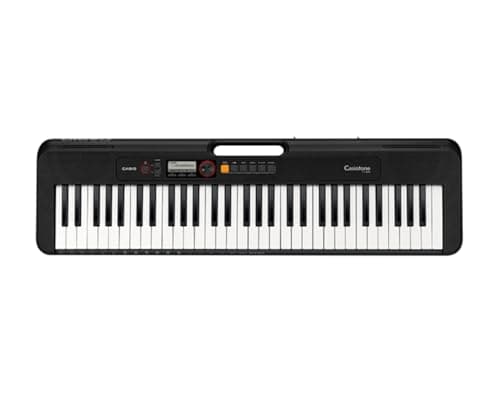
61 full-size keys, 400 tones and a power supply in the box, at the price where most keyboards still ship with narrow mini keys. That one specification is why it is here.
Published specifications
- Keys:
- 61, full-size
- Polyphony:
- 48 notes
- Tones:
- 400
- Rhythms:
- 77
- Display:
- LCD
- Connectivity:
- USB-MIDI
- In the box:
- Power supply, music rest
What it gets right
- Full-size keys at a price where mini keys are the norm — this is the specification that decides whether a child learns a hand span they can keep
- Power supply included, which is not a given and turns a cheap keyboard into an expensive paperweight when it is missing
- Light and simple enough that a child can set it up themselves, which means it gets used
Where it gives ground
- Unweighted keys, so it will not build the finger strength an acoustic piano needs
- 400 tones is a lot of browsing for a child who is meant to be practicing
What it is not good at
Preparing anyone for a real piano. It is a first keyboard for a young child, not a piano substitute — read our weighted-versus-unweighted comparison before assuming otherwise.
How the specs score against a beginner’s needs
Scores are our reading of the published specifications above against what a beginner physically needs. They are not test results — we have not played this instrument.
Specifications from Casio Casiotone CT-S200 published specifications.
Questions people actually ask
What height should a keyboard be?
High enough that the player’s forearms are roughly level with the keys when seated, with the elbows at about a right angle and the wrists neutral. For most adults the keys land somewhere around 71 to 75 cm from the floor; the exact number depends on the person, so set it from the body rather than from a measurement.
Do I really need a piano bench?
Yes, and an adjustable one. A dining chair is around 45 cm and is too low for nearly every adult and dramatically too low for a child. Sitting too low pushes the wrists up and flattens the fingers, which limits control and over years causes strain.
X-stand or Z-stand?
X-stands are cheaper, fold flat and adjust easily, which suits an instrument that moves or gets stored. Z-stands are considerably more stable and take up more floor space, which suits a heavy 88-key instrument that lives in one place.
Can I put a keyboard on a table?
Almost always the wrong height. A dining table is about 75 cm, which puts the keys near 78 cm once the instrument’s own depth is added — too high for most adults and much too high for a child. A desk is usually closer but still a compromise.
Sources
Still deciding?
Every recommendation on this site is built the same way, and the method is published in full — including what we do not do and what would get a pick dropped.
Read next
- Best keyboard gig bags and cases
Published interior lengths for 88-key bags run from 53 to 59 inches, so the label tells you nothing. How to measure, when wheels earn their 22 pounds, and four bags on real dimensions.
- What you actually need to start piano
The complete accessory list in priority order, with what each one is for and which ones can genuinely wait.
- Best headphones for a digital piano
Closed-back over-ear picks, the quarter-inch adapter problem, and why open-back headphones are the wrong tool here.
- Best beginner digital pianos: 88 keys, honestly compared
Hammer action versus semi-weighted at the entry price, with the polyphony and weight trade-offs both stated.
- Best keyboards for kids
Why mini keys are disqualifying, and two picks that keep full-size touch-sensitive keys within a child's budget.
- How much should a beginner keyboard cost?
Four bands from touch response to hammer action, plus the stand, bench and pedal costs that turn a keyboard budget into a bigger one.