Keys
Best keyboard gig bags and cases
Measure your keyboard before you read any further. The most expensive case here fits fewer boards than the cheapest bag, and both say 88-key on the label.
By Sawyer V. · Published · Last updated
Measure your keyboard before you buy anything. Published interior lengths on the four bags below run from 53.37 inches to 59 inches, and all four are sold for “88-note” or 61-note keyboards. The most expensive case on this page has the shortest interior of the lot, which means it fits fewer keyboards than the cheapest bag does. That is the single most useful fact here and it is published on every spec sheet, which is why this page is organized around interior dimensions rather than price.
Every pick states its Starter Path band, and we have not handled any of them — the method is on how we pick. Dimensions, weights and construction come from published spec sheets, cited at the bottom.
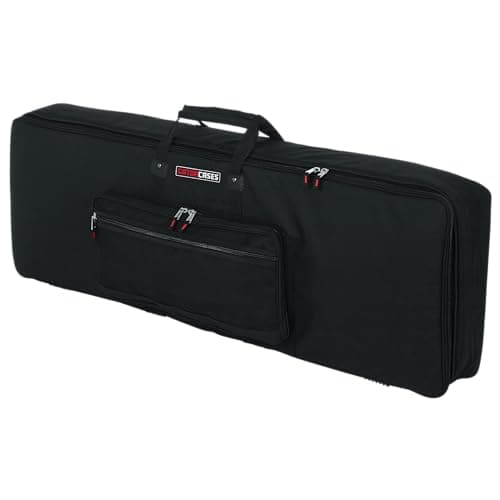
Measure first: “88-key” is not a size. Interior lengths here span 53.37 to 59 inches. For a full-depth 88-note board the Gator GKB-88 is the pick — a 58 inch by 18 inch by 7 inch interior with retention straps, at 6 lb. For a 61-note board, the GKB-61 (38 x 16 x 6 inches). Wheels are worth it only if you move the board weekly: the wheeled case weighs 22 lb empty and its 53.37 inch interior will not take a full-depth 88. And if the keyboard never leaves the house, buy a dust cover instead.
Why the label tells you nothing
A guitar comes in a handful of body shapes and a dreadnought bag is labeled as such. A ukulele comes in four body sizes and the good makers publish bout widths. Keyboards are worse than both, because the key count that everybody uses as the size — 49, 61, 76, 88 — describes only one of the three dimensions that decide whether a bag closes.
Two 88-note keyboards can differ by six inches in length, because the key count sets the width of the keybed and nothing else. Everything either side of the keys is design choice: how far the control panel extends behind the keys, whether there are speakers in the end cheeks, whether the pitch and modulation wheels sit left of the keybed or above it. A slim stage piano and a digital piano with built-in speakers and a music rest are both “88-key” and they are not the same object.
The published numbers on this page show it plainly:
Gator GKBE-88 — 59 inch interior, but only 5 inches of height.
Gator GKB-88 — 58 inch interior, 7 inches of height.
Gator GK-88SLIM — 53.37 inch interior, 6 inches of height.
So the cheapest bag is the longest and the shallowest; the mid bag is the deepest; and the expensive wheeled case is nearly six inches shorter than either. A board that fits the cheap bag may not fit the expensive one. Nothing about the price ordering tells you that, and nothing about the word “88” does either.
How to measure, in two minutes
Three numbers, with a tape measure, before you order anything.
Length, end panel to end panel at the widest point — not the keybed, the whole body. This is the number that disqualifies cases.
Depth, front edge to back edge, including any control panel that overhangs behind the keys and any permanently attached music rest bracket.
Height, at the thickest point, which on most digital pianos is not the keybed but the rear housing where the speakers and screen live. This is the number people forget, and it is why a 5 inch interior height is a real constraint rather than a technicality.
Then compare all three against the published interior figures, not the exterior ones. Allow a little room: a bag you have to force closed puts pressure on the end panels every time it is zipped, which is precisely the part you are trying to protect.
If the keyboard is still being chosen rather than measured, our 61 against 88 keys comparison is the decision that comes first, and portable keyboards covers the boards built to be carried in the first place.
The four specifications that actually separate these
Interior dimensions. Covered above and the first filter. A maker that does not publish them is asking you to guess, which is the reason the unbranded end of this category has no entry on this page.
Interior retention straps. The most under-rated feature here. A keyboard that slides inside its bag arrives end-panel-first at every speed bump, and the end panels house the jacks and the control board. Gator publishes adjustable padded retention straps on the GKB-61, the GKB-88 and the wheeled case — and publishes none on the cheapest envelope bag. In practice that matters more than a few millimeters of foam.
Frame, or the absence of one. A gig bag is padded fabric and compresses under weight. A case has a frame: the GK-88SLIM uses polyethylene under a 600D nylon shell. Foam handles knocks; only a frame handles something heavy landing on top. If the board travels in a car boot under other luggage, this is the whole decision.
Weight, including the bag. The one people never add up. A full-size digital piano is already an awkward carry; the GKB-88 adds 6 lb to it and the wheeled case adds 22 lb. A wheeled case you cannot lift into the car has moved the problem rather than solved it.
One number is conspicuously missing from this list. Gator publishes a padding thickness for the cheapest bag (10 mm) and no padding figure at all for either GKB bag, so the comparison everybody wants to make — which is better padded — cannot be made from the spec sheets. We have said so on each product card rather than inventing a figure or implying the dearer bag must have more.
The picks
The Gator GKB-88#ad is the recommendation for a full-size board. A 58 by 18 by 7 inch interior is the deepest soft bag here, which is what accommodates a digital piano with a speaker housing rather than a slim stage piano, and it has the adjustable retention straps and reinforced riveted handles. Six pounds. Buy this if your 88 measures under 58 inches and travels sometimes. Skip it if you have to walk any real distance — it has handles and no wheels, and a full-size board plus bag is a two-person lift for most people.
The Gator GKB-61#ad is the same construction at 61-note scale: 38 by 16 by 6 inch interior, 5.5 lb, retention straps, riveted handles, and an exterior pocket that takes the power supply and a sustain pedal — which is the pocket's real job, because those are the parts that get left behind. Buy this if a 61-note board goes out weekly. Skip it if your board is a slim 61: Gator sells a narrower GKB-61-SLIM, and a loose fit defeats the retention straps.
The Gator GKBE-88#ad is the honest floor and the only pick here that publishes a padding figure — 10 mm, in a rugged nylon envelope, at three pounds, with a 59 inch interior that is the longest on the page. Its limits are published too: 5 inches of interior height, two webbed handles, no retention straps. Buy this if the budget stopped at the instrument and the board needs scuff protection for occasional trips. Skip it if the keyboard has a tall rear housing, or if anything will ever be stacked on top of it.
The Gator GK-88SLIM#ad is the wheeled case, and it sits in the overspend band for two published reasons rather than one. It is roughly four times the economy bag. And its 53.37 inch interior is the shortest here, so it is not a premium version of the GKB-88 — it fits a different and narrower set of keyboards. What you get is real: a polyethylene frame, tricot-lined foam, integrated wheels, a telescoping tow handle, rubber skid bars. Buy this if you load a slim 88 in and out every week. Skip it if your board is full-depth (it will not fit), or if it moves twice a year (22 lb of empty case is a lot of object to store).
What we did not list, and why
Unbranded bags under about sixty dollars. They dominate this category by volume and several are well reviewed. Not one that we checked — and we checked a dozen — publishes an interior dimension or a padding thickness. On a page whose whole argument is to measure and compare, a product with nothing to compare cannot be recommended. This is the same filter that kept them off our ukulele cases page.
Named alternatives to Gator. We looked, specifically because four picks from one brand reads like laziness. The Kaces KBX61 was down to a single unit when we checked, and the other named makers in this size class had no live stock we could point at. Gator is listed four times because it is one of very few makers here publishing the numbers this page is built on — not because we prefer it.
49-note and 76-note bags. Both sizes exist in Gator's range and both appear in the search suggestions. They are omitted because the reasoning is identical — measure, compare the interior, check the height at the thickest point — and a page that lists every size variant stops being a buying guide and becomes a catalog.
Flight cases. Gator's molded Frequent Flyer cases are in stock and start at well over double the wheeled pick. They are built for freight handling, which is not a beginner problem, and anyone who genuinely needs one already knows it.
Dust covers. Not a case and frequently the right answer instead of one. If the keyboard lives on a stand and never travels, a cover keeps dust out of the key mechanism for a fraction of the price of any bag here — and our keyboard accessories page puts both in order against everything else competing for the same money.
What to carry with it
A bag solves the board. The things that actually get forgotten are the things that make the board useless on arrival.
The power supply, which is why the exterior pocket is worth paying for. Most beginner keyboards use a proprietary adapter rather than a standard barrel plug, so turning up without it is not something a borrowed cable fixes.
The sustain pedal, which travels badly loose in a car and lands on its jack. Our sustain pedal roundup covers the pedals worth owning in the first place.
The stand, which does not go in any of these bags and needs its own. This is the single most common oversight when a keyboard starts traveling, and our stand and bench guide covers what to look for in one that folds.
And one habit worth more than any of the above: let the keyboard come up to room temperature inside the closed bag before switching it on. A cold board opened into a warm room can form condensation on the circuit board, and that is the one transport risk a bag genuinely cannot pad against.
Quick picks
88-key board, the one to buy
A 58 inch interior and 7 inches of height, which is the most of any soft bag here and the reason it takes a full-depth digital piano. For: an 88 that travels occasionally. Skip if: you need to walk any distance with it.
| # | Product | Best for | Score | Price |
|---|---|---|---|---|
| 1 | Gator GKB-88 Padded Keyboard Gig BagThe 61-bag's construction stretched to a 58 inch interior: adjustable padded retention straps, reinforced riveted handles, one exterior pocket, six pounds. | An 88-key board without wheelsEnough | 7.6 | $169.99 · View on Amazon #ad How we’re funded |
61-key board, travels weekly
A 38 inch interior with adjustable straps that stop the keyboard sliding, riveted handles and a pocket for the power supply. For: a 61-note board going to a lesson or a service. Skip if: the board never leaves the house.
| # | Product | Best for | Score | Price |
|---|---|---|---|---|
| 1 | 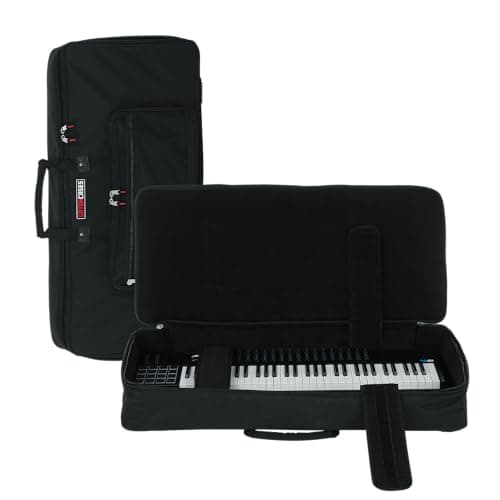 Gator GKB-61 Padded Keyboard Gig BagA 38 inch interior with adjustable padded straps that hold the keyboard in place, reinforced riveted handles and an exterior pocket for the power supply. | A 61-key board that travels weeklyEnough | 7.8 | $139.99 · View on Amazon #ad How we’re funded |
Cheapest bag that publishes its numbers
10 mm of padding, a 59 inch interior and three pounds. For: a board that needs scuff protection and a budget that stops at the instrument. Skip if: anything heavy will ever sit on top of it.
| # | Product | Best for | Score | Price |
|---|---|---|---|---|
| 1 | 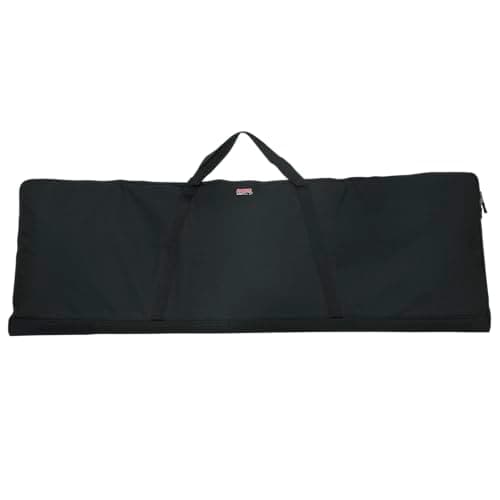 Gator GKBE-88 Cadet Series Keyboard Bag10 mm of padding in a rugged nylon envelope with two webbed handles, at three pounds. | The honest floor for an 88-key boardThe honest floor | 7.0 | $74.99 · View on Amazon #ad How we’re funded |
Only if you move it every week
A polyethylene frame, wheels and a tow handle — and 22 lb empty, with the shortest interior on this page. For: a slim 88 that gets loaded in and out regularly. Skip if: your 88 is full-depth, because it will not fit.
| # | Product | Best for | Score | Price |
|---|---|---|---|---|
| 1 | 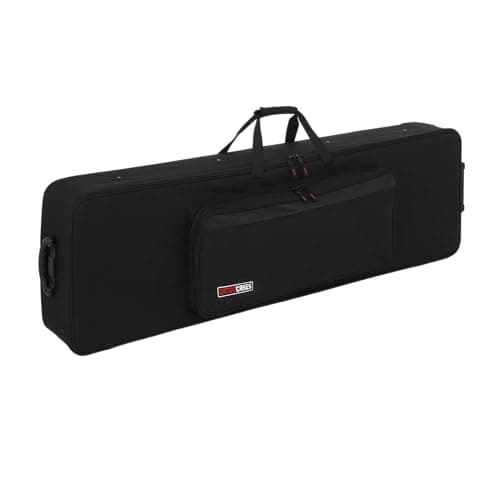 Gator GK-88SLIM Keyboard Case with WheelsA 600D nylon shell over a polyethylene frame, with a tricot-lined foam interior, integrated wheels and a telescoping tow handle. | Where overspending starts - unless you move it weeklyWhere overspending starts | 7.8 | $314.99 · View on Amazon #ad How we’re funded |
The picks in full
Gator GKBE-88 Cadet Series Keyboard Bag
GatorBest for: The honest floor for an 88-key board
10 mm of padding in a rugged nylon envelope with two webbed handles, at three pounds. It is the cheapest bag here that publishes both an interior dimension and a padding figure, which is the whole basis for knowing whether it fits and whether it protects.
Published specifications
- Fits:
- 88-note keyboards and electric pianos
- Padding:
- 10 mm
- Interior:
- 59" L x 19" W x 5" H
- Exterior:
- 60" L x 20" W x 6" H
- Weight:
- About 3 lb
- Shell:
- Rugged nylon, water resistant; no denier rating published
- Handles:
- Two webbed nylon handles
- Lockable:
- No
- Interior retention straps:
- None published — this is an envelope-style bag
What it gets right
- Publishes both an interior dimension and a padding thickness, which almost nothing else at this price does
- Three pounds, so the bag adds almost nothing to what is already an awkward carry
- The 59 inch interior is the longest here, so it takes a full-depth 88 that the slim wheeled case will not
- Cheapest route to not transporting a digital piano in a bin liner, which is the actual alternative
Where it gives ground
- Only 5 inches of interior height, so a board with a thick control panel or a raised speaker housing may not close
- No interior retention straps published, so the keyboard can slide inside the bag in transit
- Two webbed handles and no shoulder strap or backpack straps, which makes an 88 a genuinely two-handed carry
- Envelope-style construction with no rigid frame: it resists scuffs, not crushing
What it is not good at
Protecting against anything heavy landing on top. Ten millimeters of foam in a soft envelope is scuff-and-knock protection, and an 88-key board in a car boot under luggage needs a frame.
How the specs score against a beginner’s needs
Scores are our reading of the published specifications above against what a beginner physically needs. They are not test results — we have not played this instrument.
Specifications from Sound Pro — Gator GKBE-88 published specifications (10 mm padding, interior 59 x 19 x 5 in, exterior 60 x 20 x 6 in, about 3 lb, rugged nylon, two webbed nylon handles).
Gator GKB-61 Padded Keyboard Gig Bag
GatorBest for: A 61-key board that travels weekly
A 38 inch interior with adjustable padded straps that hold the keyboard in place, reinforced riveted handles and an exterior pocket for the power supply. The retention straps are the feature worth paying for: a keyboard that cannot slide inside the bag cannot land on its own end panel.
Published specifications
- Fits:
- Most 61-note keyboards
- Interior:
- 38" L x 16" W x 6" H
- Exterior:
- 39" L x 17" W x 7" H
- Weight:
- 5.5 lb
- Shell:
- Heavy-duty nylon; no denier rating published
- Padding thickness:
- Not published by the dealer
- Interior retention:
- Adjustable padded straps that hold the keyboard in position
- Handles:
- Reinforced riveted carry handles
- Storage:
- Exterior accessory pocket for cables and power supplies
What it gets right
- Adjustable interior retention straps, which is the difference between a bag that fits and a bag that stops the instrument moving
- Reinforced riveted handles rather than stitched webbing, which is where cheap bags fail first
- An exterior pocket big enough for the power supply and sustain pedal, so the parts that get left behind travel with the board
- A published 6 inch interior height, which clears the control panel on most 61-note keyboards
Where it gives ground
- Gator publishes no padding thickness for the GKB series, so the one number you would most want to compare is unavailable
- 5.5 lb empty, nearly twice the Cadet bag, and all of it is weight you carry
- Roughly double the price of the economy bag for a board that may only go to a lesson and back
- Soft-sided: the retention straps stop movement, they do not resist crushing
What it is not good at
A slim 61-note board where the extra 16 inch width is wasted. Gator sells a GKB-61-SLIM with a narrower interior, and a loose fit in a bag this size undoes the point of the retention straps.
How the specs score against a beginner’s needs
Scores are our reading of the published specifications above against what a beginner physically needs. They are not test results — we have not played this instrument.
Gator GKB-88 Padded Keyboard Gig Bag
GatorBest for: An 88-key board without wheels
The 61-bag's construction stretched to a 58 inch interior: adjustable padded retention straps, reinforced riveted handles, one exterior pocket, six pounds. It is the pick for a full-size digital piano that travels occasionally and does not justify a wheeled case.
Published specifications
- Fits:
- 88-note keyboards
- Interior:
- 58" L x 18" W x 7" H
- Exterior:
- 59" L x 19" W x 8" H
- Weight:
- 6 lb
- Shell:
- Rugged nylon; no denier rating published
- Padding thickness:
- Not published by the dealer
- Interior retention:
- Adjustable padded straps that hold the keyboard in position
- Handles:
- Reinforced riveted carry handles
- Storage:
- One exterior accessory pocket
What it gets right
- A 7 inch interior height, the most of any soft bag here, which matters because an 88-key board with a speaker housing is deeper than people expect
- The 58 inch interior takes a full-depth 88 that will not fit the slim wheeled case's 53.37 inch interior
- Adjustable retention straps and riveted handles, the same two features that make the 61 version worth its price
- Six pounds, which is a quarter of the weight of the wheeled case
Where it gives ground
- No padding thickness published, so it cannot be compared on protection against the Cadet bag's stated 10 mm
- Carry handles only: an 88-key board plus a 6 lb bag is a two-person lift for most people, and there are no wheels
- One accessory pocket is tight for a power supply, a pedal and a cable
- Soft-sided, so it is the wrong product if the board ever gets checked as luggage
What it is not good at
Being carried any distance. The bag is good; the problem is physics. A full-size digital piano in a soft bag with two handles is a short walk from car to door, not a trek across a car park, which is the entire argument for the wheeled case.
How the specs score against a beginner’s needs
Scores are our reading of the published specifications above against what a beginner physically needs. They are not test results — we have not played this instrument.
Gator GK-88SLIM Keyboard Case with Wheels
GatorBest for: Where overspending starts - unless you move it weekly
A 600D nylon shell over a polyethylene frame, with a tricot-lined foam interior, integrated wheels and a telescoping tow handle. It is the only pick here that resists crushing and the only one you can pull rather than carry - and it weighs 22 pounds empty.
Published specifications
- Fits:
- Slim 88-note keyboards
- Interior:
- 53.37" L x 15" W x 6" H
- Exterior:
- 59.84" L x 17.72" W x 9.06" H
- Weight:
- 22 lb empty
- Shell:
- 600D nylon over a polyethylene frame (hybrid construction)
- Interior lining:
- Tricot-lined foam with adjustable retention straps
- Transport:
- Integrated wheel system and telescoping tow handle
- Storage:
- One clear-paneled exterior pocket
- Base protection:
- Rubber skid bars and protective feet
What it gets right
- A polyethylene frame means it resists weight rather than only absorbing knocks, which no soft bag here does
- Wheels and a tow handle turn a two-person lift into a one-person pull, which is the real reason this category exists
- Rubber skid bars and feet, so setting it down on wet ground does not soak the base
- Tricot-lined foam with retention straps: the interior finish will not scuff a gloss end-cheek
Where it gives ground
- 22 lb empty - more than some of the keyboards it is built to carry, and all of it has to go in the car too
- The 53.37 inch interior is the SHORTEST here: this fits SLIM 88-note boards, and a full-depth 88 will not go in
- Roughly four times the economy bag and nearly double the GKB-88, for a benefit that is entirely about how far you walk
- At 59.84 inches long externally it is a genuinely awkward object to store between uses
What it is not good at
A keyboard that stays at home. For a board that lives on a stand and goes out twice a year this is a large, heavy, expensive object solving a problem you do not have - and the 53.37 inch interior means it is not even the safe default, because it does not fit every 88.
How the specs score against a beginner’s needs
Scores are our reading of the published specifications above against what a beginner physically needs. They are not test results — we have not played this instrument.
Questions people actually ask
What size gig bag do I need for an 88-key keyboard?
Measure the keyboard, because “88-key” is not a size. Published interior lengths on the bags here run from 53.37 inches to 59 inches — a six inch spread — so a board that fits one will not fit another. Measure length, depth and height at the thickest point, then compare against the interior figures rather than the model name. A full-depth 88 generally needs a 58 inch interior or longer.
Does my keyboard even need a bag?
Only if it leaves the house. A keyboard that lives on a stand in one room is better off staying there — and a dust cover costs a fraction of a bag. Buy a bag when the board starts traveling to a lesson, a rehearsal or a service, which for most people is the point at which it also starts getting scuffed.
Are keyboard cases with wheels worth it?
Only if you move the board regularly, and the trade is bigger than it looks: the wheeled case here weighs 22 pounds empty, which is more than some of the keyboards it carries. Wheels convert a two-person lift into a one-person pull, which is genuinely transformative if you load in every week and irrelevant if you carry the board from a car to a front door twice a year.
What is the difference between a gig bag and a case?
A frame. A gig bag is padded fabric: it absorbs knocks and scuffs and compresses under weight. A case has a rigid or semi-rigid frame — the wheeled pick here uses a polyethylene frame under a 600D nylon shell — so it resists something heavy landing on top. If the board ever travels under luggage, that distinction is the whole purchase.
Why do interior retention straps matter?
Because a keyboard that can slide inside its bag will eventually land on an end panel, and the end panels are where the jacks and the control board live. Gator publishes adjustable padded retention straps on the GKB bags and on the wheeled case, and publishes none on the cheapest envelope-style bag. That is the clearest difference between the tiers on this page, more than padding thickness.
Will a bag protect against humidity or temperature?
No, and digital keyboards mostly do not care — unlike a solid-wood acoustic instrument, there is no soundboard to crack. What does matter is condensation: a cold keyboard brought into a warm room can form moisture on the circuit board. Let it come up to room temperature in its bag, closed, before switching it on.
Can I use a cheap unbranded bag instead?
You can, and plenty do. The reason none is listed here is specific rather than snobbery: we could not find a single sub-$60 seller in this category that publishes an interior dimension or a padding thickness. On a page whose entire argument is that you must check the interior against your own keyboard, a bag with no published interior cannot be checked and cannot be compared.
Sources
- Sound Pro — Gator GKBE-88 published specifications (10 mm padding, interior 59 x 19 x 5 in, exterior 60 x 20 x 6 in, about 3 lb, rugged nylon, two webbed nylon handles)
- Sound Pro — Gator GKB-61 published specifications (interior 38 x 16 x 6 in, exterior 39 x 17 x 7 in, 5.5 lb, adjustable padded retention straps, reinforced riveted handles, exterior accessory pocket)
- Sound Pro — Gator GKB-88 published specifications (interior 58 x 18 x 7 in, exterior 59 x 19 x 8 in, 6 lb, rugged nylon, adjustable padded interior straps, reinforced riveted carry handles)
- Sound Pro — Gator GK-88 SLIM published specifications (interior 53.37 x 15 x 6 in, exterior 59.84 x 17.72 x 9.06 in, 22 lb, 600D nylon over polyethylene frame, tricot-lined foam, integrated wheels and telescoping tow handle, rubber skid bars)
Still deciding?
Every recommendation on this site is built the same way, and the method is published in full — including what we do not do and what would get a pick dropped.
Read next
- Keyboard accessories you actually need
Stand, bench, sustain pedal and headphones, ranked by how much they change your playing, plus the bundle items that get thrown away.
- Best portable keyboards
The three specs that decide whether a keyboard actually travels, and the boards that get all three right at a beginner price.
- Keyboard stands and benches
How to set the correct playing height, X-stand versus Z-stand, and why the adjustable bench is the item to buy first.
- 61 vs 88 key keyboard
When 61 keys stops being enough, what 88 actually costs in money and floor space, and buy paths for both answers.
- Best guitar cases and gig bags for beginners
Padding depth in millimeters, interior dimensions that tell you whether your guitar fits, and five cases across acoustic, electric and hard-case duty.
- Best ukulele cases and gig bags
Soprano, concert, tenor and baritone need four different cases, and the published interior bout widths are the only way to check. Three cases from gig bag to hard shell, and when each is worth it.