Keys
Best headphones for a digital piano
The accessory that decides whether practice happens in the evening, and the one where the wrong plug size ruins the first night.
By Sawyer V. · Published · Last updated
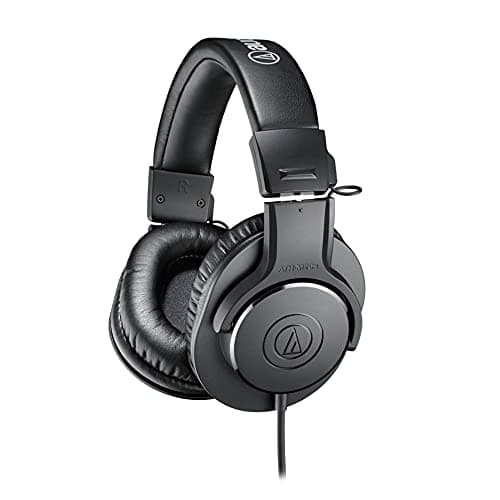
Headphones are the accessory people buy last and should buy first. They are what makes the difference between an instrument that can be practiced at nine in the evening and one that can only be played when the household agrees.
Both picks state their Starter Path band, and we have not tested them — our method is on how we pick.
The plug problem, first
This catches almost everyone. Phones and laptops use a 3.5 mm (eighth-inch) socket. Most digital pianos and many keyboards use a 6.3 mm (quarter-inch) socket, which is the larger one.
A pair of headphones with a 3.5 mm plug will not fit a quarter-inch socket without an adapter, and the adapter is a two-dollar part that nobody has in the house on the evening the piano arrives.
The Audio-Technica ATH-M20x#ad includes a snap-on quarter-inch adapter in the box, which is a small thing that removes the most common first-night frustration. Check for it on anything else you consider.
Closed-back, always
Headphones come in two broad designs and only one is right here.
Closed-back headphones seal against the head. Sound does not leak out and room noise does not leak in. That is exactly what practice headphones are for.
Open-back headphones have a perforated outer shell and deliberately let sound pass both ways. They sound more spacious and natural, they are popular with people who listen to music critically, and they are completely the wrong tool for silent practice — anyone in the room hears a thin tinny version of what you are playing.
If a listing does not say which it is, look at the earcups: solid shell is closed, visible grille is open.
What actually matters at this price
Weight. Over an hour of practice this outranks almost everything. Under 250 grams is comfortable; the ATH-M20x is 190 grams without the cable. For a child this matters more, not less.
Cable length. A 3 meter cable is generous at a piano and a trip hazard elsewhere. Fine here, and worth knowing before you order.
Honest tuning. Headphones with a heavily boosted bass flatter music and mislead a student about their own dynamics. Something reasonably neutral is better for practice, which is why studio-monitoring headphones suit this job.
Not: wireless. Bluetooth introduces latency, and latency between pressing a key and hearing it is genuinely disruptive to practicing. Use a cable.
The second pick, and when it makes sense
The Vic Firth stereo isolation headphones#ad are built for a different job: blocking a live acoustic drum kit while feeding a music track in. They attenuate far more ambient noise than ordinary closed-back headphones.
At a piano that is overkill. It becomes the right answer in one specific household: where the same pair also has to serve someone at an acoustic drum kit. In that case buy these once rather than two pairs — and see hearing protection for drummers for why that job is not optional.
What to skip
Earbuds. They do not isolate well, they fall out, and at the volume needed to overcome room noise they are a genuine hearing risk over years of practice.
Noise-cancelling headphones. Active cancellation is designed for steady low-frequency noise like an aircraft cabin, adds a small amount of latency, and costs a great deal more. A closed-back passive design does this job better and cheaper.
Anything wireless, for the latency reason above.
Quick picks
The default for a keyboard or digital piano
Closed-back, 40 mm drivers, and a quarter-inch adapter in the box — which is the socket most digital pianos actually have.
| # | Product | Best for | Score | Price |
|---|---|---|---|---|
| 1 | Audio-Technica ATH-M20xClosed-back 40 mm drivers with a 1/4 inch adapter included, which is the socket most digital pianos actually have. | Practice headphonesThe honest floor | 8.7 | $59.00 · View on Amazon #ad How we’re funded |
If the same headphones also go on an acoustic drum kit
Built to block a live drum kit while feeding music in. Overkill at a piano and the right answer if one pair has to do both jobs.
| # | Product | Best for | Score | Price |
|---|---|---|---|---|
| 1 | No image Vic Firth stereo isolation headphonesOver-ear headphones built to block a drum kit while feeding music in, which is the one job normal headphones cannot do at a live acoustic kit. | Playing along on an acoustic kitEnough | 8.8 | Check price on Amazon → #ad How we’re funded |
The picks in full
Audio-Technica ATH-M20x
Audio-TechnicaBest for: Practice headphones
Closed-back 40 mm drivers with a 1/4 inch adapter included, which is the socket most digital pianos actually have. The cheapest headphones we would put on a practicing student.
Published specifications
- Type:
- Closed-back, circumaural (over-ear)
- Drivers:
- 40 mm, copper-clad aluminum voice coils
- Frequency response:
- 15 Hz - 20,000 Hz
- Cable:
- 9.8 ft (3.0 m), single-sided, straight
- Weight:
- 6.7 oz (190 g) without cable
- In the box:
- 6.3 mm (1/4") snap-on adapter
What it gets right
- Closed-back, so the sound stays in and the room stays out — the whole point of practice headphones
- The 1/4 inch adapter is included, and that is the socket most digital pianos have rather than the 1/8 inch a phone uses
- Under 200 grams, which matters over an hour of practice on a child's head
Where it gives ground
- The cable is fixed, not detachable, so a damaged cable means new headphones
- A 3 meter cable is generous at a piano and a trip hazard anywhere else
What it is not good at
Portability. They do not fold flat and there is no case. These live at the instrument.
How the specs score against a beginner’s needs
Scores are our reading of the published specifications above against what a beginner physically needs. They are not test results — we have not played this instrument.
Specifications from Audio-Technica ATH-M20x published specifications.
Vic Firth stereo isolation headphones
Vic FirthBest for: Playing along on an acoustic kit
Over-ear headphones built to block a drum kit while feeding music in, which is the one job normal headphones cannot do at a live acoustic kit.
Published specifications
- Type:
- Closed-back stereo isolation headphones
- Purpose:
- Attenuate ambient kit volume while delivering a music feed
- Fits:
- Any 1/8 inch source
What it gets right
- Solves the problem earplugs cannot: hearing a backing track over an acoustic kit without turning the track up to damaging levels
- Doubles as hearing protection when nothing is plugged in
- Built by a drum-hardware company, so the headband survives being thrown in a bag
Where it gives ground
- Bulky and warm over a long session
- Sound quality is functional, not hi-fi — they are a tool, not listening headphones
What it is not good at
Electronic kits. A mesh-head kit is quiet enough that ordinary closed-back headphones do the job better and sound nicer.
How the specs score against a beginner’s needs
Scores are our reading of the published specifications above against what a beginner physically needs. They are not test results — we have not played this instrument.
Specifications from Vic Firth stereo isolation headphones published description.
Questions people actually ask
What headphones do I need for a digital piano?
Closed-back, over-ear, with a quarter-inch (6.3 mm) plug or an adapter for one. Most digital pianos use the larger quarter-inch socket rather than the eighth-inch a phone uses, and discovering that at 9pm with the wrong plug is a common disappointment.
Open-back or closed-back for piano practice?
Closed-back, without question. Open-back headphones deliberately leak sound both ways, which sounds lovely and completely defeats the purpose — the whole reason you are wearing them is so nobody else hears the instrument.
Can a child use adult headphones?
Physically yes, with the headband at its smallest. Weight matters more than fit: under about 250 grams is comfortable for a child over a practice session. What does matter is volume — set a sensible maximum on the instrument, because a child will not.
Do I need expensive headphones?
No. Practice headphones need to be closed, comfortable and honest. Above the entry tier you are paying for detail retrieval that matters for mixing music and does nothing for practicing scales.
Sources
Still deciding?
Every recommendation on this site is built the same way, and the method is published in full — including what we do not do and what would get a pick dropped.
Read next
- What you actually need to start piano
The complete accessory list in priority order, with what each one is for and which ones can genuinely wait.
- Best beginner digital pianos: 88 keys, honestly compared
Hammer action versus semi-weighted at the entry price, with the polyphony and weight trade-offs both stated.
- Best beginner keyboards: 61 keys that suit real lessons
Touch response over tone count, segmented for children and adult learners, with the 61-key ceiling stated plainly.
- Best hearing protection for drummers
Why foam plugs are the wrong tool, filtered plugs versus isolation headphones, and what the exposure numbers actually say.
- Keyboard stands and benches
How to set the correct playing height, X-stand versus Z-stand, and why the adjustable bench is the item to buy first.