Keys
Best sustain pedals for keyboards
The cheapest upgrade a digital piano can have, and the one most beginners are told about only when their method book asks for it in month two.
By Sawyer V. · Published · Last updated
Almost every beginner keyboard arrives with either nothing in the pedal box or a small plastic footswitch that slides across the floor the moment you use it. Both are bad in the same way: they make pedaling something you fight rather than something you do.
A real sustain pedal is the cheapest meaningful upgrade a digital piano can get. It is heavier, it stays where you put it, it feels like the pedal on a real piano, and on the better ones it does something the footswitch cannot do at all.
We have not used these pedals. What follows is our reading of what each maker publishes; the method is on how we pick. One note: Yamaha’s own spec pages refused every request we made, so the figures for the FC4A come from a named retailer spec sheet and the product card says so.
Buy the M-Audio SP-2 if you want one pedal that works correctly on any keyboard, thanks to the polarity switch on its base. Buy the Roland DP-10 if your instrument supports half-damper and you intend to keep playing. Buy the Yamaha FC4A if your main problem is a pedal that will not stay still.
What the pedal is actually for
On an acoustic piano, the right pedal lifts the dampers off the strings so notes keep ringing after your fingers leave the keys. It is how a piano sounds connected rather than clipped, and it is written into the music as pedal markings.
A digital piano reproduces that electronically, but only if something is plugged into the sustain jack. A beginner working through a method book without a pedal is playing the notes and leaving out an instruction printed on the page.
The three specs nobody explains
1. Polarity. A sustain pedal is a switch, and brands disagree about whether the switch should be open or closed at rest. Plug a pedal of the wrong polarity into a keyboard and it behaves backwards: everything sustains until you press the pedal, which then stops it. This is the single most common sustain pedal problem, and the simplest cure is a pedal with a polarity switch on the base.
2. Half-damper, also called continuous. A normal pedal is on or off. A half-damper pedal reports its position continuously, so a partial press gives partial sustain, which is what a pianist actually does. It requires support at both ends: Roland publishes the caveat itself, telling owners to move the pedal’s switch to the plain Switch position on instruments that do not support it.
3. Grip and weight. Unglamorous and the reason most people replace a pedal. A light plastic switch on a wooden floor migrates a few inches with every press until you are stretching for it. Weight and a rubber base fix it, and a longer body helps because your foot rests on the pedal rather than shoving it.
How we ranked these
How much it feels like a piano pedal first, then half-damper support, then whether it works with any keyboard, then whether it stays put on the floor, then room to grow. All from published specifications.
The picks
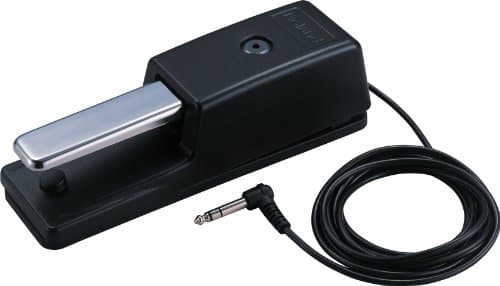
The Roland DP-10#ad is the best pedal here and the only one that publishes half-damper support. A function switch selects Continuous for gradual pedaling or Switch for plain on/off, the cable is 2.2 m for stacked setups, and a long rubber plate extends the footprint to 402 mm so your foot lands on rubber rather than on a sliding block. It weighs 700 g.
Honest limits: Roland does not publish the plug type or polarity, so compatibility cannot be fully confirmed from the spec sheet, and its own manual warns that on instruments without half-damper support you may have to move the switch. It is also the most expensive pedal here, for a feature a first-year player will not use.
The M-Audio SP-2#ad is the one we would buy for most beginners, and the reason is the switch on the base. Polarity is the problem that makes a cheap pedal look broken, and this one lets you flip it in five seconds rather than hunting through a keyboard menu. It has a piano-style chrome pedal, a rubber bottom specified to grip the floor, and a 6 ft cable with a standard quarter-inch jack.
What it does not do is half-damper — M-Audio publishes nothing about continuous operation, so treat it as an on/off pedal. M-Audio also publishes no weight or dimensions, and warns explicitly that the pedal is not for audio outputs.
The Yamaha FC4A#ad is the heavy one. At a published 2 lb 3 oz on a non-slip underside, with a body 10.9 inches deep, it behaves underfoot like a piano pedal rather than a switch. If your current pedal walks across the room, this is the direct fix.
It is explicitly on/off with no half-pedal operation, no polarity switch is published, and — the caveat we flagged above — every Yamaha spec page refused our requests, so those figures are retailer-sourced rather than from Yamaha.
Before you buy: check the keyboard
Does it have a sustain jack at all? The cheapest keyboards omit it. If there is no quarter-inch pedal input on the back, no pedal will help, and that omission is one of the things that separates a toy from an instrument — see are cheap keyboards worth it.
Does it have a pedal polarity setting? Many do, buried in the function menu. If yours does, a pedal without its own switch is fine.
Does it support half-damper? Usually listed on the specification sheet as half-damper or continuous pedal support. If it is absent, the Roland still works — it just works as an on/off pedal.
The rest of the starting kit, in the order we would buy it, is in what you actually need to start piano and keyboard accessories you actually need.
Quick picks
The one to buy if the budget allows
The only pedal here that publishes half-damper support, with a switch for Continuous or plain on/off and the longest cable of the three.
| # | Product | Best for | Score | Price |
|---|---|---|---|---|
| 1 | Roland DP-10The only pedal here that publishes half-damper support. | Half-damper pedalingEnough | 9.0 | $59.98 · View on Amazon #ad How we’re funded |
The universal value pick
A polarity switch on the base means it behaves correctly on any brand of keyboard, which is the problem most cheap pedals create.
| # | Product | Best for | Score | Price |
|---|---|---|---|---|
| 1 | 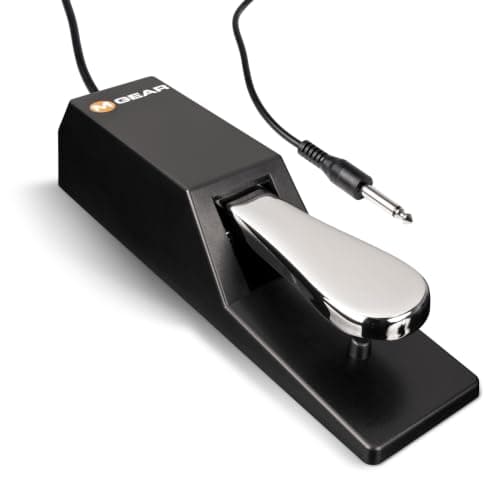 M-Audio SP-2A piano-shaped pedal with a polarity switch on the base, which is the feature that stops it behaving backwards on whatever keyboard you own. | Working with any keyboardThe honest floor | 7.0 | $25.00 · View on Amazon #ad How we’re funded |
If the pedal keeps sliding away
The heaviest here at a published 2 lb 3 oz, on a non-slip base and a body long enough to plant a foot on.
| # | Product | Best for | Score | Price |
|---|---|---|---|---|
| 1 | 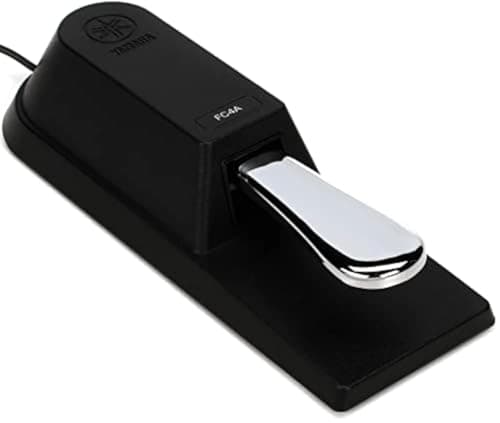 Yamaha FC4AThe heavy one. | Weight that stays where you put itThe honest floor | 6.8 | $28.95 · View on Amazon #ad How we’re funded |
The picks in full
Roland DP-10
RolandBest for: Half-damper pedaling
The only pedal here that publishes half-damper support. A switch sets it to Continuous for gradual pedaling or Switch for plain on/off, and a long rubber plate keeps it still on a hard floor.
Published specifications
- Function switch:
- Continuous (half damper) or Switch (on/off)
- Half-damper:
- Yes — full and half-damper compatible
- Cable:
- 2.2 m (7 ft 2 in)
- Base:
- Non-slip rubber plate
- Dimensions:
- 68 x 220 x 64 mm; 68 x 402 x 64 mm with the rubber plate
- Weight:
- 700 g (1 lb 9 oz)
- Polarity switch:
- None published — the function switch sets damper mode, not polarity
What it gets right
- Half-damper support, which is the one pedal feature that becomes musically useful in the second year
- Longest published cable here at 2.2 m, aimed at stacked and awkwardly placed keyboards
- The rubber plate extends the footprint to 402 mm, so a foot lands on the plate rather than pushing the pedal
Where it gives ground
- Roland's own manual warns that on instruments without half-damper support the pedal may not behave as hoped and the switch must be moved to Switch
- Plug type and polarity are not published, so compatibility cannot be confirmed from the spec sheet alone
- The most expensive of the three, for a feature a first-year beginner will not use
What it is not good at
Guaranteed plug-and-play on every keyboard. Roland documents the caveat itself: half-damper needs an instrument that supports it.
How the specs score against a beginner’s needs
Scores are our reading of the published specifications above against what a beginner physically needs. They are not test results — we have not played this instrument.
Specifications from Roland — DP-10 product page, Roland — DP-10 specifications.
M-Audio SP-2
M-AudioBest for: Working with any keyboard
A piano-shaped pedal with a polarity switch on the base, which is the feature that stops it behaving backwards on whatever keyboard you own.
Published specifications
- Type:
- Switchable damper pedal, piano-style
- Polarity switch:
- Yes — switch on the base for either polarity
- Half-damper:
- Not published by M-Audio; treat as on/off
- Cable / plug:
- 6 ft cable, 1/4 inch jack
- Base:
- Rubber bottom designed to grip the floor
- Surface:
- Chrome foot pedal
- Weight:
- Not published by M-Audio
What it gets right
- The polarity switch means it works the right way round on keyboards from any brand, without hunting through a menu
- Rubber base is specified to grip the floor, which is the difference between a pedal that stays put and one that walks away
- A 6 ft cable and a standard 1/4 inch jack cover normal digital piano placement
Where it gives ground
- No published half-damper support, so gradual pedaling is not available
- Polarity is set by hand on the base — if it behaves backwards, you have to turn the pedal over to fix it
- M-Audio publishes no weight or dimensions, so the footprint cannot be compared before buying
What it is not good at
Expressive damper technique. M-Audio documents it as an on/off switch into a dedicated sustain input, and nothing more.
How the specs score against a beginner’s needs
Scores are our reading of the published specifications above against what a beginner physically needs. They are not test results — we have not played this instrument.
Specifications from M-Audio — SP-2 product page, M-Audio — SP-2 troubleshooting (polarity switch).
Yamaha FC4A
YamahaBest for: Weight that stays where you put it
The heavy one. At a published 2 lb 3 oz on a non-slip base, it behaves like a piano pedal underfoot rather than a plastic block that slides across the floor.
Published specifications
- Type:
- Sustain footswitch, piano-style
- Half-damper:
- No — on/off operation only (retailer spec sheet)
- Plug:
- 1/4 inch TS (retailer spec sheet)
- Base:
- Non-slip rubber underside (retailer spec sheet)
- Dimensions:
- 2.6" x 3.5" x 10.9" (retailer spec sheet)
- Weight:
- 2 lb 3 oz (retailer spec sheet)
- Polarity switch:
- None published
What it gets right
- The heaviest pedal here on a non-slip base, which is the practical fix for a pedal that creeps
- A 10.9 inch body is closer to an acoustic piano pedal than a small switch block
- Standard 1/4 inch plug fits the dedicated sustain input on most digital pianos
Where it gives ground
- No half-pedal operation — it is an on/off switch
- No polarity switch published, so compatibility depends on the keyboard rather than on a setting you control
- Every Yamaha-hosted spec page refused our fetches, so the figures above come from a named retailer spec sheet rather than from Yamaha
What it is not good at
Gradual damper release. The published description rules out half-pedaling, so subtle sustain is out of reach.
How the specs score against a beginner’s needs
Scores are our reading of the published specifications above against what a beginner physically needs. They are not test results — we have not played this instrument.
Specifications from Yamaha — FC4A sustain footswitch (shop listing), Guitar Center — FC4A specifications (retailer spec sheet).
Questions people actually ask
Do I need a sustain pedal as a beginner?
Not in week one, and yes by about month two. Most beginner method books introduce the pedal early, and playing pedal-marked music without one teaches the wrong sound. It is the first accessory we would add to a keyboard.
What is pedal polarity, and why does my pedal work backwards?
Polarity is which way the switch closes. Brands differ, so a pedal built for one keyboard can behave inverted on another: notes sustain until you press, then stop. The fix is a pedal with a polarity switch, or a keyboard setting that reverses it.
What is half-damper, and do I need it?
Half-damper means the pedal reports how far down it is, not just on or off, so you can partially lift the dampers the way an acoustic piano allows. It needs both a pedal and a keyboard that support it. It is a second-year feature, not a first-month one.
Why does my sustain pedal slide across the floor?
Because it is light and the floor is hard. Weight, a rubber base and a longer footprint all fight it, which is why the piano-style pedals here are heavier than the plastic footswitch that came in the box.
Can I use a guitar or keyboard pedal from another brand?
Usually, as long as the plug is the same quarter-inch type and the polarity matches or can be switched. What you cannot do is plug a sustain pedal into an audio output, which M-Audio warns about directly.
Sources
Still deciding?
Every recommendation on this site is built the same way, and the method is published in full — including what we do not do and what would get a pick dropped.
Read next
- Keyboard accessories you actually need
Stand, bench, sustain pedal and headphones, ranked by how much they change your playing, plus the bundle items that get thrown away.
- What you actually need to start piano
The complete accessory list in priority order, with what each one is for and which ones can genuinely wait.
- Best beginner digital pianos: 88 keys, honestly compared
Hammer action versus semi-weighted at the entry price, with the polyphony and weight trade-offs both stated.
- Keyboard specs, and which ones matter
What polyphony really limits, why 700 voices is not a feature, and the four specs that genuinely decide whether a keyboard is good.
- Best piano books for beginners
Adult or child, teacher or alone: the two questions that pick the book, plus four current methods with their weaknesses stated.