Guitars
How to check a used guitar before you buy
Used is where the value is in guitars, and it is also where the unplayable ones end up. Ten minutes and no playing ability will tell you which one you are looking at.
By Sawyer V. · Published · Last updated
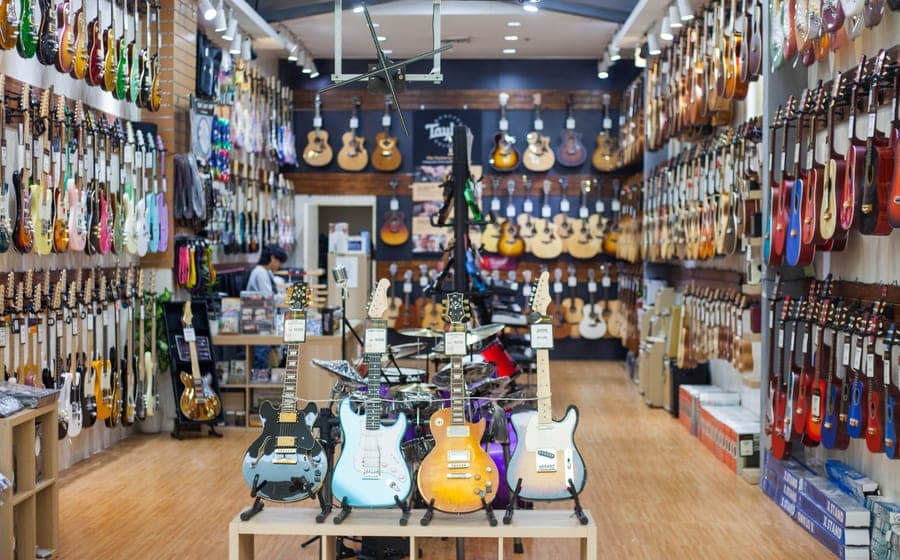
Guitars are the one instrument on this site where we push people toward the used market without hesitation. They are built in enormous numbers, most are bought by people who stop within a year, and the parts that wear out are cheap. A three-year-old guitar in good order is not a worse instrument than a new one; it is the same instrument with someone else having paid the depreciation.
The catch is that the same market is where unplayable guitars go to be someone else’s problem. The good news is that telling the two apart takes about ten minutes and no ability to play. Everything below can be done by a parent who has never held a guitar.
Check in this order: neck straightness, fret condition, string height at the twelfth fret, then the bridge on an acoustic or the jack and pots on an electric. A twisted neck, a lifting acoustic bridge or a cracked headstock repair ends the conversation. High action, dead strings and grubby hardware are normal and cheap.
Before you go: know what the thing is worth new
Look up the exact model and what it sells for new. This takes a minute and it is the single most useful thing you can do, because a large share of used listings are priced from what the seller paid years ago rather than from what the model costs today.
Entry-level lines get replaced and renamed often, and the old name usually sells for less than the seller thinks. Our sense of what the tiers cost is in how much a beginner guitar should cost.
The ten-minute inspection
In order. The first two decide whether the rest is worth doing.
1. Sight the neck. Hold the guitar flat, body on your lap, and look down the fingerboard from the headstock end as if sighting down a rifle. You want an almost straight line with a very slight dip in the middle. A gentle curve is normal and adjustable. What you are looking for is a neck that twists — one side of the fingerboard higher than the other as the line runs away from you. A twist is not adjustable. Walk away.
2. Check the truss rod. Find the adjustment nut, usually under a cover on the headstock or just inside the soundhole on an acoustic. You are not adjusting anything; you are confirming it exists, that the nut is not stripped, and that it is not already cranked to its limit. Ask the seller if it turns. A neck whose truss rod has no travel left cannot be straightened.
3. Feel the fret ends. Run a hand lightly down both edges of the fingerboard. Sharp ends that catch mean the fingerboard has dried and shrunk, which is a humidity story and usually means the guitar was stored badly. It is fixable by a tech but it is a paid job, and it tells you how the rest of the instrument was treated.
4. Look at fret wear. Look at the first four frets under a light. Shallow dents where the strings sit are normal. Deep flat spots or grooves mean a refret or at least a fret level, which on a cheap guitar costs more than the guitar.
5. Measure the action. Press nothing; just look at the gap between the bottom of the strings and the top of the twelfth fret. On a steel-string acoustic you are looking for something around the thickness of two stacked credit cards on the treble side, a little more on the bass. Much more than that and the guitar needs a setup, which is cheap, or a neck reset, which is not. Ask a tech to tell the two apart. What a setup covers is in what a guitar setup is.
6. Acoustic only: look at the bridge. This is the one that costs real money. Look at where the bridge meets the top, from the side and at eye level. It should sit flat. A visible gap, a lifting front edge, or a bulge in the top behind the bridge means the glue joint is failing or the top is deforming under string tension. That is a repair bill, not a bargain.
Then look inside with a phone light for cracks running along the grain of the top, and for braces that have come unglued. A tap around the top that sounds rattly rather than solid is worth asking about.
7. Electric only: plug it in. Bring a cable and use the seller’s amp, or bring your own small one. Turn every knob through its travel and flick every switch. Crackles usually mean dirty pots, which is a cheap clean. Total silence on one pickup, or sound that cuts out when you wiggle the cable at the jack, means wiring work — cheap at a tech, annoying if you were hoping to play tonight.
8. Check the tuners. Turn each one. They should turn smoothly and the string should move in pitch immediately. Slipping, gritty or loose tuners are the single most common reason a beginner guitar feels broken, and replacements are inexpensive.
9. Look behind the nut and at the headstock. A repaired headstock break shows as a line across the back of the neck, sometimes with a color mismatch. A good repair is strong and should be reflected in the price; an undisclosed one tells you about the seller.
10. Play an open chord, or have someone do it. Even a single strum and a note at the twelfth fret tells you whether the intonation is close. If open strings are in tune and the twelfth-fret notes are badly sharp or flat, the saddle is in the wrong place or the guitar needs a setup.
What is cheap, and what ends the conversation
The useful split, because almost every used guitar has something wrong with it.
Cheap and expected: dead strings, high action from a missing setup, grubby hardware, a dirty fingerboard, worn tuner buttons, crackly pots, light dings and finish checking. None of these are reasons to walk; several are reasons to negotiate.
Worth pricing carefully: sharp fret ends, worn frets in the first position, a replaced but unbranded pickup, missing saddle height, an acoustic with no case in a dry climate.
Walk away: a twisted neck, a truss rod that is stripped or already at its limit, a lifting or reglued acoustic bridge, a bellied top, cracks through the sides near the neck block, or a neck angle so far out that the action cannot come down. These are repair jobs that cost more than the guitar is worth, and on a beginner instrument nobody is going to do them.
The general version of this argument — when used is the right call and when it is not — is in used versus new.
Budget for the setup, not just the guitar
Assume every used guitar needs new strings and a setup, and treat that as part of the price. A setup is the difference between an instrument that hurts to play and one that does not, and on a used guitar it is not optional — you are inheriting whatever the last owner left behind.
This is also why a very cheap used guitar is often a bad deal. If the setup and strings cost a meaningful fraction of the purchase price, the saving against a new instrument with a warranty has mostly evaporated. Our view of the cheap end is in are cheap guitars worth it, and the string question is in best beginner guitar strings.
Where to buy
A local shop’s used wall. The most expensive used option and the one we recommend for a first guitar. The shop has already checked the neck, it will usually set the guitar up before it leaves, and you can hand it back if something is wrong.
Private sale. The cheapest, and the one this checklist is written for. Meet in daylight somewhere public, bring a cable if it is an electric, and do not let politeness stop you sighting the neck in front of the seller.
Online marketplaces from a distance. Only where there is a real return window, and even then accept that you are buying the photographs. Ask directly: does the truss rod turn freely, is the bridge flat to the top, when was it last set up. A seller who answers those three questions clearly is usually telling the truth.
When to buy new instead
Used stops making sense in three cases. If nobody nearby is selling the size you need — and for a child, size is not negotiable, see guitar sizes for kids. If the saving is small enough that a warranty and a shop setup are worth more. And if the buyer is going to be discouraged by an instrument that looks tired, which matters more for a child than most adults admit.
For a new electric at the price most used ones actually sell for, the Squier Sonic Stratocaster#ad is the instrument we keep coming back to; the acoustic equivalent is the Yamaha FG800#ad, which has a solid top at a price where laminate is normal. Both are covered in full in best beginner electric guitars and best beginner acoustic guitars.
What we would buy
Squier Sonic Stratocaster
Squier by FenderBest for: The honest floor, electric
The cheapest electric that still has full-scale geometry, sealed tuners and a real 9.5 inch fingerboard radius. Nothing about it will make a beginner's first year harder.
Published specifications
- Scale length:
- 25.5" (647.7 mm) — full size
- Body / neck:
- Poplar body, maple neck, "C" profile
- Fingerboard:
- Maple or Indian laurel, 9.5" (241 mm) radius
- Frets:
- 21, narrow tall
- Nut width:
- 1.650" (42 mm), synthetic bone
- Pickups:
- Three ceramic single-coils (SSS)
- Bridge:
- 6-saddle vintage-style synchronized tremolo
What it gets right
- Full 25.5 inch scale, so nothing learned here has to be relearned later
- Synthetic bone nut rather than a soft plastic one — the part that decides whether a cheap guitar stays in tune
- Sealed-gear tuners, which is the single most important spec on a first electric
Where it gives ground
- Poplar body and ceramic pickups are exactly what you would expect at this tier
- The tremolo bridge will pull the guitar out of tune if a beginner uses it, and beginners always use it
What it is not good at
Staying in tune if you use the whammy bar. If that matters, buy the hardtail (HT) version of the same guitar instead — it is the identical instrument with the tremolo deleted.
How the specs score against a beginner’s needs
Scores are our reading of the published specifications above against what a beginner physically needs. They are not test results — we have not played this instrument.
Specifications from Squier Wiki — Sonic Stratocaster specifications.
Yamaha FG800
YamahaBest for: Buy once, acoustic
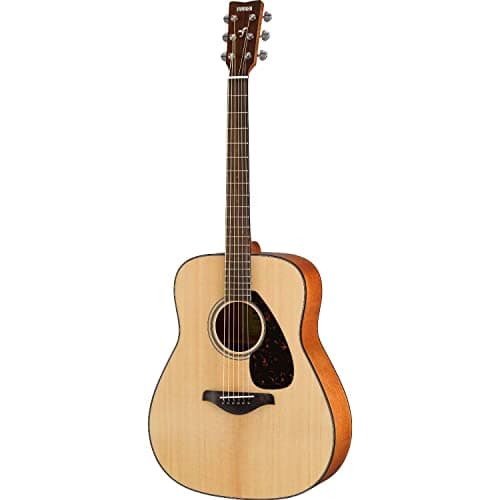
A solid Sitka spruce top with scalloped bracing at the entry price. Solid-versus-laminate is the one acoustic spec that changes what the instrument does over years, and this is the cheapest place to get it done right.
Published specifications
- Top:
- Solid Sitka spruce
- Back / sides:
- Nato / okume
- Neck / fingerboard:
- Nato neck, rosewood fingerboard, R400 mm (23-5/8") radius
- Scale length:
- 650 mm (25-9/16")
- Nut width:
- 43 mm (1-11/16")
- Bracing:
- Scalloped
- Body:
- Traditional Western (dreadnought), 412 mm (16-1/4") wide, 100-118 mm deep
- Hardware:
- Die-cast chrome tuners, urea nut and saddle
What it gets right
- A solid top, not a laminate — the only acoustic spec at this price that genuinely changes over time
- Scalloped bracing and die-cast tuners are specifications you normally pay considerably more for
- Yamaha's most-copied entry acoustic; parts, setups and advice are everywhere
Where it gives ground
- A full dreadnought body is a big box — 412 mm across and up to 118 mm deep
- Nato and okume back and sides are the cost saving; the top is where the money went
What it is not good at
Fitting a smaller player. The dreadnought body is wide and deep enough that a young teenager can struggle to get their arm over it comfortably. If that is the buyer, look at the JR1 or a concert-size body instead.
How the specs score against a beginner’s needs
Scores are our reading of the published specifications above against what a beginner physically needs. They are not test results — we have not played this instrument.
Specifications from Yamaha Europe — FG/FS800 series specifications.
Questions people actually ask
Is it safe to buy a used guitar as a beginner?
Yes, with one rule: check the neck before you check anything else. A guitar with a straight, adjustable neck and worn everything-else is a good buy. A guitar with a twisted neck is scrap at any price, and it is the one fault a beginner cannot see unless they look for it deliberately.
How much less should a used guitar cost?
Enough to cover a setup and a set of strings, at minimum, because almost every used guitar needs both. Beyond that it depends on the model. Guitars from the big beginner lines are plentiful secondhand, so there is no reason to pay close to new for one.
What is the most common problem with used beginner guitars?
High action caused by a guitar that was never set up, followed by old strings. Both are cheap to fix and both are why the instrument was abandoned in the first place. People rarely sell a guitar that felt good to play.
Can I check a guitar without knowing how to play?
All of it except the electronics, and those you can check by plugging in and wiggling the cable. Sighting a neck, measuring string height, feeling fret ends and looking at a bridge are all things a non-player can do.
Should I buy used online or in person?
In person for a private sale, because none of the checks below work from a photograph. Online is reasonable from a shop that inspects and sets up its used stock and offers a return window, which is most of what you are paying the extra for.
Still deciding?
Every recommendation on this site is built the same way, and the method is published in full — including what we do not do and what would get a pick dropped.
Read next
- Should a first instrument be used or new?
Where secondhand is the best value on the site and where it hides expensive faults, plus a check-before-you-pay list per family.
- What a guitar setup actually is
The four adjustments in a setup, why budget guitars need one most, and which parts of it a beginner can safely do at home.
- Are cheap guitars worth it?
The line between cheap and too cheap, named part by part, with what each failure does to a beginner who cannot diagnose it.
- How much should a beginner guitar cost?
Four price bands defined by specification rather than by number, plus the hidden costs that turn a $200 budget into a $270 purchase.
- How to buy your first guitar
The order to decide in, the four specifications that decide whether a cheap guitar is playable, and what to check before you pay.