Guitars
Guitar scale length, and why it matters
Two numbers separated by three-quarters of an inch change string tension, bending effort and how far your fingers have to stretch.
By Sawyer V. · Published · Last updated

Scale length appears on every guitar spec sheet and is skipped by almost every buyer, which is unfortunate, because it is the number that decides how hard the instrument is to play.
Scale length is the vibrating length of the string, from nut to saddle. Longer means higher string tension and wider fret spacing; shorter means lower tension and a shorter reach. 25.5 inches and 24.75 inches are the two standards, and the shorter one is marginally easier on the hands.
What the number is measuring
The nut is the slotted piece at the top of the fretboard. The saddle sits on the bridge at the other end. The distance between them is the length of string that actually vibrates, and everything else follows from it.
Fret positions are calculated as fixed proportions of that length, so a longer scale spreads the same twenty-something frets over more distance. And because a longer string must be pulled tighter to reach the same pitch, scale length directly sets how much tension you are fighting.
The two standards
| 25.5″ | 24.75″ | |
|---|---|---|
| Associated with | Stratocaster and Telecaster style | Les Paul and SG style |
| String tension | Higher at the same gauge and tuning | Lower — slinkier feel |
| Fret spacing | Slightly wider | Slightly closer |
| Bending | Takes more effort | Easier |
| Sound | Brighter, tighter low end | Warmer, looser |
The Squier Sonic Stratocaster#ad is a 25.5 inch instrument; the Epiphone Power Players Les Paul#ad uses the shorter Gibson-style scale. That is one of several reasons those two guitars feel different in the hand, and it is a more useful difference to understand than the shape.
How much difference does three-quarters of an inch make?
Less than the internet claims and more than nothing.
At the first fret, the gap between them is negligible. By the twelfth fret the accumulated difference is enough to notice if you switch between two guitars in the same session, and mostly invisible if you only own one.
Tension is the more noticeable effect. The same set of strings at the same tuning sits slacker on a shorter scale, which means slightly less force to fret and noticeably less effort to bend a note. Players with hand strength concerns feel this immediately.
If your hands are struggling generally, string gauge is a bigger and cheaper lever than scale length — see beginner guitar strings and why the guitar hurts your fingers.
Short-scale guitars, which are a different category
Below the two standards sit genuinely short-scale instruments, generally 22 to 24 inches.
The Squier Mini Stratocaster#ad is one: a 22.75 inch scale that brings the frets close enough together for a child aged roughly 8 to 12 to make chord shapes without stretching past what their hand can do. It is a full guitar in every other respect — six strings, standard tuning, real hardware.
Acoustic fractional sizes work the same way, and the age and height mapping is in guitar sizes for kids.
For adults with small hands, short-scale instruments are a legitimate permanent choice rather than a stepping stone. The relevant options are in guitars for small hands.
Scale length is not body size
The single most useful thing on this page, and it catches out a lot of buyers.
A parlor-bodied acoustic can be full-scale. A dreadnought can be short-scale. The body decides how much instrument you reach around; the scale decides how far your fretting fingers stretch. They are independent, and a buyer who conflates them ends up with a small guitar that is still hard to fret, or a large one that fits their hand perfectly.
Body shapes are covered in guitar body shapes explained.
Bass is where it gets serious
On a bass guitar, the standard scale is 34 inches, and the jump from a 25.5 inch guitar is a genuine physical barrier rather than a subtle preference.
That difference is most of why we do not usually recommend bass as a first instrument for a child, and why short-scale basses around 30 inches exist as a real category. The comparison is in guitar or bass for beginners.
What to actually do with this
If you can try guitars, play a 25.5 and a 24.75 back to back and notice which one your hand prefers. If you cannot, do not agonize: both are standard for good reason, and almost every player ends up comfortable on whichever one they own.
Where scale length genuinely should drive the decision is at the extremes — a child, or an adult with small hands. In those cases it is the first specification to check and the one most likely to decide whether the instrument gets played.
What we would buy
Squier Sonic Stratocaster
Squier by FenderBest for: The honest floor, electric
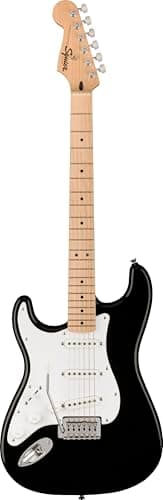
The cheapest electric that still has full-scale geometry, sealed tuners and a real 9.5 inch fingerboard radius. Nothing about it will make a beginner's first year harder.
Published specifications
- Scale length:
- 25.5" (647.7 mm) — full size
- Body / neck:
- Poplar body, maple neck, "C" profile
- Fingerboard:
- Maple or Indian laurel, 9.5" (241 mm) radius
- Frets:
- 21, narrow tall
- Nut width:
- 1.650" (42 mm), synthetic bone
- Pickups:
- Three ceramic single-coils (SSS)
- Bridge:
- 6-saddle vintage-style synchronized tremolo
What it gets right
- Full 25.5 inch scale, so nothing learned here has to be relearned later
- Synthetic bone nut rather than a soft plastic one — the part that decides whether a cheap guitar stays in tune
- Sealed-gear tuners, which is the single most important spec on a first electric
Where it gives ground
- Poplar body and ceramic pickups are exactly what you would expect at this tier
- The tremolo bridge will pull the guitar out of tune if a beginner uses it, and beginners always use it
What it is not good at
Staying in tune if you use the whammy bar. If that matters, buy the hardtail (HT) version of the same guitar instead — it is the identical instrument with the tremolo deleted.
How the specs score against a beginner’s needs
Scores are our reading of the published specifications above against what a beginner physically needs. They are not test results — we have not played this instrument.
Specifications from Squier Wiki — Sonic Stratocaster specifications.
Epiphone Power Players Les Paul
EpiphoneBest for: Ages roughly 8-13
A 22.73 inch scale on a mahogany body with two real humbuckers, and a gig bag, strap, cable and picks in the box. The short scale is the whole point: it is reachable.
Published specifications
- Scale length:
- 22.73" — 3/4+ size
- Body / neck:
- Mahogany body, bolt-on mahogany neck, SlimTaper D profile
- Frets:
- 22, sculpted heel for upper-fret access
- Pickups:
- Epiphone 650R (neck) and 700T (bridge) humbuckers
- Bridge:
- LightningBar compensated wrap-around
- In the box:
- Gig bag, strap, picks, guitar cable
What it gets right
- A wrap-around bridge has nothing to knock out of tune — the right choice for a kid's guitar
- Mahogany body and neck rather than the plywood usual at this size
- Ships with the accessories that otherwise cost another chunk on top
Where it gives ground
- Les Pauls are dense, and even a 3/4+ one has weight a small child will notice on a strap
- Humbuckers only — no bright, clean single-coil sound available
What it is not good at
Very small children. At 3/4+ this suits roughly age 8 upward; a five-year-old needs the smaller scale of a Squier Mini or a Loog.
How the specs score against a beginner’s needs
Scores are our reading of the published specifications above against what a beginner physically needs. They are not test results — we have not played this instrument.
Specifications from Epiphone (Gibson) — Power Players Les Paul.
Squier Mini Stratocaster
Squier by FenderBest for: Ages roughly 6-12
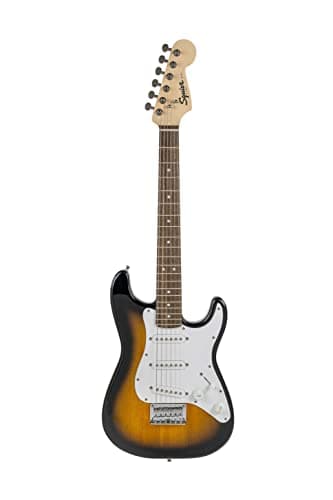
A 22.75 inch scale, 20 frets and a hardtail bridge. Fender's own sizing guidance puts it at roughly ages 6 to 12, and the fixed bridge removes the main way a child detunes a guitar.
Published specifications
- Scale length:
- 22.75" (578 mm) — 3/4 size
- Frets:
- 20
- Body / neck:
- Laminated hardwood body, maple neck, "C" profile
- Fingerboard:
- 9.5" radius
- Nut width:
- 1.6" (40.6 mm), synthetic bone
- Pickups / bridge:
- Three single-coils, 5-way switch, 6-saddle hardtail
- Detail:
- Smaller strap pins, side-mounted output jack
What it gets right
- Hardtail bridge — no tremolo to pull it out of tune, which matters more than any other spec on a child's guitar
- The narrower 1.6 inch nut is genuinely easier for small fingers than a full-size 1.65 inch
- Side-mounted jack and smaller strap pins are real design thought, not a shrunk adult guitar
Where it gives ground
- Laminated hardwood body — it is built to a price and it looks it up close
- 20 frets, so a couple of notes at the top of the neck simply are not there
What it is not good at
Growing with the player. A child who sticks with it will outgrow the 22.75 inch scale in a couple of years, and that is the expected outcome, not a defect.
How the specs score against a beginner’s needs
Scores are our reading of the published specifications above against what a beginner physically needs. They are not test results — we have not played this instrument.
Specifications from Squier Wiki — Mini Stratocaster specifications.
Questions people actually ask
What is guitar scale length?
The vibrating length of the string, measured from the nut to the bridge saddle. It sets how far apart the frets are and, at a given tuning, how much tension the strings sit under.
Is 24.75 or 25.5 inches better for beginners?
Neither is better, and the shorter 24.75 inch scale is slightly easier: lower string tension for the same tuning, so less force to fret and less effort to bend, with frets marginally closer together.
Does scale length change the sound?
A little. A longer scale is slightly brighter and tighter in the low end; a shorter one is slightly warmer and looser. It is a real difference and far smaller than the difference between pickup types.
What scale length should a child have?
Short. A 22.75 inch mini electric or a 3/4 acoustic around 22-23 inches suits most children aged roughly 8 to 12. The measurement that matters is whether the hand can span the frets, not the child’s age.
Sources
Still deciding?
Every recommendation on this site is built the same way, and the method is published in full — including what we do not do and what would get a pick dropped.
Read next
- Best guitars for small hands
Scale length and nut width explained as a reach problem, with picks for adults with small hands and for children.
- What size guitar does a child need?
Age and height chart with real scale lengths, the ten-second fit check, and why height beats age every time.
- Guitar body shapes, and which one fits you
What dreadnought, concert, parlor and jumbo actually change, and how to pick a shape by your body rather than by the sound.
- Best beginner electric guitars: what's worth it from $150 to $400
Segmented by player and price band, with the three specs that actually decide whether a first electric survives its first year.
- Best beginner guitar strings
Why gauge outranks brand, the default set for electric and acoustic, and when going lighter actually helps.