Guitars
Guitar body shapes, and which one fits you
Body shape is the specification most likely to make a guitar uncomfortable, and the one buying guides skip because it does not photograph as a number.
By Sawyer V. · Published · Last updated

Acoustic guitar buying guides publish scale length, nut width and top material, and then describe body shape with adjectives. That is backwards. Shape is the specification most likely to make an instrument physically uncomfortable, and discomfort in month one is the leading cause of guitars going back in the case permanently.
Bigger body means more volume and more bass, and more instrument to reach around. For most beginners a concert or auditorium body is the comfortable default; a dreadnought suits full-size players who strum; a parlor suits fingerpicking and quiet playing. Scale length does not change between them.
The shapes, and what each one does
| Shape | Size | Sound | Suits |
|---|---|---|---|
| Parlor | Smallest full-scale body | Quiet, focused, light on bass | Fingerstyle, blues, playing alone |
| Concert | Small, narrow waist | Balanced, clear mids | Most beginners, smaller players |
| Auditorium / grand auditorium | Medium | Even across the range | Players who both strum and pick |
| Dreadnought | Large, deep, square shoulders | Loud, strong bass | Strumming, singing over it, playing with others |
| Jumbo | Largest | Loudest, biggest low end | Heavy strumming, large players |
The dreadnought default, and why it exists
The dreadnought is the shape most people picture when they picture an acoustic guitar, and it is what the majority of beginner instruments are, including the Yamaha FG800#ad and the Fender CD-60S#ad.
That is not an accident of fashion. A dreadnought is loud, has a strong low end, and cuts through when someone is singing over it or when there is a second instrument in the room. For strumming songs, which is what most beginners actually do, it is a sensible default.
The cost is size. Square shoulders and a deep body mean the strumming arm has to come up and over a large box, and a player with a shorter reach ends up hunching. Nobody warns adults about this because everybody assumes an adult fits a full-size guitar, which is true of the neck and not always true of the body.
How to tell whether the shape fits you
Sit down with the guitar in playing position and check three things.
Where does your forearm land? It should rest naturally on the upper bout with the shoulder relaxed. If the shoulder has to lift to get the arm over the body, the box is too deep for you.
Can you see the fretboard without leaning? Leaning forward over the top of a large-bodied guitar to see your left hand is a posture problem that becomes a back problem.
Does the guitar stay put? A body that is too big for you tends to slide and gets clamped in place by the right arm, which then cannot strum freely.
None of those improve with practice. They are fit problems, and the fix is a different shape rather than more determination.
Shape versus size — not the same question
This is the most common confusion in the whole topic, so it is worth being explicit.
Body shape changes the depth and outline of the box. Scale length — the distance the strings vibrate over, which sets how far apart the frets are — is typically unchanged. A parlor and a dreadnought can both be full-scale instruments.
Fractional size shortens the scale itself, which brings the frets closer together for smaller hands. The Yamaha JR1 (FG Junior)#ad is a 3/4 size guitar, and that is a genuinely different instrument to a small-bodied full-scale one.
So: a small adult with a full-size hand span wants a smaller shape, not a fractional size. A child wants a fractional size. The sizing detail is in guitar sizes for kids and the scale length explanation is in guitar scale length explained.
Cutaways
A cutaway is the scoop in the upper body that lets the fretting hand reach the highest frets. It is a genuine convenience and a minor tonal cost — slightly less air in the box, marginally less bass.
For a beginner it is close to irrelevant, because nothing in the first year happens above the twelfth fret. Do not pay extra for one and do not avoid a guitar that has one.
Electric guitar shapes are a different argument
On a solid-body electric, shape has almost no effect on sound, because the sound comes from the strings and the pickups rather than from a resonating box.
What it does change is weight, balance and whether the guitar stays where you put it. A double-cutaway body with a long upper horn balances well on a strap; some single-cutaway shapes are heavier and can dive at the headstock. Both matter more than they sound, and neither affects the notes.
The electric choices themselves are in best beginner electric guitars.
What we would buy
Yamaha FG800
YamahaBest for: Buy once, acoustic
A solid Sitka spruce top with scalloped bracing at the entry price. Solid-versus-laminate is the one acoustic spec that changes what the instrument does over years, and this is the cheapest place to get it done right.
Published specifications
- Top:
- Solid Sitka spruce
- Back / sides:
- Nato / okume
- Neck / fingerboard:
- Nato neck, rosewood fingerboard, R400 mm (23-5/8") radius
- Scale length:
- 650 mm (25-9/16")
- Nut width:
- 43 mm (1-11/16")
- Bracing:
- Scalloped
- Body:
- Traditional Western (dreadnought), 412 mm (16-1/4") wide, 100-118 mm deep
- Hardware:
- Die-cast chrome tuners, urea nut and saddle
What it gets right
- A solid top, not a laminate — the only acoustic spec at this price that genuinely changes over time
- Scalloped bracing and die-cast tuners are specifications you normally pay considerably more for
- Yamaha's most-copied entry acoustic; parts, setups and advice are everywhere
Where it gives ground
- A full dreadnought body is a big box — 412 mm across and up to 118 mm deep
- Nato and okume back and sides are the cost saving; the top is where the money went
What it is not good at
Fitting a smaller player. The dreadnought body is wide and deep enough that a young teenager can struggle to get their arm over it comfortably. If that is the buyer, look at the JR1 or a concert-size body instead.
How the specs score against a beginner’s needs
Scores are our reading of the published specifications above against what a beginner physically needs. They are not test results — we have not played this instrument.
Specifications from Yamaha Europe — FG/FS800 series specifications.
Fender CD-60S
FenderBest for: Easiest acoustic to fret
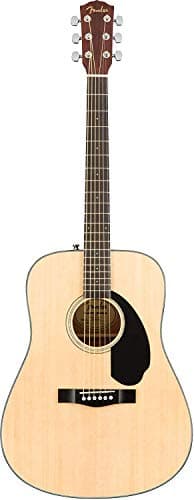
Solid spruce top, mahogany back and sides, and rolled fingerboard edges on a slightly shorter 25.3 inch scale. The rolled edges are the reason to pick this one.
Published specifications
- Top:
- Solid spruce
- Back / sides:
- Mahogany
- Scale length:
- 25.3" (643 mm)
- Nut width:
- 1.69" (43 mm)
- Fingerboard:
- 12" radius, 20 frets, rolled edges
- Bracing:
- Quartersawn scalloped "X"
- Neck:
- Fender "Easy-to-Play" shape
What it gets right
- Rolled fingerboard edges remove the sharp edge that makes a new player's hand hurt after twenty minutes
- Solid spruce top at the same tier as the FG800, with mahogany rather than nato back and sides
- The 25.3 inch scale is slightly shorter than most dreadnoughts — marginally lower string tension
Where it gives ground
- Still a full dreadnought body, so the size objection is the same as the FG800's
- The 12 inch fingerboard radius is quite round compared with the FG800's flatter 400 mm
What it is not good at
Being obviously better than the FG800. These two are genuinely close, they trade blows on back-and-sides wood versus bracing, and anyone telling you one is clearly superior has not looked at the spec sheets.
How the specs score against a beginner’s needs
Scores are our reading of the published specifications above against what a beginner physically needs. They are not test results — we have not played this instrument.
Specifications from Fender — CD-60S Dreadnought.
Yamaha JR1 (FG Junior)
YamahaBest for: 3/4 acoustic, ages 7-11
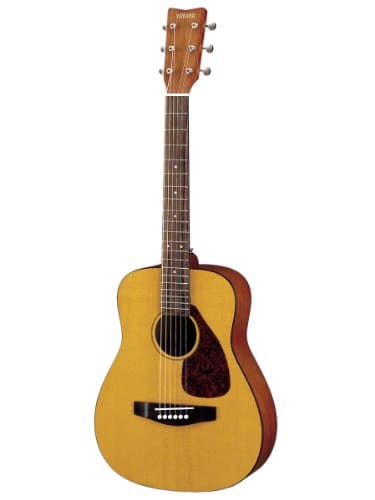
A 540 mm scale on a body 389 mm long and 317 mm across, with a gig bag included. It is a scaled-down FG, not a toy that happens to be small.
Published specifications
- Scale length:
- 540 mm (21-1/4") — 3/4 size
- Nut width:
- 43 mm (1-11/16")
- Top:
- Spruce (laminate)
- Back / sides:
- Meranti
- Neck / fingerboard:
- Nato neck, rosewood fingerboard and bridge
- Body:
- 389 mm long, 317 mm wide, 80-90 mm deep; 845 mm overall
- In the box:
- Gig bag
What it gets right
- The body is genuinely small — 317 mm across against the FG800's 412 mm, which is what actually decides whether a child can hold it
- Full 43 mm nut width despite the short scale, so chord shapes are not cramped
- Gig bag included, which on a child's instrument is not an accessory but a requirement
Where it gives ground
- Laminate spruce top, unlike the solid-top FG800 — this is the compromise for the size and price
- Meranti back and sides are basic
What it is not good at
Being a lifetime instrument. This is deliberately a stepping stone; a child who keeps playing moves to a full-size body in a few years and this one becomes the travel guitar.
How the specs score against a beginner’s needs
Scores are our reading of the published specifications above against what a beginner physically needs. They are not test results — we have not played this instrument.
Specifications from Yamaha USA shop — JR1 3/4 size acoustic guitar.
Questions people actually ask
What is the most comfortable acoustic guitar body shape?
Concert and auditorium bodies, for most people. They keep full scale length while being shallower and narrower at the waist than a dreadnought, so the strumming arm sits in a more natural position and there is less box to reach around.
Is a dreadnought too big for a beginner?
Not for a full-size adult, and often yes for a smaller player. The scale length is the same either way — what changes is the depth and width of the box, which is a comfort problem rather than a reach problem.
What is a parlor guitar good for?
Fingerstyle, blues, singing quietly, and sitting on a sofa. A small body produces less volume and less bass, which sounds like a downside and is genuinely pleasant for playing alone in a room.
Does body shape change the sound much?
Yes, mostly in the low end. A bigger box moves more air and produces more bass and more volume. It does not make a guitar objectively better, and a smaller body is frequently the more useful instrument for a beginner playing alone.
Sources
Still deciding?
Every recommendation on this site is built the same way, and the method is published in full — including what we do not do and what would get a pick dropped.
Read next
- Best beginner acoustic guitars: solid tops from $200 to $350
Solid versus laminate tops, the dreadnought body-size problem, and picks for adults and children separately.
- Best guitars for small hands
Scale length and nut width explained as a reach problem, with picks for adults with small hands and for children.
- Guitar scale length, and why it matters
What scale length is, how 25.5 and 24.75 inches actually feel different, and why it matters more than body size for smaller hands.
- Best guitars for adult beginners
Why adults should skip the entry tier, four picks covering electric and acoustic, and the body size question nobody warns adults about.
- What size guitar does a child need?
Age and height chart with real scale lengths, the ten-second fit check, and why height beats age every time.