Guitars
Solid top or laminate for a first acoustic?
It is the single largest price step in a beginner acoustic guitar, and the reason is three thin layers of glue.
By Sawyer V. · Published · Last updated
Somewhere in the middle of the beginner acoustic price range there is a step, and it is the step from a laminate top to a solid one. Above it, guitars start being described with words like “opens up.” Below it, they are described by their features.
The physical difference is small and the consequence is not.
A solid top is one piece of wood and vibrates as a single unit, so it sounds fuller and gets better over years of playing. A laminate top is thin layers glued together, sounds flatter, does not improve, and is far more resistant to cracking. Buy solid if the budget reaches it; buy laminate deliberately for a child, a travel guitar or a dry house.
Why the top is the part that matters
On an acoustic guitar, the strings produce almost no audible sound by themselves. They drive the bridge, the bridge drives the soundboard, and the soundboard — the top — moves air. It is the loudspeaker of the instrument.
The back and sides matter far less, which is why manufacturers make them from laminate even on guitars with solid tops. That is not a cost-cutting compromise being hidden from you; it is where the money should go.
So when a spec sheet says “solid spruce top, laminate mahogany back and sides,” as the Yamaha FG800#ad does, that is the correct allocation of a beginner budget rather than a corner being cut.
What solid wood does
It vibrates as one piece. A single sheet of spruce flexes freely. A laminate is three thin layers with glue between them, and the glue lines damp the vibration — less energy makes it into the air, and the sound is correspondingly flatter.
It improves. This is the part that sounds like folklore and is well documented by anyone who has owned one instrument for a decade. Playing a solid-top guitar changes it over years: the sound becomes fuller and more responsive. A laminate top does not do this. It is as good on day one as it will ever be.
It is more responsive to how you play. A lighter touch produces a proportionally quieter sound, and a hard strum opens up. Laminate compresses that range, which makes it more forgiving and less expressive.
What laminate does better
Being honest about this matters, because laminate gets written about as though it were simply the cheap option.
It survives humidity. Solid wood expands and contracts with the moisture in the air, and when it shrinks against braces that do not, it cracks. Laminate’s alternating grain directions make it dramatically more stable. A solid-top guitar left in a dry, centrally heated room through a winter is at real risk; a laminate one mostly is not. The full care picture is in guitar maintenance.
It survives being knocked about. Layered construction is tougher against dents and impacts.
It is cheaper, which means the same budget buys better hardware elsewhere — and tuners that hold pitch matter more to a beginner than a resonant top does.
That combination is exactly why the Yamaha JR1 (FG Junior)#ad is laminate, and why we do not treat that as a mark against it in guitar sizes for kids. A child’s guitar that lives on a bedroom floor and gets outgrown in two years has no use for a top that improves over ten.
How to tell them apart
Look into the soundhole at the edge of the top. On a solid top, the grain you see on the outside continues through the cross-section as one piece. On a laminate, you can see thin horizontal lines where the layers are stacked, often with a different-colored inner ply.
Read the spec sheet carefully. Manufacturers who use solid wood say so, every time, because it is a selling point. “Spruce top” means laminate. “Solid spruce top” means solid. The omission is deliberate.
Ignore the finish and the trim. Gloss, binding and rosette decoration tell you nothing about the top, and inexpensive guitars are frequently dressed to look like more.
Which to buy
Buy solid if the player is an adult or a teenager who will keep the guitar, if the house is not extremely dry, and if the budget reaches it. The Yamaha FG800#ad and the Fender CD-60S#ad are both solid-top instruments and both sit in our buy-once band for exactly this reason.
Buy laminate if the guitar is for a child, if it will travel or live in a difficult environment, or if the budget is genuinely tight and you would rather spend the difference on tuners and a setup. That is a considered choice, not a compromise.
What a solid top does not fix: a high action, slipping tuners, or a bad setup. A well set-up laminate guitar is easier to play and more likely to keep a beginner practicing than a badly set-up solid-top one. Where that line sits is in are cheap guitars worth it.
What we would buy
Yamaha FG800
YamahaBest for: Buy once, acoustic
A solid Sitka spruce top with scalloped bracing at the entry price. Solid-versus-laminate is the one acoustic spec that changes what the instrument does over years, and this is the cheapest place to get it done right.
Published specifications
- Top:
- Solid Sitka spruce
- Back / sides:
- Nato / okume
- Neck / fingerboard:
- Nato neck, rosewood fingerboard, R400 mm (23-5/8") radius
- Scale length:
- 650 mm (25-9/16")
- Nut width:
- 43 mm (1-11/16")
- Bracing:
- Scalloped
- Body:
- Traditional Western (dreadnought), 412 mm (16-1/4") wide, 100-118 mm deep
- Hardware:
- Die-cast chrome tuners, urea nut and saddle
What it gets right
- A solid top, not a laminate — the only acoustic spec at this price that genuinely changes over time
- Scalloped bracing and die-cast tuners are specifications you normally pay considerably more for
- Yamaha's most-copied entry acoustic; parts, setups and advice are everywhere
Where it gives ground
- A full dreadnought body is a big box — 412 mm across and up to 118 mm deep
- Nato and okume back and sides are the cost saving; the top is where the money went
What it is not good at
Fitting a smaller player. The dreadnought body is wide and deep enough that a young teenager can struggle to get their arm over it comfortably. If that is the buyer, look at the JR1 or a concert-size body instead.
How the specs score against a beginner’s needs
Scores are our reading of the published specifications above against what a beginner physically needs. They are not test results — we have not played this instrument.
Specifications from Yamaha Europe — FG/FS800 series specifications.
Fender CD-60S
FenderBest for: Easiest acoustic to fret
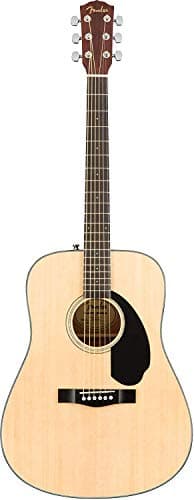
Solid spruce top, mahogany back and sides, and rolled fingerboard edges on a slightly shorter 25.3 inch scale. The rolled edges are the reason to pick this one.
Published specifications
- Top:
- Solid spruce
- Back / sides:
- Mahogany
- Scale length:
- 25.3" (643 mm)
- Nut width:
- 1.69" (43 mm)
- Fingerboard:
- 12" radius, 20 frets, rolled edges
- Bracing:
- Quartersawn scalloped "X"
- Neck:
- Fender "Easy-to-Play" shape
What it gets right
- Rolled fingerboard edges remove the sharp edge that makes a new player's hand hurt after twenty minutes
- Solid spruce top at the same tier as the FG800, with mahogany rather than nato back and sides
- The 25.3 inch scale is slightly shorter than most dreadnoughts — marginally lower string tension
Where it gives ground
- Still a full dreadnought body, so the size objection is the same as the FG800's
- The 12 inch fingerboard radius is quite round compared with the FG800's flatter 400 mm
What it is not good at
Being obviously better than the FG800. These two are genuinely close, they trade blows on back-and-sides wood versus bracing, and anyone telling you one is clearly superior has not looked at the spec sheets.
How the specs score against a beginner’s needs
Scores are our reading of the published specifications above against what a beginner physically needs. They are not test results — we have not played this instrument.
Specifications from Fender — CD-60S Dreadnought.
Yamaha JR1 (FG Junior)
YamahaBest for: 3/4 acoustic, ages 7-11
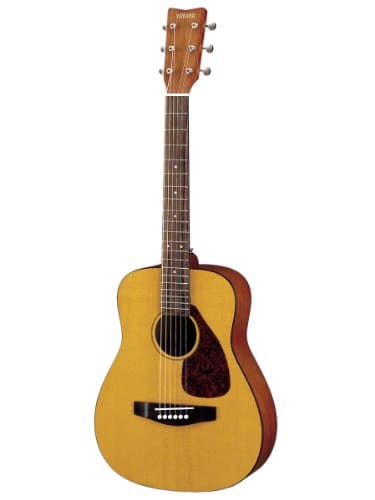
A 540 mm scale on a body 389 mm long and 317 mm across, with a gig bag included. It is a scaled-down FG, not a toy that happens to be small.
Published specifications
- Scale length:
- 540 mm (21-1/4") — 3/4 size
- Nut width:
- 43 mm (1-11/16")
- Top:
- Spruce (laminate)
- Back / sides:
- Meranti
- Neck / fingerboard:
- Nato neck, rosewood fingerboard and bridge
- Body:
- 389 mm long, 317 mm wide, 80-90 mm deep; 845 mm overall
- In the box:
- Gig bag
What it gets right
- The body is genuinely small — 317 mm across against the FG800's 412 mm, which is what actually decides whether a child can hold it
- Full 43 mm nut width despite the short scale, so chord shapes are not cramped
- Gig bag included, which on a child's instrument is not an accessory but a requirement
Where it gives ground
- Laminate spruce top, unlike the solid-top FG800 — this is the compromise for the size and price
- Meranti back and sides are basic
What it is not good at
Being a lifetime instrument. This is deliberately a stepping stone; a child who keeps playing moves to a full-size body in a few years and this one becomes the travel guitar.
How the specs score against a beginner’s needs
Scores are our reading of the published specifications above against what a beginner physically needs. They are not test results — we have not played this instrument.
Specifications from Yamaha USA shop — JR1 3/4 size acoustic guitar.
Questions people actually ask
Is a solid top guitar worth it for a beginner?
Usually yes, if the budget reaches it. A solid top is the one acoustic specification that keeps paying off — it sounds better new and continues improving with playing, where a laminate top stays where it started.
How can you tell if a guitar top is solid or laminate?
Look at the edge of the soundhole. A solid top shows continuous grain running through the thickness of the wood; a laminate shows thin horizontal lines where the layers meet. Manufacturers also state it, and any spec sheet that does not say “solid” is almost certainly laminate.
Do laminate guitars sound bad?
No. They sound flatter and less resonant than a comparable solid top, and a good laminate guitar is a perfectly enjoyable instrument. The difference is real and it is smaller than enthusiasts suggest.
Is laminate ever better than solid?
For durability, yes. Laminate barely responds to humidity swings, so it does not crack the way a solid top can. For a child, a travel guitar, or a house with no humidity control, that is a genuine advantage.
Sources
Still deciding?
Every recommendation on this site is built the same way, and the method is published in full — including what we do not do and what would get a pick dropped.
Read next
- Best guitar humidifiers
Solid top or laminate decides whether you need one at all. Two-way against refillable, why a sealed case is non-negotiable, and three humidifiers on published specifications.
- Best beginner acoustic guitars: solid tops from $200 to $350
Solid versus laminate tops, the dreadnought body-size problem, and picks for adults and children separately.
- Are cheap guitars worth it?
The line between cheap and too cheap, named part by part, with what each failure does to a beginner who cannot diagnose it.
- Guitar maintenance a beginner actually needs
The four jobs that matter, the humidity problem that ruins acoustics, and an honest list of what you can safely ignore.
- How much should a beginner guitar cost?
Four price bands defined by specification rather than by number, plus the hidden costs that turn a $200 budget into a $270 purchase.
- Guitar body shapes, and which one fits you
What dreadnought, concert, parlor and jumbo actually change, and how to pick a shape by your body rather than by the sound.