Ukuleles
Best ukuleles for kids
A child's ukulele has one job before it has any others: stay in tune between Tuesday and Thursday. Everything else is negotiable.
By Sawyer V. · Published · Last updated
The ukulele is the best first instrument for a young child by a comfortable margin, and the reasons are entirely physical rather than musical. Nylon strings at low tension mean a four-year-old’s fingers can press them. A soprano body is about 21 inches long, so it can be held without help. And several usable chords need one finger, which means a real song in the first week.
That combination is unique. A guitar demands more strength and a bigger reach; a keyboard requires sitting still at a fixed station; drums require reaching four things at once. Our full cross-instrument comparison for a child is in the best first instrument for a child.
The one job: staying in tune
A child cannot tune an instrument and cannot tell an out-of-tune instrument from their own mistake. So a ukulele that drifts teaches a child, week after week, that the sounds they make are wrong. There is no more efficient way to end a young child’s interest in music.
Two things cause drift. Friction tuners — plain pegs held by friction alone — slip under nylon strings, which stretch far more than steel. And a molded plastic nut binds the string so tuning happens in jumps. Both picks here have geared tuners and a proper nut.
The humidity problem nobody warns you about
This is the argument for a composite body, and it is more practical than it sounds.
A thin wooden soundboard responds to moisture in the air. In a dry house in winter — central heating, no humidifier — the wood shrinks. On a well-built instrument it survives. On an inexpensive one with thin bracing and rushed glue joints, a seam opens or the top develops a crack, and the instrument is finished.
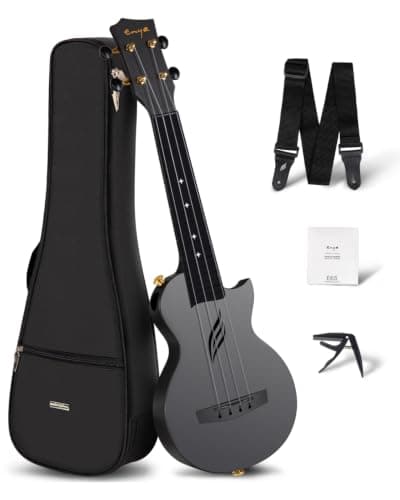
The Enya Nova U Mini’s carbon-fiber and polycarbonate body simply does not participate in any of that. It is also water resistant, which for an instrument owned by a six-year-old is not a theoretical benefit.
The honest cost is tone. A composite body sounds noticeably less warm than mahogany, and it will never improve. If the child is seven or older, careful with their things, and the house is not brutally dry, the Kala is the better instrument. If they are four, the Enya is.
What to skip
Anything sold in the toy aisle. The tell is nylon strings on an instrument with no adjustable tuners and no stated scale length. These are shaped like ukuleles and cannot be tuned to pitch at all — the child plays something that is not music and cannot be made into music.
Ukulele bundles under $30. The bag, strap, tuner, capo and spare strings are worth about $20 retail, so the instrument itself has cost almost nothing. Buy a $65 ukulele and a $12 clip-on tuner instead; it is a better outcome for barely more money.
What to buy alongside
A clip-on tuner, absolutely non-negotiable for a child. Roughly $12, clips to the headstock, reads the pitch from the vibration of the wood. It also means an adult who does not play can tune the instrument in twenty seconds, which is what makes it get tuned regularly.
A stand, for the same reason as with every instrument: one that lives on a stand in the corner gets picked up several times a day, and one that lives in a bag under a bed gets picked up on lesson day. Full accessory list in what comes with a ukulele.
Buying a whole set rather than one instrument is a different problem — durability and tuning stability start to outrank tone, and nobody is going to manage humidity. That is in best ukuleles for classrooms and groups.
Quick picks
Ages roughly 4 to 8, or any house that is hard on instruments
Composite body, 430 grams, water resistant. It ignores the humidity swings that crack cheap wooden ukuleles and it survives being carried around by the neck.
| # | Product | Best for | Score | Price |
|---|---|---|---|---|
| 1 | Enya Nova U MiniA 21 inch carbon-fiber-and-polycarbonate body weighing 430 grams. | Young kids, survives anythingThe honest floor | 8.0 | $59.14 · View on Amazon #ad How we’re funded |
Ages roughly 7 and up, if tone matters
Solid mahogany with a bone-substitute nut. It sounds considerably better and it needs to live somewhere with stable humidity.
| # | Product | Best for | Score | Price |
|---|---|---|---|---|
| 1 | 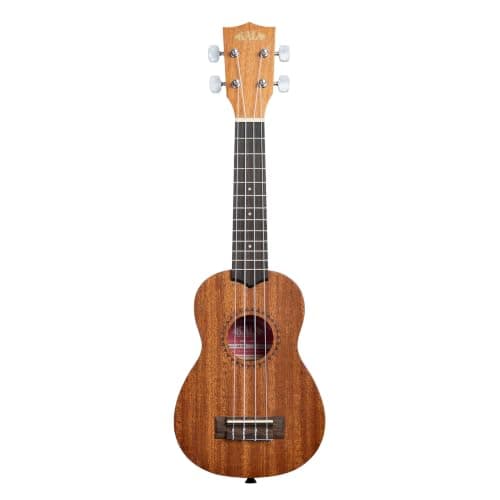 Kala KA-15SMahogany throughout, a GraphTech NuBone nut and saddle, and Aquila strings fitted from the factory. | The honest floor, sopranoThe honest floor | 8.7 | $69.00 · View on Amazon #ad How we’re funded |
The picks in full
Enya Nova U Mini
EnyaBest for: Young kids, survives anything
A 21 inch carbon-fiber-and-polycarbonate body weighing 430 grams. It is water resistant and it does not care about humidity, which is the honest reason to buy it for a six-year-old.
Published specifications
- Size:
- Soprano, 21"
- Top / back / sides:
- 30% carbon fiber and polycarbonate composite
- Weight:
- 430 g (0.9 lb)
- Overall length:
- 22"
- Nut width:
- 1-3/8"
- Body:
- Arched back, radius fretboard, cutaway
- In the box:
- Semi-hard case, strap, capo, spare strings
What it gets right
- Composite body — it does not crack in a dry house or swell in a damp one, which is what actually kills cheap wooden ukuleles
- 430 grams; a five-year-old can carry it around by the neck all day, and they will
- Case, strap, capo and spare strings included
Where it gives ground
- It does not sound like wood, and no amount of playing will change that
- The composite body is a fixed quantity — there is no breaking-in and no improvement over time
What it is not good at
Tone. A mahogany Kala sounds warmer and fuller, plainly. You are buying survivability, and that is a legitimate thing to buy for a young child, but be clear that is the trade.
How the specs score against a beginner’s needs
Scores are our reading of the published specifications above against what a beginner physically needs. They are not test results — we have not played this instrument.
Specifications from Enya Music — Nova carbon fiber ukulele collection.
Kala KA-15S
Kala Brand MusicBest for: The honest floor, soprano
Mahogany throughout, a GraphTech NuBone nut and saddle, and Aquila strings fitted from the factory. The nut material is the spec that separates this from the pile of look-alikes.
Published specifications
- Size:
- Soprano
- Top / back / sides:
- Mahogany
- Neck / fretboard:
- Mahogany neck, rosewood fretboard
- Nut and saddle:
- GraphTech NuBone
- Scale length:
- 13.625"
- Frets:
- 12
- Nut width:
- 1.375"
- Overall length:
- 21.062"
- Strings:
- Aquila Super Nylgut
What it gets right
- NuBone nut and saddle rather than molded plastic — this is what decides whether the instrument plays in tune up the neck
- Aquila strings fitted at the factory, so the first thing you would otherwise replace is already done
- 21 inches overall and light enough for a small child to hold unsupported
Where it gives ground
- 12 frets only, and the body joint stops you well short of the high notes
- Soprano scale means less room between frets — adult fingers with wide fingertips will find it cramped
What it is not good at
Adult hands, sometimes. A 13.625 inch scale is genuinely tight. If the player is a grown-up with large hands, read our soprano-versus-concert comparison before buying this size.
How the specs score against a beginner’s needs
Scores are our reading of the published specifications above against what a beginner physically needs. They are not test results — we have not played this instrument.
Specifications from Kala Brand Music — KA-15S specifications.
Questions people actually ask
What age can a child start ukulele?
Around four or five for a soprano, which is genuinely earlier than any other stringed instrument. The reasons are physical: nylon strings under low tension need almost no finger strength, the body is small enough to hold unaided, and several chords need only one finger.
What size ukulele for a child?
Soprano, at 13.6 inches of scale and about 21 inches overall. This is the one instrument family where the standard small size is already child-appropriate, so there is no fractional sizing to work out.
Is a plastic ukulele any good?
A composite one is, and it is worth distinguishing that from a toy. A carbon-fiber and polycarbonate body will not crack in a dry house or swell in a damp one, which is what actually kills inexpensive wooden ukuleles. It does not sound like wood and no amount of playing will change that — you are trading tone for survivability, which for a young child is often the right trade.
Should I buy a colored kids ukulele?
Only from a manufacturer that also publishes the nut material and the scale length. A bright finish is not itself a warning sign, but a listing that leads with the color and never mentions the nut is telling you which specification it would rather not discuss.
Sources
Still deciding?
Every recommendation on this site is built the same way, and the method is published in full — including what we do not do and what would get a pick dropped.
Read next
- Best beginner ukuleles: what's worth it from $60 to $120
Segmented by hand size rather than price, with the nut-material spec that separates a real ukulele from a decoration.
- The best first instrument for a child
Instrument by instrument, the real starting age set by hand size and reach, with a pick for each and the noise column filled in.
- What comes with a ukulele, and what you still need
What is really in the box, what the bundle accessories are worth, and the three things you genuinely need.
- Best guitars for kids: sized by reach, not by age
Segmented by age band with real scale lengths and body dimensions, plus why buying big to grow into reliably backfires.
- How much should a beginner ukulele cost?
Four bands from $30 to $200, defined by nut material and tuner type rather than by brand, with the accessory list included.