Ukuleles
How to hold and strum a ukulele
Almost every beginner strums in the wrong place with too much force, and the instrument sounds harsh as a result. Both are five-minute fixes.
By Sawyer V. · Published · Last updated

The ukulele has an unusually short path from nothing to music: a couple of chords and a steady strum is a real song within a week. What gets in the way is almost never the chord shapes. It is the right hand.
A beginner who strums in the wrong place with too much force concludes that their instrument sounds cheap, which is often untrue and always discouraging.
Hold the ukulele against your chest with your forearm, not your hand. Strum with the index finger over the fretboard where the neck meets the body, not over the soundhole. Use much less force than feels natural — the instrument is small and does not need driving.
Holding it, sitting down
The ukulele is small enough that it has no natural resting place, which is why beginners grip it.
Rest it against your chest, high up, with the back of the body touching you. Your strumming forearm presses lightly against the lower edge to hold it in position. The strumming hand itself does not hold the instrument — that is the whole point, and it is what most beginners get wrong.
The fretting hand supports the neck from underneath with the thumb behind it, and it is not clamping. If your fretting hand is holding the ukulele up, you cannot change chords freely.
Angle the neck slightly upward rather than horizontal. It puts the fretting wrist at a more natural angle, which matters over a long session.
Standing up, and straps
Standing, there is nothing supporting the instrument except your arms, and the strumming arm ends up clamping the body to your ribs.
A clamped arm cannot strum loosely, so the sound goes hard and the wrist stops moving. This is the single most common reason a ukulele sounds harsh.
A strap fixes it completely. Ukulele straps come in two forms: a conventional strap needing buttons fitted, or a hook-style strap that loops through the soundhole and around the neck and needs no modification. For a beginner, the second is the easy answer — more on the small kit in ukulele accessories you actually need.
Children
Small children cannot hold an instrument against their chest with a forearm, because their arms are not long enough to reach around the body and still strum.
Sit them down and let the ukulele rest on their thigh, angled up, with the fretting hand on the neck. A Kala KA-15S#ad at roughly 21 inches overall is light enough that this works from about four or five. It is one of the main reasons the soprano size exists and why we recommend it in best ukuleles for kids.
Where to strum
Not over the soundhole. This is the thing nearly everyone does and it is worth changing on day one.
Strum over the fretboard, roughly where the neck joins the body. The string is under more tension there and the tone comes out warmer and rounder, which is the sound you actually want.
Over the soundhole is louder, brighter and harsher, and on an inexpensive instrument that harshness is exactly what makes it sound cheap. Moving your hand two inches is a free upgrade.
Closer to the bridge is brighter and thinner still — useful as a deliberate effect, not as a default.
What to strum with
Index finger. The standard. Nail catches the strings on the downstroke, the fleshy pad catches them on the upstroke, and the two sounds differ slightly, which is part of what makes a strum feel alive.
Thumb. Softer and warmer. Good for quiet playing and for accompanying singing without drowning yourself out.
Several fingers together. Fuller and less precise. Useful once the basic motion is reliable.
A felt pick, if you want a pick. Standard plastic guitar picks sound thin and clicky on nylon strings and can mark a soft top. Felt picks exist specifically for this instrument.
The motion
The strum comes from the wrist, not the elbow. Think of shaking water off your hand rather than sweeping your whole forearm.
Keep the hand relaxed and let it stay loose through the stroke. A tense hand produces a hard, uneven sound and gets tired.
Use far less force than feels correct. The ukulele is a small instrument with a light top and low string tension, and hitting it hard does not make it louder in any useful way — it makes it clatter. Nearly every beginner over-strums.
Four patterns that cover most songs
Write D for down and U for up, and count the beat as one-and-two-and-three-and-four-and.
1. All downs. D D D D, one per beat. Not a placeholder — it works, and getting four even downstrokes in time is a real skill.
2. Down-up. D U D U D U D U. Introduces the upstroke and doubles the rhythmic density.
3. The common one. D, D U, U D U. This single pattern fits an enormous amount of popular music and is worth drilling until it is automatic.
4. Island strum. D, D U, U D U with an emphasis that gives it a lilt. Same movement, different accent.
A useful trick for all of them: keep your hand moving continuously up and down in time, and simply miss the strings on the strokes you do not want. That keeps the rhythm steady and is how experienced players do it.
If it still sounds bad
It is out of tune. The most likely cause by a distance. See how to tune a ukulele.
You are pressing too hard on the frets. Excess pressure pushes the string sharp. Press just enough to stop the buzz and no more.
Your fingers are touching neighboring strings. Very common on a soprano with adult hands, and a genuine argument for a Cordoba 15CM#ad concert size — see best concert ukuleles.
The strings are old. Nylon goes false and stops playing in tune with itself. A fresh set of Aquila Super Nylgut ukulele strings#ad is the cheapest improvement available to any ukulele.
What we would buy
Kala KA-15S
Kala Brand MusicBest for: The honest floor, soprano
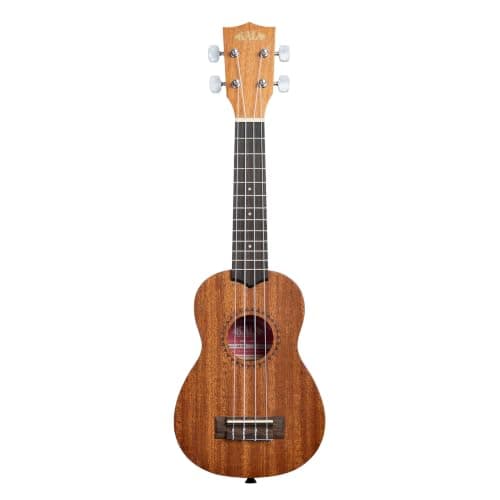
Mahogany throughout, a GraphTech NuBone nut and saddle, and Aquila strings fitted from the factory. The nut material is the spec that separates this from the pile of look-alikes.
Published specifications
- Size:
- Soprano
- Top / back / sides:
- Mahogany
- Neck / fretboard:
- Mahogany neck, rosewood fretboard
- Nut and saddle:
- GraphTech NuBone
- Scale length:
- 13.625"
- Frets:
- 12
- Nut width:
- 1.375"
- Overall length:
- 21.062"
- Strings:
- Aquila Super Nylgut
What it gets right
- NuBone nut and saddle rather than molded plastic — this is what decides whether the instrument plays in tune up the neck
- Aquila strings fitted at the factory, so the first thing you would otherwise replace is already done
- 21 inches overall and light enough for a small child to hold unsupported
Where it gives ground
- 12 frets only, and the body joint stops you well short of the high notes
- Soprano scale means less room between frets — adult fingers with wide fingertips will find it cramped
What it is not good at
Adult hands, sometimes. A 13.625 inch scale is genuinely tight. If the player is a grown-up with large hands, read our soprano-versus-concert comparison before buying this size.
How the specs score against a beginner’s needs
Scores are our reading of the published specifications above against what a beginner physically needs. They are not test results — we have not played this instrument.
Specifications from Kala Brand Music — KA-15S specifications.
Cordoba 15CM
CordobaBest for: Adult hands, concert size
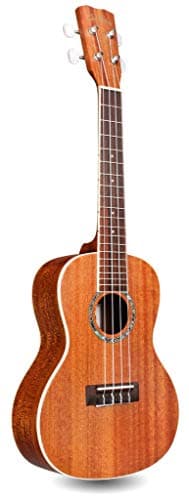
A 375 mm concert scale with 18 frets and a 35 mm nut. The extra inch and a bit of scale over a soprano is the difference between cramped and comfortable for most adults.
Published specifications
- Size:
- Concert
- Top / back / sides:
- Mahogany
- Fingerboard:
- Rosewood
- Scale length:
- 375 mm (14-3/4")
- Frets:
- 18
- Nut width:
- 35 mm (1-3/8")
- Body / overall:
- 280 mm body, 610 mm (24") overall
- Strings / finish:
- Aquila, satin finish, abalone rosette
What it gets right
- 18 frets against a soprano's 12 — a whole extra register that a soprano simply does not have
- The 375 mm scale gives noticeably more room between frets without becoming a tenor-sized instrument
- Aquila strings and an abalone rosette; it looks considerably more expensive than it is
Where it gives ground
- Identical 35 mm nut width to the Kala soprano — the extra room is between the frets, not across the neck
- 24 inches overall is a lot of instrument for a small child
What it is not good at
Sounding like a ukulele in the postcard sense. The concert body is fuller and rounder; the bright, plinky voice people picture is the soprano's.
How the specs score against a beginner’s needs
Scores are our reading of the published specifications above against what a beginner physically needs. They are not test results — we have not played this instrument.
Specifications from Cordoba Guitars — 15CM.
Aquila Super Nylgut ukulele strings
AquilaBest for: The cheapest real upgrade
The string set most good ukuleles ship with from the factory, and the single most transformative thing you can do to an inexpensive one that did not.
Published specifications
- Material:
- Super Nylgut synthetic
- Tuning:
- Standard GCEA
- Fits:
- Soprano, concert or tenor — buy the set for your size
What it gets right
- Louder and brighter than the generic nylon fitted to cheap ukuleles, with far more sustain
- They settle and hold pitch faster than plain nylon, which shortens the miserable first week of constant retuning
- Cheap enough that it is the obvious first upgrade on any instrument that did not come with them
Where it gives ground
- Sets are size-specific, and a soprano set on a tenor will not reach
- New strings of any kind stretch for a few days before they settle
What it is not good at
Fixing a bad instrument. New strings cure a dull sound; they do nothing for intonation error, which is built into the bridge position and cannot be strung out.
How the specs score against a beginner’s needs
Scores are our reading of the published specifications above against what a beginner physically needs. They are not test results — we have not played this instrument.
Specifications from Kala Brand Music — KA-15S, fitted with Aquila Super Nylgut from the factory.
Questions people actually ask
Where should you strum a ukulele?
Over the fretboard, roughly where the neck joins the body — not over the soundhole. Strumming over the hole is loud and harsh; over the fretboard is warmer and is where most experienced players actually strum.
Should you use a pick on a ukulele?
Usually not. Nylon strings and a light top are designed for fingers, and a hard plastic pick sounds thin and clicky. If you want one, use a felt pick, which is made for the instrument.
Do you need a strap for a ukulele?
Not for sitting, and it helps a great deal standing up. A strap frees the right arm from holding the instrument, which is the most common cause of a tense, harsh strum.
Which finger do you strum with?
The index finger, most commonly — nail on the way down, fleshy pad on the way up. Thumb-only strumming is softer and useful for quiet playing.
Sources
Still deciding?
Every recommendation on this site is built the same way, and the method is published in full — including what we do not do and what would get a pick dropped.
Read next
- Best beginner ukuleles: what's worth it from $60 to $120
Segmented by hand size rather than price, with the nut-material spec that separates a real ukulele from a decoration.
- How to tune a ukulele
GCEA explained, using a clip-on tuner, why new strings drift for a week, and when tuning is not the problem.
- Ukulele accessories you actually need
The three items that genuinely matter, the best cheap upgrade, and what a bundle is really padding with.
- Ukulele tunings, and which one to use
Standard GCEA, what re-entrant tuning does, high-G versus low-G, and the baritone exception that changes every chord shape.
- Best ukuleles for kids
Wood or composite, with the humidity problem that kills cheap wooden ukuleles in dry houses stated plainly.