Strings
Violin vs fiddle
The same wooden box, two traditions. The differences that matter are in the setup, the bowing and the room you learn in, not in the instrument you buy.
By Sawyer V. · Published · Last updated
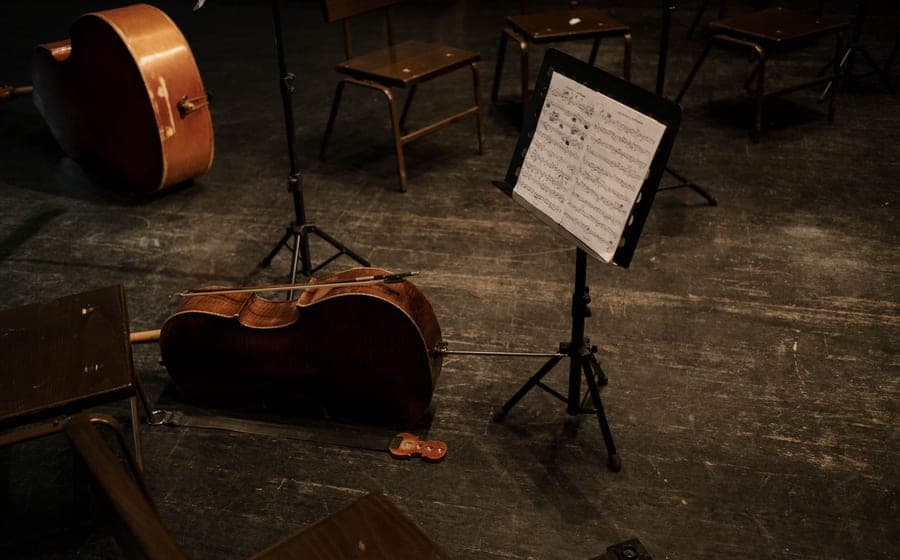
This is the most frequently asked question about the instrument, and it has a short answer: a fiddle is a violin. Same body, same four strings, same tuning of G, D, A and E, same bow. If you walk into a shop and ask for a fiddle you will be handed a violin.
The word describes a musical world rather than an object. That world differs enough that the question is worth more than a one-line answer.
Buy a violin either way, because that is what both words describe. If you know you want to play fiddle music, ask the shop for a slightly flatter bridge curve and fit steel-core strings with four fine tuners. Neither choice limits you; both are reversible in an afternoon.
What is genuinely identical
The instrument, the strings available for it, the tuning, the bow, the sizes, the way it is held, and the first six months of learning to make a clean sound. A beginner in either tradition spends that time on the same problems: bow parallel to the bridge, left hand relaxed, fingers landing in tune, and the same strings not sounding accidentally.
Anyone who tells you a fiddle is built differently is describing a setup choice, not a different instrument.
What actually differs
The bridge, sometimes. The top of a violin bridge is curved so the bow can reach one string at a time. Some fiddle players have that curve flattened slightly, which makes it easier to bow two strings together for drones and double stops, and slightly harder to play cleanly on one. It is a luthier job, not a purchase, and it is reversible.
The strings. Fiddle players often prefer steel-core sets: brighter, louder, very stable and cheaper. Classical players more often move to synthetic cores for warmth and complexity. Both fit any violin, and the comparison is in best violin strings for beginners.
Fine tuners. Four of them is the norm in fiddle playing and on student instruments generally; many classical players use one on the E and tune the rest with the pegs. This follows from the strings: steel cores need finer adjustment than synthetic.
The bowing. The biggest real difference, and it is technique. Fiddle styles use short, rhythmic, repeated patterns — the shuffle is the obvious example — where classical bowing prizes long, even, sustained strokes. The right arm is doing a different job.
How you learn. Classical teaching is built on reading notation from the first lesson. Fiddle traditions are largely taught by ear, at sessions and jams, by copying someone sitting opposite you. That difference shapes what your first year feels like more than any hardware.
Vibrato and ornaments. Classical playing builds vibrato early as part of the sound. Fiddle styles use it more sparingly and lean instead on cuts, rolls, slides and drones that are specific to each tradition.
Which one should a beginner choose?
Choose the music, and the rest follows. It is the same advice we give about instruments generally in what instrument should I learn.
Choose a classical start if the goal is orchestra, school strings, exams or reading written music. It is the more systematic route, and it makes the fiddle repertoire available later.
Choose a fiddle start if the goal is playing tunes with other people reasonably soon. Old-time and Irish sessions welcome beginners who can play three tunes slowly, which is a much shorter runway than an orchestra offers. If that is the appeal, the wider set of instruments in that world is in best bluegrass starter instruments.
Either way the honest warning is the same one we give in is violin hard to learn: this is the least forgiving instrument on the site in the first months, because nothing tells you where the notes are and the sound is entirely down to your bow arm.
What to buy
One instrument covers both, and at the student level the outfit matters more than the label. The Stentor Student II Violin Outfit#ad is the outfit we point people toward in best beginner violins: carved solid tonewoods, ebony fittings, a full range of fractional sizes, and a bow and case in the box.
Then make two cheap adjustments if fiddle music is the plan. Fit a steel-core set such as D'Addario Prelude violin set (4/4 medium)#ad, which is stable, bright and inexpensive. And ask a shop about the bridge curve when the instrument gets its setup — a small flattening is a few minutes of work and costs almost nothing when it is done alongside everything else.
What you should not do is buy a cheaper instrument because it is labeled a fiddle. The word is not a quality tier, and the same floor applies either way: it is in how much a beginner violin should cost.
What we would buy
Stentor Student II Violin Outfit
StentorBest for: First violin, every size
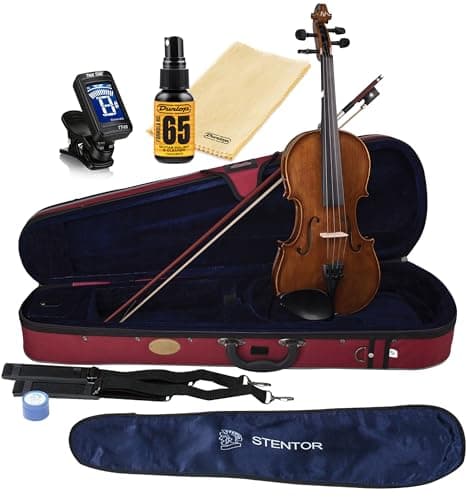
Solid carved spruce and maple with an ebony fingerboard, set up in a workshop before shipping, and made in five fractional sizes. The workshop setup is the specification that matters most on a beginner violin.
Published specifications
- Top:
- Solid carved spruce
- Back / sides:
- Solid figured maple
- Fingerboard:
- Ebony
- Pegs:
- Ebony or rosewood
- Sizes:
- 4/4, 3/4, 1/2, 1/4, 1/8
- Strings:
- Steel core, factory fitted
- Outfit:
- Wooden bow with ebony frog and natural horsehair, rosin, shaped lightweight case with music pocket and rucksack straps
What it gets right
- Ebony fingerboard and pegs, not stained hardwood — a stained fingerboard wears through and a soft peg will not hold a tuning
- Individually set up in a workshop before it ships, which is the single biggest variable on a cheap violin
- Available in five fractional sizes, so the same instrument family covers a child from about age five to adult
Where it gives ground
- The supplied steel-core strings are the first upgrade most teachers suggest
- The bow is functional rather than good; it is the second upgrade
What it is not good at
Being bought without measuring. Violin size is set by the player's arm length, not their age, and a violin one size too big is genuinely unplayable rather than merely awkward. Measure first.
How the specs score against a beginner’s needs
Scores are our reading of the published specifications above against what a beginner physically needs. They are not test results — we have not played this instrument.
Specifications from Stentor Music — Student II violin outfit.
D'Addario Prelude violin set (4/4 medium)
D'AddarioBest for: School and first-year players
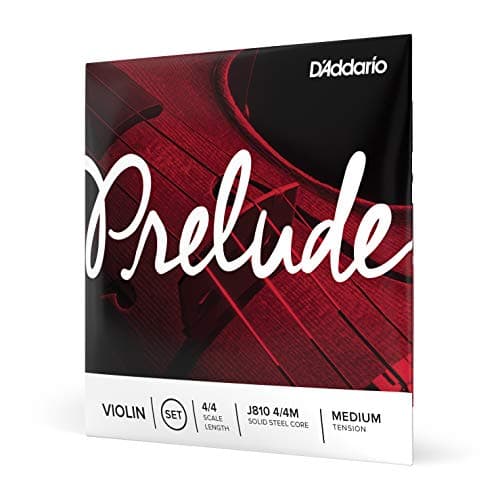
The steel-core set D'Addario itself calls the educator's choice. It is unaffected by temperature and humidity swings, which is the specification that matters for an instrument living in a school locker.
Published specifications
- Core:
- Solid steel core
- Windings:
- Aluminum-wound A; nickel-wound D and G; solid steel E (retailer spec sheet)
- End type:
- Ball end
- Size / tension:
- 4/4, medium (light and heavy also offered)
- Set:
- Four strings, E-A-D-G, also sold singly
- Stability:
- D'Addario: unaffected by temperature and humidity changes
- Gauges / tension in lb:
- Not published by D'Addario
What it gets right
- D'Addario states the steel core is unaffected by temperature and humidity swings — the reason school programs standardize on it
- Labeled by the maker as ideal for students and the educator's preferred choice
- Ball end and available in every fractional size from 1/16 to 4/4, so a whole section can run one brand
Where it gives ground
- Steel core is brighter and simpler than a synthetic-core set; D'Addario's own wording is the warmest sound available in a solid steel core design, not the warmest available
- No gauge figures or tension in pounds are published, so it cannot be tension-matched against other brands numerically
- Per-string winding materials are not on D'Addario's own page — the figures above come from a named retailer
What it is not good at
Tonal complexity. D'Addario positions Prelude as its student steel line and routes players wanting synthetic-core color to a different range.
How the specs score against a beginner’s needs
Scores are our reading of the published specifications above against what a beginner physically needs. They are not test results — we have not played this instrument.
Specifications from D'Addario — Prelude violin string set, 4/4 medium, D'Addario — orchestral string comparison guide (core types), Shar Music — Prelude per-string winding (retailer spec sheet).
Questions people actually ask
Is a fiddle the same as a violin?
The instrument is the same. The word describes what is being played and how: fiddle usually means folk, bluegrass, country, Irish or old-time music, and violin usually means classical. A shop selling you a fiddle is selling you a violin.
Is there any physical difference at all?
Sometimes, and it is setup rather than construction. Some fiddle players have the bridge shaped with a slightly flatter curve to make double stops easier, and many use steel-core strings and four fine tuners. All of that can be changed on any violin by a luthier.
Is fiddle easier to learn than violin?
The first year is equally hard, because the hard part is getting a decent sound and playing in tune, and that is identical. Fiddle traditions often teach by ear and put you in a group playing simple tunes sooner, which many beginners find more motivating.
Can I switch from one to the other?
Yes, and plenty of players do both. What transfers is everything physical. What has to be learned is style: the rhythmic drive, shuffle bowing patterns, ornaments and the habit of playing without written music.
Should a child learn classical first?
Only if that is the music they want to play. A classical start builds reading and technique thoroughly; a fiddle start builds ear and rhythm and gets a child playing with others sooner. Neither closes the other off.
Still deciding?
Every recommendation on this site is built the same way, and the method is published in full — including what we do not do and what would get a pick dropped.
Read next
- Best beginner violins: measure first, then buy
Arm-length sizing chart, why workshop setup is the spec that matters most, and one pick available in five sizes.
- Best instruments to start bluegrass on
What each instrument does in a bluegrass band, which are easiest to start, and a pick for the three most accessible seats.
- Is the violin hard to learn?
The two skills that have to be built simultaneously, a realistic stage-by-stage timeline, and the four things that make it easier.
- How to hold a violin and bow
Instrument position, the shoulder rest question, a bow hold that stays relaxed, and why the bow must stay parallel to the bridge.
- Best beginner mandolins
A-style versus F-style, why a carved solid top matters more here than on a guitar, and the setup a mandolin needs.