Start Here
Learning an instrument alongside your child
A parent who practices is worth more than a parent who reminds, and the difference shows up within the first month.
By Sawyer V. · Published · Last updated
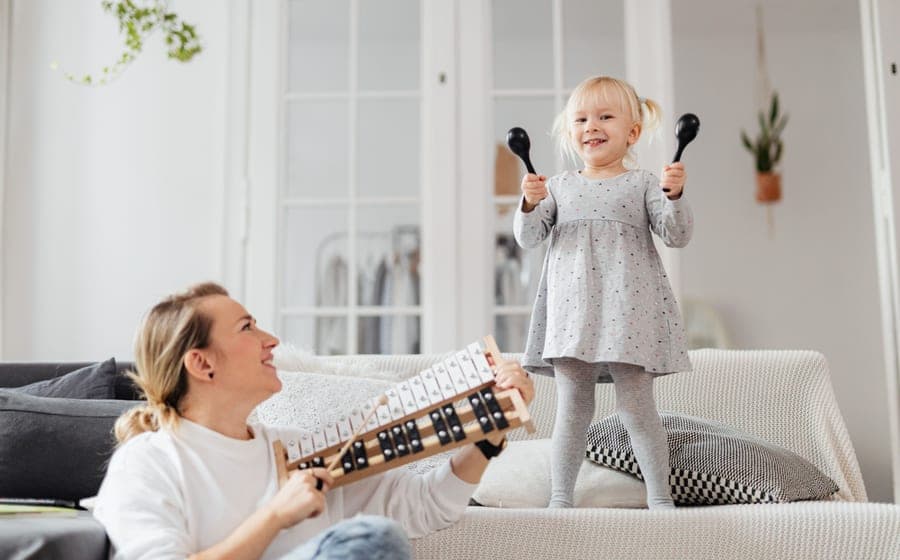
The usual model for a child learning an instrument is that the child learns and the parent administers: reminds, drives to lessons, asks whether practice happened.
There is a better version, and it costs you twenty minutes a day.
Learn alongside them rather than supervising. Practice at the same time in the same room, on your own instrument, at your own level. The one rule is never compare progress — the child will move faster physically and that must not become a competition.
Why it works
It normalizes being bad at something. A child watching an adult struggle with a chord change learns that struggling is what learning looks like. That single observation prevents a great deal of quitting, because most children assume adults are simply competent at things.
It removes the nagging dynamic. “Have you practiced?” is a demand. “I’m going to practice, want to join me?” is an invitation, and it works far better with the same child.
It makes practice a fixed event. The single strongest predictor of a beginner continuing is whether practice is a routine rather than a decision. A shared twenty minutes after dinner is a routine.
You can actually help. A parent who has fought the same chord shape can say something useful. A parent who has not can only ask whether it is going well.
The failure mode
There is one, it is predictable, and it is competition.
Children generally progress faster on the physical side. Their hands adapt quicker, calluses form faster, and they are less self-conscious about sounding bad. Adults progress faster on the conceptual side — reading, structure, understanding what a piece is doing.
If either party starts measuring, someone loses. A child who is beating their parent may coast; a child who feels behind may quit. Neither outcome is about the music.
The fix is simply never to make it a comparison. You are two people who both play, at your own levels, in the same room. That framing holds up indefinitely.
Which instruments share well
Ukulele is the easiest. One size genuinely suits both — a Kala KA-15S#ad soprano works for a five-year-old and for an adult, though an adult with wide fingertips may prefer a concert. Two ukuleles cost very little, and several chords need one finger so both players are making music in week one.
Keyboard shares without buying two. One board, two players, different times. A Casio Casiotone CT-S200#ad has 61 full-size keys, which matters for both: an adult needs the standard width and a child needs to learn on it rather than unlearn a narrower one later. See best keyboards for kids.
Guitar needs two different instruments. A child under about ten needs a fractional size or a short-scale instrument, and an adult needs full scale. A Loog Pro Acoustic#ad for a young child and a full-size acoustic for the adult works well, because the three-string guitar uses standard guitar tuning and everything transfers. Sizing is in guitar sizes for kids.
Drums do not share. One kit, one player, and taking turns produces exactly the conflict this arrangement is supposed to avoid.
Setting it up
Practice at the same time, in the same room. Not necessarily the same material. Two people playing different things in one room is companionable in a way that separate practice is not.
Twenty minutes is plenty. Frequency beats duration for both of you, and a short session is one a child will agree to.
Learn one shared song. Even a very simple one. Playing together, however badly, is the point of the whole arrangement, and it is what a child remembers.
Let them teach you something. A child who has worked out a chord shape first and shows a parent has just had the best possible experience with an instrument. Engineer it if you can.
Do not become the teacher. Learning together and instructing are different relationships, and mixing them turns practice into school. If you want a teacher, hire one — see lessons versus teaching yourself.
When not to do this
If you would resent it. A parent practicing out of obligation transmits exactly that, and it is worse than not participating.
If the child specifically wants their own thing. Older children in particular sometimes want an activity that is theirs. Respect it — that ownership is itself a motivator.
If you are competitive. Be honest with yourself. If you would find it irritating to be overtaken by an eight-year-old, choose a different instrument to them or skip it.
What to buy
Two ukuleles is the cheapest and easiest version of this and the one we suggest most often. Sizing and picks for the child’s side are in best ukuleles for kids.
If you are still choosing the instrument at all, the age constraints are in what age to start an instrument and the field is narrowed in best first instrument for a child.
What we would buy
Kala KA-15S
Kala Brand MusicBest for: The honest floor, soprano
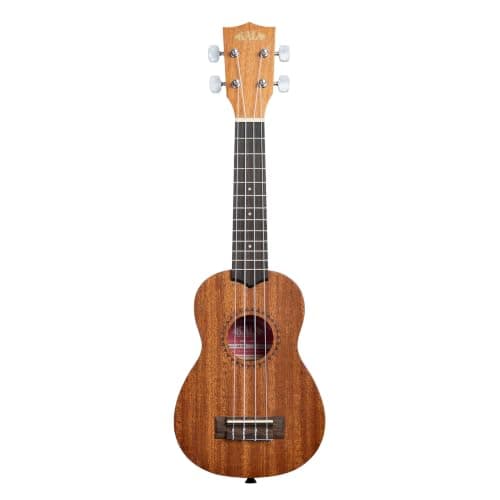
Mahogany throughout, a GraphTech NuBone nut and saddle, and Aquila strings fitted from the factory. The nut material is the spec that separates this from the pile of look-alikes.
Published specifications
- Size:
- Soprano
- Top / back / sides:
- Mahogany
- Neck / fretboard:
- Mahogany neck, rosewood fretboard
- Nut and saddle:
- GraphTech NuBone
- Scale length:
- 13.625"
- Frets:
- 12
- Nut width:
- 1.375"
- Overall length:
- 21.062"
- Strings:
- Aquila Super Nylgut
What it gets right
- NuBone nut and saddle rather than molded plastic — this is what decides whether the instrument plays in tune up the neck
- Aquila strings fitted at the factory, so the first thing you would otherwise replace is already done
- 21 inches overall and light enough for a small child to hold unsupported
Where it gives ground
- 12 frets only, and the body joint stops you well short of the high notes
- Soprano scale means less room between frets — adult fingers with wide fingertips will find it cramped
What it is not good at
Adult hands, sometimes. A 13.625 inch scale is genuinely tight. If the player is a grown-up with large hands, read our soprano-versus-concert comparison before buying this size.
How the specs score against a beginner’s needs
Scores are our reading of the published specifications above against what a beginner physically needs. They are not test results — we have not played this instrument.
Specifications from Kala Brand Music — KA-15S specifications.
Casio Casiotone CT-S200
CasioBest for: Kids, full-size keys
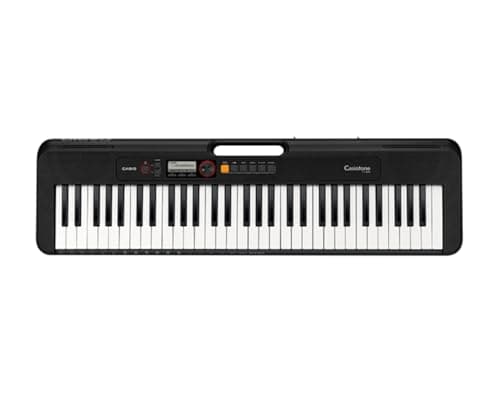
61 full-size keys, 400 tones and a power supply in the box, at the price where most keyboards still ship with narrow mini keys. That one specification is why it is here.
Published specifications
- Keys:
- 61, full-size
- Polyphony:
- 48 notes
- Tones:
- 400
- Rhythms:
- 77
- Display:
- LCD
- Connectivity:
- USB-MIDI
- In the box:
- Power supply, music rest
What it gets right
- Full-size keys at a price where mini keys are the norm — this is the specification that decides whether a child learns a hand span they can keep
- Power supply included, which is not a given and turns a cheap keyboard into an expensive paperweight when it is missing
- Light and simple enough that a child can set it up themselves, which means it gets used
Where it gives ground
- Unweighted keys, so it will not build the finger strength an acoustic piano needs
- 400 tones is a lot of browsing for a child who is meant to be practicing
What it is not good at
Preparing anyone for a real piano. It is a first keyboard for a young child, not a piano substitute — read our weighted-versus-unweighted comparison before assuming otherwise.
How the specs score against a beginner’s needs
Scores are our reading of the published specifications above against what a beginner physically needs. They are not test results — we have not played this instrument.
Specifications from Casio Casiotone CT-S200 published specifications.
Loog Pro Acoustic
LoogBest for: Ages 6-9, first chords fast
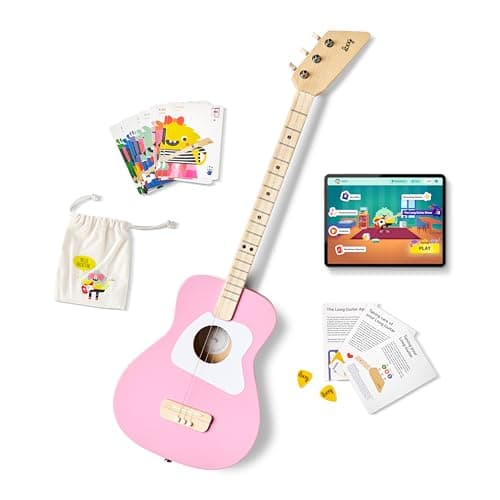
Three strings, a 20.4 inch scale and two pounds. It uses standard guitar strings and standard tuning, so everything learned on it transfers directly to a six-string.
Published specifications
- Strings:
- 3, standard guitar strings and tuning
- Scale length:
- 20.4" (520 mm)
- Dimensions:
- 29.2" long, 8.8" wide, 2.6" deep
- Weight:
- 2.0 lb (0.9 kg)
- Body / neck:
- Basswood body, maple neck and fingerboard
- Frets:
- 18
- Age guidance:
- Manufacturer states from age 6
What it gets right
- Three strings means a real chord on the first day, which is the single biggest predictor of a child continuing
- Standard tuning and standard strings — this is not a proprietary instrument that teaches a dead end
- Two pounds and 29 inches long; a six-year-old can pick it up unaided
Where it gives ground
- Three strings, so full six-string chord shapes are not available
- Basswood and a short scale mean a quiet, thin voice compared with any full acoustic
What it is not good at
Being the guitar for long. It is a deliberate bridge to a six-string, and if the child is already 9 or 10 you should probably skip straight to a 3/4 six-string instead.
How the specs score against a beginner’s needs
Scores are our reading of the published specifications above against what a beginner physically needs. They are not test results — we have not played this instrument.
Specifications from Loog Guitars — Pro Acoustic specifications.
Questions people actually ask
Should parents learn an instrument with their child?
It works well and is worth doing if you want to. A parent who practices demonstrates that practice is normal, that being bad at something at first is normal, and that adults learn things — all of which a reminder cannot.
What instrument can a parent and child both learn?
Ukulele is the easiest to share, because the same instrument suits both and two of them cost very little. Keyboard works well too, since one board can be used by both at different times.
Will the child feel they are competing with me?
Only if you make it a comparison. Children usually progress faster than adults on the physical side, and framing that as a race is the main way this arrangement goes wrong.
Do we need two instruments?
For ukulele and guitar, yes — sizes differ and taking turns creates conflict. For keyboard, one board works, since practice is naturally at different times.
Sources
Still deciding?
Every recommendation on this site is built the same way, and the method is published in full — including what we do not do and what would get a pick dropped.
Read next
- The best first instrument for a child
Instrument by instrument, the real starting age set by hand size and reach, with a pick for each and the noise column filled in.
- What age should a child start an instrument?
Realistic starting ages set by each instrument's physical demands, why starting early backfires, and what to do while waiting.
- Why beginners quit, and what prevents it
The three points where beginners stop, what causes each, and the interventions that work at each stage.
- Best ukuleles for kids
Wood or composite, with the humidity problem that kills cheap wooden ukuleles in dry houses stated plainly.
- Best keyboards for kids
Why mini keys are disqualifying, and two picks that keep full-size touch-sensitive keys within a child's budget.