Drums
Best drum sets for kids
There is one test that matters and it takes ten seconds: can they sit at it with both feet flat on the pedals and both hands on the drums.
By Sawyer V. · Published · Last updated
Drums have a peculiar advantage as a child’s first instrument: there is no finger strength requirement, nothing to tune, no intonation to get wrong, and a satisfying sound is available on the first hit. A five-year-old can play something that sounds like drumming within minutes, which is not true of any string instrument.
The obstacles are physical fit and noise, and the first one is the one people get wrong. Our method, and the fact that we have not played these kits, is on how we pick.
A child needs a kit where they can sit with both feet flat on the pedals and both hands comfortably on the drums. Junior kits with a 16 inch bass drum suit roughly ages 3 to 6; 18 to 20 inch kits suit 6 to 10; full-size 22 inch kits suit about 11 and up. Reach, not age, is the actual test.
Why an adult kit is not a kit they grow into
On a guitar, an oversized instrument is uncomfortable and can technically still be played. On a drum kit it is a different situation entirely, because drumming requires four limbs to operate four things at once, and if any one of them is out of reach the whole coordination cannot be practiced.
A full-size bass drum is 22 inches in diameter. The pedal sits in front of it, which puts it a fixed distance forward of the throne. A child’s leg is not long enough to reach that pedal while sitting at a height where their hands can also reach the drums. They can have their feet on the pedals or their hands on the drums, not both.
Throne height cannot rescue this. Lowering the throne so their feet reach means their knees come up and their hands are below the snare. Raising it so their hands work means their feet dangle. There is no setting that works, and the child spends the session unable to do the one thing drumming is.
A 16 inch bass drum — six inches smaller in diameter — moves the pedal substantially closer, and everything comes into range at once.
Acoustic or electronic for a child
This is genuinely close and depends almost entirely on the building.
Acoustic wins on feel. A real drum responds to where and how hard it is struck, in ways rubber and mesh pads only approximate. Cymbals in particular have a range of sounds depending on how they are hit, and no pad reproduces that.
Electronic wins on hours. A kit with headphones can be played at eight in the evening in an apartment. An acoustic one cannot, and a kit that can be played for twenty minutes daily accumulates far more practice than one available for two hours on a Saturday afternoon.
Practice hours beat authenticity by a wide margin at this age. If there is any doubt about the noise, take the electronic kit — the Alesis Debut ships with headphones for exactly this reason.
What to skip
Toy drum sets. The tell is plastic heads that are not tunable and cymbals made of thin steel or plastic. These do not sound like drums, cannot be tuned, and the “cymbals” make a sound closer to a biscuit tin. A child who plays one is not practicing drumming, and there is no path from it to the real thing.
A full-size kit bought at age seven to save buying twice. Covered above: the child cannot operate it. Junior kits resell easily because every family faces this two years later.
Electronic kits with rubber pads rather than mesh, at the bottom of the range. Rubber pads are noticeably louder in the room than mesh — a hard stick on hard rubber makes a real clack — and they have almost no rebound, which makes them tiring and teaches a stroke that does not work on a real drum.
What you also need
Hearing protection for an acoustic kit, from day one. A child’s hearing is not more robust than an adult’s and the exposure is at close range. Children’s ear defenders or musicians’ plugs, every session.
A practice pad. Cheap, silent, and where most early technique work happens. It is also the thing that lets them practice in a hotel room, at a grandparent’s house, or at 9pm. See drum kit vs practice pad.
Smaller sticks. Adult 5A sticks are too long and too heavy for a small child’s hands. Junior sticks are inexpensive and make a real difference to whether they can control the stroke.
Quick picks
Ages roughly 3 to 6, acoustic
A 16 inch bass drum, which is the smallest size where a very young child's leg reaches the pedal at a sensible throne height.
| # | Product | Best for | Score | Price |
|---|---|---|---|---|
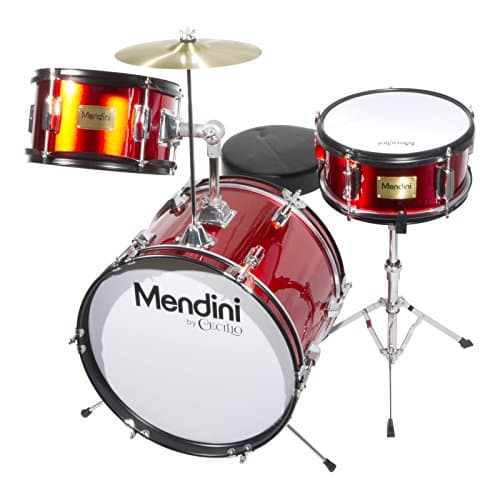
| 1 | Mendini by Cecilio 16" Junior KitA three-piece with an 11x16 bass drum, real hardwood shells and triple-flanged hoops. | Ages roughly 3-6, acousticThe honest floor | 7.0 | $170.99 · View on Amazon #ad How we’re funded |
Ages roughly 5 to 9, and any home where noise is a problem
Purpose-built small geometry with mesh pads and headphones in the box. Alesis states 5 to 9 and the dimensions back that up.
| # | Product | Best for | Score | Price |
|---|---|---|---|---|
| 1 | No image Alesis Debut KitFour 6 inch mesh pads sized and spaced for a small child, with headphones, a throne and sticks in the box. | Ages roughly 5-9The honest floor | 8.0 | Check price on Amazon → #ad How we’re funded |
The picks in full
Mendini by Cecilio 16" Junior Kit
Mendini by CecilioBest for: Ages roughly 3-6, acoustic
A three-piece with an 11x16 bass drum, real hardwood shells and triple-flanged hoops. It is the smallest acoustic kit where the pedal is actually where a small child's foot is.
Published specifications
- Configuration:
- 3-piece: 11"x16" bass with pedal, 6"x10" mounted tom, 5"x10" snare
- Cymbal:
- 9.5" with mounting arm
- Shells:
- Hardwood, triple-flanged hoops
- In the box:
- Wooden sticks, round padded adjustable throne
What it gets right
- A 16 inch bass drum puts the pedal within reach of a three- or four-year-old's leg, which no full-size kit does
- Triple-flanged hoops and hardwood shells, so it can genuinely be tuned rather than just hit
- Adjustable throne included, and at this age that is the part that has to move most
Where it gives ground
- Three pieces and one cymbal — this is a starting point, not a kit
- The included cymbal and pedal are the cheapest components and behave like it
What it is not good at
Anyone over about seven. Growth out of this kit is measured in a couple of years, and paying for it twice is worse than starting a six-year-old on a proper junior five-piece.
How the specs score against a beginner’s needs
Scores are our reading of the published specifications above against what a beginner physically needs. They are not test results — we have not played this instrument.
Specifications from Cecilio Music — Mendini kids drum set, 3-piece 16".
Alesis Debut Kit
AlesisBest for: Ages roughly 5-9
Four 6 inch mesh pads sized and spaced for a small child, with headphones, a throne and sticks in the box. Alesis states it is designed for ages 5 to 9 and the geometry backs that up.
Published specifications
- Pads:
- Four 6" mesh pads (snare and three toms)
- Cymbals:
- Three 10" pads — hi-hat, crash, ride
- Pedals:
- Hi-hat and bass drum pedals included
- Module:
- DM-Lite: 120 sounds, 10 kits, 30 play-along tracks, drum coach
- Age guidance:
- Manufacturer states ages 5-9
- In the box:
- Metal rack, height-adjustable throne, sticks, headphones, cables, Melodics lessons
What it gets right
- Purpose-built small geometry — the pads are within a small child's reach rather than an adult kit with the legs shortened
- Headphones included, which for a kids' drum kit is the difference between practicing and being asked to stop
- Height-adjustable throne, so it tracks a growing child for a couple of years
Where it gives ground
- 6 inch pads are small enough that an older child will feel boxed in quickly
- The DM-Lite module is basic; 120 sounds and no real editing
What it is not good at
Lasting. Alesis's own 5-to-9 guidance is honest, and a 10-year-old should start on the Nitro Max instead. Buying this for an older child to save money buys a kit they will resent in a year.
How the specs score against a beginner’s needs
Scores are our reading of the published specifications above against what a beginner physically needs. They are not test results — we have not played this instrument.
Specifications from Alesis Drums — Debut Kit.
Questions people actually ask
What age is a kids drum set for?
Junior acoustic kits with a 16 inch bass drum suit roughly ages 3 to 6. A 18 to 20 inch bass drum suits roughly 6 to 10. Full-size 22 inch kits suit about 11 and up. Alesis states its Debut electronic kit is designed for ages 5 to 9. The sizing table is in drum set sizes by age.
Are drums a good instrument for a child?
Physically, yes — there is no finger strength requirement, no intonation to get wrong, and a child can make a satisfying sound immediately. The obstacles are noise and floor space, and both are solvable with an electronic kit. Cross-family comparison in the best first instrument for a child.
How loud is a kids drum set?
A junior acoustic kit is quieter than a full-size one and still loud — comfortably above the level anyone would want to sit next to for an hour without protection. An electronic kit with headphones is close to silent in the room, with only the pedals thumping.
Should a child start on an electronic kit?
If noise is a constraint, yes without hesitation — a kit that can be played in the evening accumulates far more practice than one that cannot. The trade is that cymbal technique does not develop properly on rubber pads, which becomes relevant if they move to an acoustic kit later.
Sources
Still deciding?
Every recommendation on this site is built the same way, and the method is published in full — including what we do not do and what would get a pick dropped.
Read next
- Drum set sizes by age
Bass drum diameter by age with a reach test, and the throne-height problem that no chart can capture.
- How loud are drums?
Measured decibel levels against the NIOSH limit, what travels through walls and floors, and which quieting options actually work.
- Best electronic drum sets for beginners
Mesh versus rubber pads, the kick-thump problem that headphones do not solve, and picks for adults and children.
- The best first instrument for a child
Instrument by instrument, the real starting age set by hand size and reach, with a pick for each and the noise column filled in.
- How much should a beginner drum set cost?
Four bands defined by completeness and hardware quality, with the shells-only trap and the real running costs.