Keys
Are cheap keyboards worth it?
A cheap keyboard does not fall apart. It works perfectly and quietly fails to teach the two things a beginner most needs to learn.
By Sawyer V. · Published · Last updated
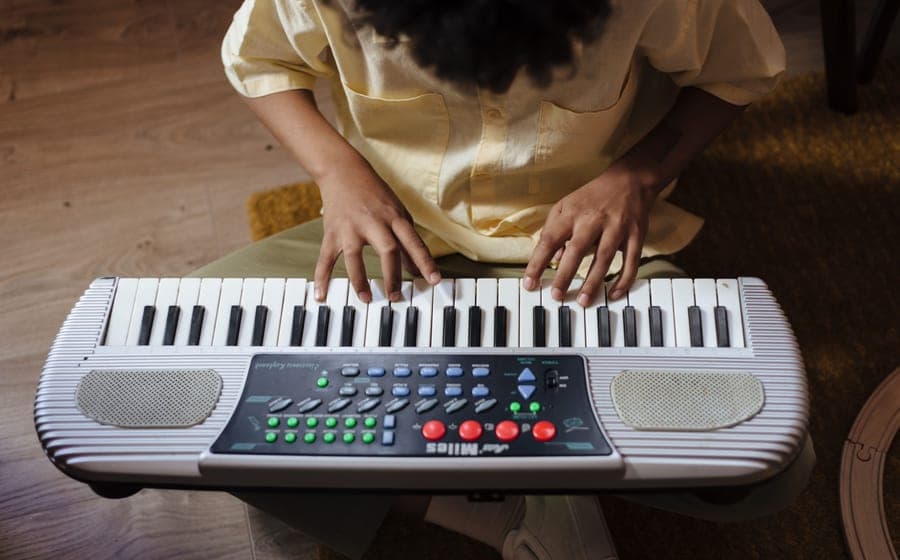
Cheap keyboards are worth it above roughly $150. Below about $120 you lose touch response, full-size keys, or both. The difficulty is that neither failure is visible — the instrument works perfectly and simply cannot teach dynamics or correct hand span.
Why this question is different from the guitar version
A cheap guitar fails loudly. It will not stay in tune, the strings are hard to press, the fret ends are sharp. The player can tell something is wrong even if they cannot name it.
A cheap keyboard fails silently. Every key sounds. Nothing buzzes, nothing drifts out of tune, nothing hurts. The instrument does exactly what it says on the box. What it cannot do is teach two specific things, and the student will not discover the gap for a year or more.
That makes cheap keyboards more dangerous, not less. There is no feedback loop.
The three specifications
1. Touch response
Playing harder must make it louder. On a non-touch keyboard every note comes out at identical volume no matter what the player does.
Dynamics — bringing a melody out over an accompaniment, shaping a phrase, playing a passage softly — is one of the earliest genuinely musical skills a student develops. On a non-touch instrument it cannot be practiced, because the instrument does not respond. The student is not doing it wrong; there is nothing to do. A year later at a real piano everything comes out at one flat volume, and they have no idea why.
Touch response is the single most important specification on a beginner keyboard, and it is routinely absent below about $120 and routinely unmentioned in the listing.
2. Full-size keys
A standard white key is about 23 mm wide. Mini keys are narrower, and a keyboard using them will describe itself as compact or portable rather than giving the number.
The consequence is hand span. A student learns how far apart an octave is by feel, not by measurement, and on narrow keys they learn the wrong distance. Everything then has to be recalibrated on a standard keyboard, and recalibrating a learned-by-feel distance is harder than learning it once.
This matters most for young children, which is the opposite of the intuition that leads people to buy them small keys.
3. At least 61 keys
Five octaves. Beginner method books stay well inside that for a year or two, so 61 is genuinely enough and 88 is a choice rather than a requirement — the argument is in 61 vs 88 keys.
49 keys is not enough. Four octaves runs out as soon as both hands are playing at once with any separation, and the 49-key instruments are usually the ones with mini keys and no touch response as well.
What genuinely does not matter
Tone count. 650 sounds against 61 is a marketing number. Nobody learned to play because of sound number 400, and there is a decent argument that a smaller number is better because it removes the browsing.
Accompaniment styles. Fun, occasionally motivating for a child, entirely irrelevant to whether the player develops.
Speakers. Any built-in speaker is adequate for a room, and most practice ends up on headphones anyway.
Brand. Among manufacturers that publish real specifications, at this tier the differences are small. Yamaha, Casio, Roland and Alesis all build honest entry instruments.
The listing test
If a keyboard listing does not state whether the keys are touch-sensitive and whether they are full-size, those omissions are not accidental. A manufacturer that has touch response says so in the first line, because it is the specification buyers who know anything are looking for.
A listing that leads with the tone count, the number of rhythms and the included stool has told you which specifications it would rather you did not ask about.
What we would buy
Yamaha PSR-E383
YamahaBest for: Learning tools, 61 keys
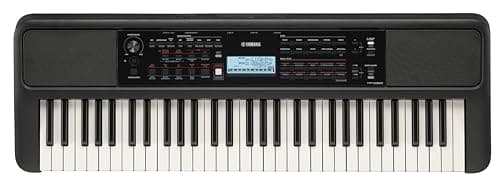
61 touch-sensitive keys and 125 lesson songs with hand-separate practice and scoring. The touch response is the spec that matters; the 650 tones are the spec that sells it.
Published specifications
- Keys:
- 61, organ-style (unweighted), touch-sensitive
- Touch response:
- Soft / medium / hard / off
- Polyphony:
- 48 notes
- Tones:
- 650 (258 panel, 25 drum/SFX, 20 arpeggio, 347 XGlite)
- Lessons:
- 125 lesson songs, right/left/both-hand practice with evaluation
- In the box:
- Music rest, PA130 power adapter
What it gets right
- Touch-sensitive keys — playing harder makes it louder, which is the thing a beginner has to learn early and a non-touch keyboard cannot teach
- The lesson mode with hand-separate practice and scoring is genuinely useful, not a gimmick
- Power adapter included, which is not a given at this tier
Where it gives ground
- Unweighted organ-style keys — this will not build the finger strength a piano needs
- 61 keys, so a method book that assumes 88 will eventually run out of instrument
What it is not good at
Preparing anyone for an acoustic piano. If there is a real piano in the child's future, the unweighted action is a habit to unlearn later. Read our 61-versus-88 comparison before deciding.
How the specs score against a beginner’s needs
Scores are our reading of the published specifications above against what a beginner physically needs. They are not test results — we have not played this instrument.
Specifications from Yamaha — PSR-E383 specifications.
Casio Casiotone CT-S1
CasioBest for: 61 keys, piano sound first
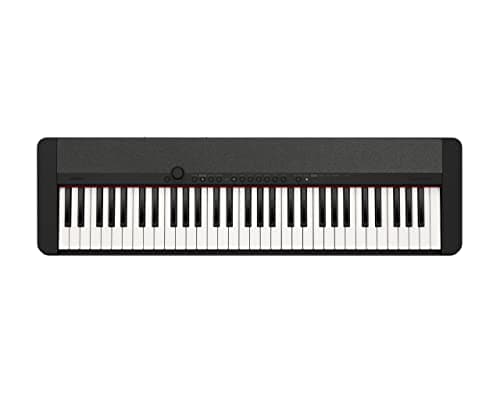
61 full-size touch-sensitive keys, 61 tones and no arranger clutter. It is the 61-key board for someone who wants to play piano rather than operate a keyboard.
Published specifications
- Keys:
- 61, full-size, touch-sensitive
- Polyphony:
- 64 notes
- Tones:
- 61, including a stereo grand piano
- Weight:
- 9.9 lb
- Dimensions:
- 36.61" W x 10.15" D x 3.30" H
- Connectivity:
- USB-MIDI
What it gets right
- Deliberately few sounds and a clean panel, which removes the single biggest distraction from actual practice
- 9.9 pounds and 3.3 inches tall — it can live on a shelf between sessions, and an instrument that lives out of the way gets played less
- 64-note polyphony, higher than the PSR-E383's 48
Where it gives ground
- No lesson mode at all, unlike the PSR-E383
- Unweighted keys, same fundamental limit as any 61-key board
What it is not good at
Entertaining a young child. There is no light-up key guidance, no play-along scoring and only 61 sounds. That restraint is the point for an adult beginner and a drawback for a seven-year-old.
How the specs score against a beginner’s needs
Scores are our reading of the published specifications above against what a beginner physically needs. They are not test results — we have not played this instrument.
Specifications from Casio — CT-S1 product page.
Questions people actually ask
Are cheap keyboards worth it?
Above roughly $150 they are genuinely fine. Below about $120 you typically lose touch response, full-size keys, or both — and unlike a cheap guitar, nothing about the instrument will look or feel broken. It works. It just cannot teach two of the things the student needs to learn.
Are cheap keyboards harder to play?
Not harder, which is exactly the problem. A cheap keyboard is usually easier to press than a real piano, so a student develops speed without strength. The difficulty is deferred rather than removed, and it arrives all at once at the first acoustic piano.
Is a used keyboard a good idea?
Often better value than a new cheap one. Keyboards have no consumable parts and few moving ones, so a five-year-old mid-range board is usually a better instrument than a new entry-level one at the same price. Check every key sounds and that the power adapter is included.
Do more sounds make a keyboard better?
No, and past a point it makes it worse. A student with 650 sounds spends practice time browsing them. The Casio CT-S1’s 61 sounds and clean panel is a deliberate design decision in the other direction, and for an adult learner it is the better one.
Sources
Still deciding?
Every recommendation on this site is built the same way, and the method is published in full — including what we do not do and what would get a pick dropped.
Read next
- How much should a beginner keyboard cost?
Four bands from touch response to hammer action, plus the stand, bench and pedal costs that turn a keyboard budget into a bigger one.
- Best beginner keyboards: 61 keys that suit real lessons
Touch response over tone count, segmented for children and adult learners, with the 61-key ceiling stated plainly.
- Weighted vs unweighted keys
Hammer, semi-weighted and synth action explained by effect on the hands, with the one question that settles the choice.
- Are cheap guitars worth it?
The line between cheap and too cheap, named part by part, with what each failure does to a beginner who cannot diagnose it.
- Are cheap ukuleles worth it?
The intonation failure that cannot be repaired, what causes it, and the two specs that tell you whether an instrument has it.