Keys
Best keyboards for adult beginners
An adult beginner does not need the lesson lights or the demo songs. They need an action that will still be right in three years.
By Sawyer V. · Published · Last updated
Beginner keyboard advice is written almost entirely for children, and the priorities do not transfer. Lesson lights, hundreds of voices, built-in songs and rhythm accompaniments exist to hold the attention of a nine-year-old. An adult who has decided to learn the piano has already solved the attention problem.
What an adult has instead is a shortage of hours, usually a shortage of space, and a clear sense of being embarrassed by a toy. Those are different buying criteria and they point at a different board.
Every pick states its Starter Path band, and none of them have been physically tested by us — the method is on how we pick.
Put the money into the key action and ignore the feature count. If you want to learn piano properly, buy 88 weighted keys once. If you want to play songs, 61 full-size touch-sensitive keys is enough and the saving is large.
Answer one question before you shop
Do you want to play the piano, or do you want to play songs?
They sound like the same thing. They are not, and they buy different instruments.
Playing the piano means reading written music, working through repertoire, possibly graded exams. It uses the full range and it requires a weighted action, because the whole technique is built on controlling how hard the key is struck.
Playing songs means chords under a melody, accompanying a voice, working out things you like by ear. It rarely leaves the middle three octaves and it does not need a weighted action at all.
Adults frequently buy for the first goal and then live the second one, which is how a heavy 88-key board ends up unused in a spare room. Be honest about which you are.
If you want to learn piano properly
The Yamaha P-145#ad is the buy-once answer: 88 keys with a graded hammer action, meaning the low notes are heavier than the high ones the way an acoustic piano’s are. That is the specification a teacher is actually asking for, and it is the one you cannot add later.
Everything else on it is deliberately spare — a small voice list, a simple panel, a slim cabinet. For an adult who wants an instrument rather than a gadget, that restraint is the point.
If the budget will not stretch, the Alesis Recital#ad is the compromise we would make. You get 88 full-size keys with a semi-weighted action rather than a hammer one. It is not the same feel and we will not pretend it is, but the key count and key width are right, and those are the two things that limit repertoire. What you are giving up is set out in weighted versus unweighted keys.
If you want to play songs
The Casio Casiotone CT-S1#ad is our pick for adults in this camp. 61 full-size touch-sensitive keys, a piano sound clearly prioritised over a features list, about ten pounds, and battery capable so it can be played wherever you happen to be.
It also looks like an instrument rather than a toy, which is a real consideration for an adult buying their first keyboard and a reason a lot of good boards never get bought.
The Yamaha PSR-E383#ad is the alternative if you want the learning tools after all. It carries a built-in lesson system and a much wider voice library, which some adults genuinely use and others switch on twice. Buy it if you know you are the first kind.
What adults get wrong
Buying for the version of themselves in five years. The most expensive board you can afford is not the right board if it means practicing in a spare room you never go into. Location beats specification more often than anyone admits.
Skipping the bench. Adults are more likely than children to practice at a dining table on a dining chair, and more likely to accumulate wrist and shoulder trouble as a result. The seat height is not a detail, and the fix is in our stand and bench guide.
Not buying headphones. Adult practice time is late evening, after other people are in the house. Headphones are the accessory that converts intent into hours, and they are covered in keyboard accessories you actually need.
Expecting a child’s progress curve. Adults usually move faster early and plateau harder, because the limit is practice hours rather than aptitude. The honest version of that expectation is in learning an instrument as an adult.
The realistic first year
Twenty minutes most days beats two hours on Sunday, and the reason is physical: the hand-shape learning that piano depends on consolidates between sessions rather than during them.
An adult practicing consistently is generally playing simple pieces with both hands within a few months, which is a genuinely satisfying place to be. What derails it is almost never the instrument — it is the instrument being in the wrong room, at the wrong height, at a volume that cannot be used after nine o’clock.
Buy the board that removes those three problems and the practice takes care of itself.
Quick picks
Buy once, if you are reasonably serious
88 weighted keys is what every piano teacher and every graded syllabus assumes. If you expect to still be playing in three years, start here and stop shopping.
| # | Product | Best for | Score | Price |
|---|---|---|---|---|
| 1 | No image Yamaha P-14588 graded hammer keys, a concert grand sample and 24 pounds. | Buy once, 88 weighted keysEnough | 9.0 | Check price on Amazon → #ad How we’re funded |
88 keys on a tight budget
The compromise worth making: full key count and full-size keys, with a semi-weighted action rather than a hammer one.
| # | Product | Best for | Score | Price |
|---|---|---|---|---|
| 1 | 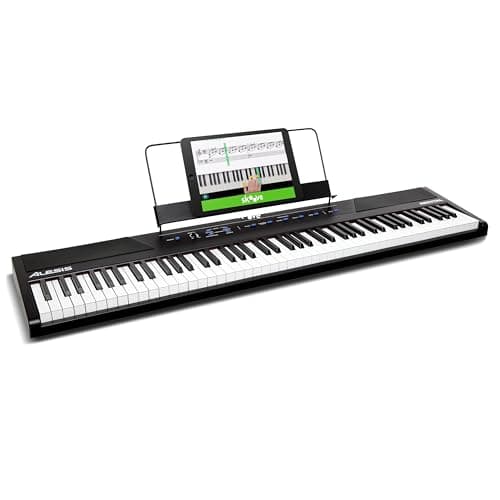 Alesis Recital88 full-size semi-weighted keys and 128-note polyphony for meaningfully less than a hammer-action piano. | 88 keys on a tight budgetThe honest floor | 7.7 | $259.99 · View on Amazon #ad How we’re funded |
Small space, chords and songs rather than exams
61 full-size keys, batteries, and a piano sound better than the size suggests. The right answer if the goal is playing songs rather than sitting exams.
| # | Product | Best for | Score | Price |
|---|---|---|---|---|
| 1 | 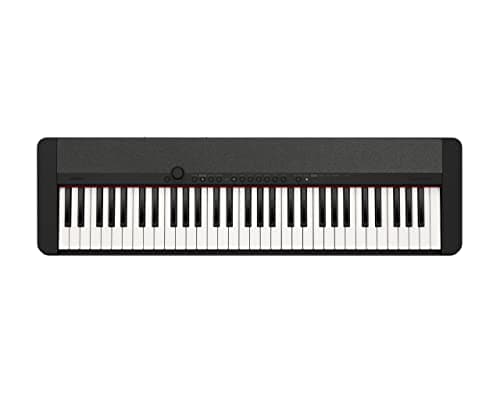 Casio Casiotone CT-S161 full-size touch-sensitive keys, 61 tones and no arranger clutter. | 61 keys, piano sound firstThe honest floor | 7.8 | $219.99 · View on Amazon #ad How we’re funded |
| 2 | 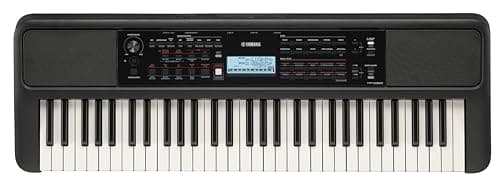 Yamaha PSR-E38361 touch-sensitive keys and 125 lesson songs with hand-separate practice and scoring. | Learning tools, 61 keysThe honest floor | 7.6 | $199.99 · View on Amazon #ad How we’re funded |
The picks in full
Yamaha P-145
YamahaBest for: Buy once, 88 weighted keys
88 graded hammer keys, a concert grand sample and 24 pounds. If the plan is piano lessons rather than keyboard playing, this is where the shopping actually starts.
Published specifications
- Keys:
- 88, GHC (Graded Hammer Compact), fully weighted and graded
- Polyphony:
- 64 notes
- Sound:
- Yamaha CFIIIS concert grand sample, damper resonance DSP
- Speakers:
- 7 W built-in
- Dimensions:
- 1,326 x 268 x 129 mm (52-3/16" x 10-9/16" x 5-1/16")
- Weight:
- 11.1 kg (24 lb 8 oz)
- In the box:
- Music rest, sustain foot switch
What it gets right
- Graded hammer action — the low keys are heavier than the high ones, which is the thing an unweighted keyboard cannot teach
- All 88 keys, so no method book ever runs off the end of the instrument
- Genuinely portable at 24 pounds and 268 mm deep; it fits on a desk
Where it gives ground
- 64-note polyphony is the entry-tier number; heavy sustain-pedal passages will drop notes eventually
- A single sustain footswitch, not a proper piano-style pedal — most players replace it
What it is not good at
Anything other than piano. There are only a handful of voices and no arranger features, so if the player wants to make beats or layer sounds, a PSR-E383 will make them happier for less money.
How the specs score against a beginner’s needs
Scores are our reading of the published specifications above against what a beginner physically needs. They are not test results — we have not played this instrument.
Specifications from Yamaha USA — P-145 specifications.
Casio Casiotone CT-S1
CasioBest for: 61 keys, piano sound first
61 full-size touch-sensitive keys, 61 tones and no arranger clutter. It is the 61-key board for someone who wants to play piano rather than operate a keyboard.
Published specifications
- Keys:
- 61, full-size, touch-sensitive
- Polyphony:
- 64 notes
- Tones:
- 61, including a stereo grand piano
- Weight:
- 9.9 lb
- Dimensions:
- 36.61" W x 10.15" D x 3.30" H
- Connectivity:
- USB-MIDI
What it gets right
- Deliberately few sounds and a clean panel, which removes the single biggest distraction from actual practice
- 9.9 pounds and 3.3 inches tall — it can live on a shelf between sessions, and an instrument that lives out of the way gets played less
- 64-note polyphony, higher than the PSR-E383's 48
Where it gives ground
- No lesson mode at all, unlike the PSR-E383
- Unweighted keys, same fundamental limit as any 61-key board
What it is not good at
Entertaining a young child. There is no light-up key guidance, no play-along scoring and only 61 sounds. That restraint is the point for an adult beginner and a drawback for a seven-year-old.
How the specs score against a beginner’s needs
Scores are our reading of the published specifications above against what a beginner physically needs. They are not test results — we have not played this instrument.
Specifications from Casio — CT-S1 product page.
Alesis Recital
AlesisBest for: 88 keys on a tight budget
88 full-size semi-weighted keys and 128-note polyphony for meaningfully less than a hammer-action piano. Semi-weighted is a real compromise and the page should say so, so: it is a real compromise.
Published specifications
- Keys:
- 88, full-size, semi-weighted
- Touch response:
- Adjustable — low / medium / high
- Polyphony:
- 128 notes
- Voices:
- 5, layerable and splittable
- Speakers:
- 2 x 20 W
- Weight:
- 15.7 lb
- Extras:
- Lesson mode, metronome, reverb, chorus
What it gets right
- All 88 keys at a price where most instruments give you 61 — the method book never runs out of instrument
- 128-note polyphony, double the Yamaha P-145's 64
- 15.7 pounds, lighter than the P-145's 24 and a genuine consideration if it moves between rooms
Where it gives ground
- Semi-weighted is not hammer action and not graded — the resistance is springs, not weights
- Five voices total, and the piano sample is clearly the entry tier
What it is not good at
Building acoustic-piano technique. Semi-weighted keys let a beginner play faster than their hands have earned, and the habit shows the first time they sit at a real piano. If lessons on an acoustic are coming, spend up to the hammer action.
How the specs score against a beginner’s needs
Scores are our reading of the published specifications above against what a beginner physically needs. They are not test results — we have not played this instrument.
Specifications from Alesis — Recital product page.
Yamaha PSR-E383
YamahaBest for: Learning tools, 61 keys
61 touch-sensitive keys and 125 lesson songs with hand-separate practice and scoring. The touch response is the spec that matters; the 650 tones are the spec that sells it.
Published specifications
- Keys:
- 61, organ-style (unweighted), touch-sensitive
- Touch response:
- Soft / medium / hard / off
- Polyphony:
- 48 notes
- Tones:
- 650 (258 panel, 25 drum/SFX, 20 arpeggio, 347 XGlite)
- Lessons:
- 125 lesson songs, right/left/both-hand practice with evaluation
- In the box:
- Music rest, PA130 power adapter
What it gets right
- Touch-sensitive keys — playing harder makes it louder, which is the thing a beginner has to learn early and a non-touch keyboard cannot teach
- The lesson mode with hand-separate practice and scoring is genuinely useful, not a gimmick
- Power adapter included, which is not a given at this tier
Where it gives ground
- Unweighted organ-style keys — this will not build the finger strength a piano needs
- 61 keys, so a method book that assumes 88 will eventually run out of instrument
What it is not good at
Preparing anyone for an acoustic piano. If there is a real piano in the child's future, the unweighted action is a habit to unlearn later. Read our 61-versus-88 comparison before deciding.
How the specs score against a beginner’s needs
Scores are our reading of the published specifications above against what a beginner physically needs. They are not test results — we have not played this instrument.
Specifications from Yamaha — PSR-E383 specifications.
Questions people actually ask
What keyboard should an adult beginner buy?
If the goal is to learn piano properly, an 88-key board with a weighted hammer action. If the goal is to play songs and accompany singing, a 61-key full-size board is sufficient and much cheaper. Decide which of those two you actually want first.
Is 40 too old to learn piano?
No. Adults typically progress faster than children in the first year because they practice deliberately, understand structure and can read instructions. What adults lose is available hours, not capability.
Do adults need 88 keys?
Only if working through classical repertoire or graded exams, where the extra range is genuinely used. For pop, chords, accompaniment and most self-taught playing, 61 keys covers years of material.
Should an adult beginner get lessons?
A handful of lessons early is disproportionately valuable, mostly for hand position and posture — the two things that are hard to self-diagnose and expensive to unlearn. After that, self-teaching works better for adults than it does for children.
Sources
Still deciding?
Every recommendation on this site is built the same way, and the method is published in full — including what we do not do and what would get a pick dropped.
Read next
- Best beginner digital pianos: 88 keys, honestly compared
Hammer action versus semi-weighted at the entry price, with the polyphony and weight trade-offs both stated.
- Weighted vs unweighted keys
Hammer, semi-weighted and synth action explained by effect on the hands, with the one question that settles the choice.
- Digital piano or acoustic piano to start?
Running costs, tuning, volume control and why a neglected acoustic is worse than a good digital, with the case for each stated fairly.
- Learning an instrument as an adult
What genuinely changes for an adult starter, which instruments suit it, and the three mistakes that end most attempts.
- Best portable keyboards
The three specs that decide whether a keyboard actually travels, and the boards that get all three right at a beginner price.