Guitars
Yamaha FG800 vs Fender CD-60S
Both have a solid spruce top at a price where laminate is normal. The choice comes down to which neck your hand prefers, not which brand you trust.
By Sawyer V. · Published · Last updated
These two turn up on nearly every beginner shortlist, they cost about the same, and both do the thing that matters most at this price: they put a solid piece of spruce on the top rather than a laminate.
So the honest comparison is not about which is the better guitar. It is about which neck your hand gets on with, and they are genuinely different in that respect.
We have not played either. This is our reading of the published specifications, and the method is on how we pick.
Buy the Fender CD-60S#ad if the player is new, has smaller hands, or has struggled with a guitar before: the neck shape and rolled fingerboard edges make it the friendlier instrument. Buy the Yamaha FG800#ad if you want the guitar that most people keep, and are willing to work through a slightly less forgiving neck to get there.
The specs that actually differ
Fingerboard radius. The Fender is a 12 inch radius, which is on the flatter side; the Yamaha is R400 mm, about 15.75 inches, flatter still on paper but paired with a different neck profile. In the hand the Fender reads as the more relaxed neck because of the second difference.
Neck shape and edges. Fender fits the CD-60S with a neck it markets as Easy-to-Play and with rolled fingerboard edges, which removes the sharp corner along the side of the fingerboard. That is a real comfort difference for a beginner gripping too hard, and Yamaha does not publish an equivalent.
Back and sides. Mahogany on the Fender, nato and okume on the Yamaha. Both are ordinary at this tier, and neither is a reason to choose.
Scale length. 25.3 inches on the Fender, 25.6 on the Yamaha. A small difference, and slightly less string tension on the Fender.
Bracing. Both scalloped: quartersawn X on the Fender, scalloped on the Yamaha. This is the part that shapes how the top moves, and it is where the two guitars get their different voices.
What is the same
Nut width is 43 mm on both, which is the standard steel-string figure and the reason neither is a solution for very small hands. Both are dreadnought-bodied, so both are large instruments to hold. Both ship with hardware that is adequate rather than special.
Who should buy which
The CD-60S suits the player who has been put off before, the smaller adult, and the teenager who is going to be discouraged by a neck that fights back. Its job is to remove excuses.
The FG800 suits the player who intends to keep the guitar. The FG line has been Yamaha’s volume seller for decades, and the combination of a solid top with scalloped bracing is why it is our default recommendation in best beginner acoustic guitars.
Neither suits a player who cannot get comfortable around a dreadnought body. If that is the issue, the answer is a smaller body rather than a different brand — see guitars for small hands and best travel guitars.
What to spend next
On either guitar, the next two purchases matter more than the difference between them: a setup, and a decent set of strings. Both are covered in best beginner guitar strings, and the reason a setup is not optional is in what a guitar setup is.
What we would buy
Yamaha FG800
YamahaBest for: Buy once, acoustic
A solid Sitka spruce top with scalloped bracing at the entry price. Solid-versus-laminate is the one acoustic spec that changes what the instrument does over years, and this is the cheapest place to get it done right.
Published specifications
- Top:
- Solid Sitka spruce
- Back / sides:
- Nato / okume
- Neck / fingerboard:
- Nato neck, rosewood fingerboard, R400 mm (23-5/8") radius
- Scale length:
- 650 mm (25-9/16")
- Nut width:
- 43 mm (1-11/16")
- Bracing:
- Scalloped
- Body:
- Traditional Western (dreadnought), 412 mm (16-1/4") wide, 100-118 mm deep
- Hardware:
- Die-cast chrome tuners, urea nut and saddle
What it gets right
- A solid top, not a laminate — the only acoustic spec at this price that genuinely changes over time
- Scalloped bracing and die-cast tuners are specifications you normally pay considerably more for
- Yamaha's most-copied entry acoustic; parts, setups and advice are everywhere
Where it gives ground
- A full dreadnought body is a big box — 412 mm across and up to 118 mm deep
- Nato and okume back and sides are the cost saving; the top is where the money went
What it is not good at
Fitting a smaller player. The dreadnought body is wide and deep enough that a young teenager can struggle to get their arm over it comfortably. If that is the buyer, look at the JR1 or a concert-size body instead.
How the specs score against a beginner’s needs
Scores are our reading of the published specifications above against what a beginner physically needs. They are not test results — we have not played this instrument.
Specifications from Yamaha Europe — FG/FS800 series specifications.
Fender CD-60S
FenderBest for: Easiest acoustic to fret
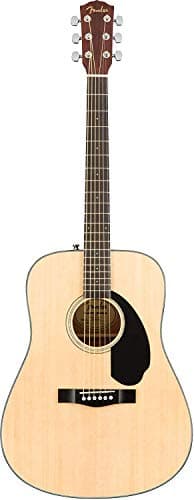
Solid spruce top, mahogany back and sides, and rolled fingerboard edges on a slightly shorter 25.3 inch scale. The rolled edges are the reason to pick this one.
Published specifications
- Top:
- Solid spruce
- Back / sides:
- Mahogany
- Scale length:
- 25.3" (643 mm)
- Nut width:
- 1.69" (43 mm)
- Fingerboard:
- 12" radius, 20 frets, rolled edges
- Bracing:
- Quartersawn scalloped "X"
- Neck:
- Fender "Easy-to-Play" shape
What it gets right
- Rolled fingerboard edges remove the sharp edge that makes a new player's hand hurt after twenty minutes
- Solid spruce top at the same tier as the FG800, with mahogany rather than nato back and sides
- The 25.3 inch scale is slightly shorter than most dreadnoughts — marginally lower string tension
Where it gives ground
- Still a full dreadnought body, so the size objection is the same as the FG800's
- The 12 inch fingerboard radius is quite round compared with the FG800's flatter 400 mm
What it is not good at
Being obviously better than the FG800. These two are genuinely close, they trade blows on back-and-sides wood versus bracing, and anyone telling you one is clearly superior has not looked at the spec sheets.
How the specs score against a beginner’s needs
Scores are our reading of the published specifications above against what a beginner physically needs. They are not test results — we have not played this instrument.
Specifications from Fender — CD-60S Dreadnought.
Questions people actually ask
Which is easier to play for a beginner?
The CD-60S, usually. Fender fits it with what it calls an Easy-to-Play neck shape and rolled fingerboard edges, and the 12 inch radius is flatter than the Yamaha’s. For a hand that has never fretted a chord, that combination is friendlier.
Which one sounds better?
They are different rather than ranked. Both have a solid spruce top, which is what matters most at this price. The Yamaha has scalloped bracing and nato and okume back and sides; the Fender has mahogany back and sides and quartersawn scalloped X bracing.
Do both have a solid top?
Yes, and that is the headline on both. A solid top ages and opens up; a laminate top does not. The full argument is in solid top vs laminate.
Which is better for small hands?
The CD-60S has a marginally shorter scale at 25.3 inches against the Yamaha’s 25.6, and its rolled edges make the neck feel less square. Neither is a small-bodied guitar though, and if reach is the problem a concert or parlor body is the better answer.
Will either need a setup?
Almost certainly, like any guitar at this price. Budget for one on either instrument. It is the cheapest thing that makes a beginner guitar comfortable.
Still deciding?
Every recommendation on this site is built the same way, and the method is published in full — including what we do not do and what would get a pick dropped.
Read next
- Best beginner acoustic guitars: solid tops from $200 to $350
Solid versus laminate tops, the dreadnought body-size problem, and picks for adults and children separately.
- Solid top or laminate for a first acoustic?
What a solid top does that a laminate cannot, when laminate is the smarter buy, and how to tell which one you are looking at.
- Best guitars for small hands
Scale length and nut width explained as a reach problem, with picks for adults with small hands and for children.
- How much should a beginner guitar cost?
Four price bands defined by specification rather than by number, plus the hidden costs that turn a $200 budget into a $270 purchase.
- Best beginner guitar strings
Why gauge outranks brand, the default set for electric and acoustic, and when going lighter actually helps.