Guitars
Guitar amp settings, explained
The two knobs beginners confuse are gain and volume, and confusing them is why a first amp so often sounds like a wasp in a jar.
By Sawyer V. · Published · Last updated
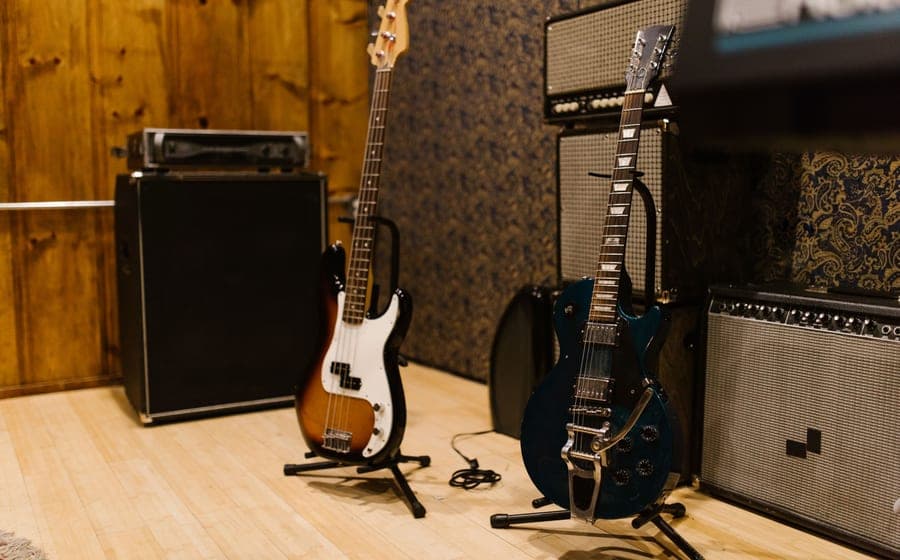
A first amplifier arrives with five or six knobs, no manual worth reading, and no indication of which one is causing the noise. Most beginners turn everything up, decide the amp is bad, and stop touching it.
There is an order to these controls and it makes the whole panel obvious.
Start with everything at halfway and gain at zero. Set volume to a level you can play at. Add gain slowly until you hear the distortion you want. Then adjust bass, middle and treble — one at a time, listening to what changes.
Gain is not volume
This is the whole page in one heading.
Gain (sometimes labeled drive, overdrive or pre-amp) sets how hard the incoming signal is pushed into the amplifier’s first stage. Push it hard and the signal clips — it cannot go any higher, so the tops of the waveform flatten off, and that is what distortion is.
Volume (sometimes master) sets how loud the finished result comes out of the speaker.
Which means you can have a heavily distorted sound at a whisper: gain high, volume low. Beginners who do not know this turn the volume up trying to get distortion, get loud clean instead, and annoy everyone in the building for nothing.
On a two-channel amp like the Fender Frontman 10G#ad, the clean and overdrive channels are two different gain structures with a switch between them rather than a knob.
The tone controls
Bass is the low end — weight and thump. Too much on a small speaker turns to mud, because a six-inch cone cannot reproduce it and just flaps.
Middle is where the guitar actually lives. It is the least glamorous control and the most consequential: scooping the mids out sounds impressive alone and disappears completely the moment anyone else is playing.
Treble is brightness, attack and string noise. Too much is harsh and fatiguing, especially through headphones.
Reverb, if present, simulates a room. A small amount makes almost anything sound better and covers small mistakes. A large amount is a specific effect rather than a default.
Three starting points
Use these as departure points, not destinations. Every guitar, room and pair of ears differs.
| Sound | Gain | Bass | Middle | Treble |
|---|---|---|---|---|
| Clean practice | Zero | Halfway | Just above halfway | Just below halfway |
| Blues / classic rock crunch | Around a third | Halfway | Above halfway | Halfway |
| Rock rhythm | Around two thirds | Just above halfway | Halfway | Just above halfway |
Note that the middle control never goes low. The scooped-mid sound is a trap that makes a guitar vanish in any context with other instruments in it.
The guitar is part of the setting
Half of your tone happens before the signal reaches the amp.
The pickup selector changes the sound more than any single amp knob: a bridge pickup is bright and cutting, a neck pickup is warm and round. The volume control on the guitar itself also feeds the amp less signal, which cleans up an overdriven sound without touching the amp at all — a technique worth learning in week one.
Which pickups you have, and what they do, is in guitar pickups explained.
Why your amp might sound bad anyway
Too much gain. By far the most common. Fizz replaces notes, and every mistake gets smeared together into a noise that seems fine until you record it.
Dead strings. No amp setting rescues strings that have gone dull and false. They are the cheapest fix on this list.
Speaker pointing at your legs. Small combos sit on the floor and fire at your knees, so all you hear is bass. Put it on a chair or tilt it back and the amp transforms.
Treble too high through headphones. Headphones deliver high frequencies straight into your ears with none of the room absorption a speaker gets. Roll the treble back when you plug in the Audio-Technica ATH-M20x#ad.
The sockets, and what to do with them
The back and front panels carry more than the input jack, and two of those sockets change how much practice actually happens.
The aux or line input. A 3.5mm socket that takes a phone or a laptop and mixes it with your guitar through the same speaker. Playing along to recordings is how most beginners practice, and having both sounds come out of one place at a balanced level is genuinely better than a phone speaker fighting an amplifier.
Use it deliberately. Set the backing track first, then bring your guitar up until you can hear yourself slightly under it. A beginner who sets their own volume above the track cannot hear when they are out of time, which is the specific thing playing along is supposed to teach.
The headphone output. Plugging in mutes the speaker on almost every amp that has one. That is what converts “I can play when the house is empty” into “I can play,” and it is the socket to check for before buying anything.
One caution worth repeating: headphones make it very easy to sit at a level you would never tolerate from a speaker. Set it where you could hold a conversation over it.
What you can ignore. Effects loops, line outputs and speaker jacks are for rigs a beginner does not have. Nothing on a small practice amp needs to be connected for it to do its job.
A note on modeling amps
Some small amps carry several voicings rather than one, with a selector that switches between simulations of different classic amplifiers. The Boss Katana Mini#ad is a compact example.
The controls work exactly as described above within each voicing. The only extra advice is to pick one voicing and stay on it for a while — endless switching is a well-documented way to spend a practice session not practicing.
Which amp to buy in the first place is in best beginner guitar amps, and whether you need one at all is in do you need an amp to learn electric guitar.
What we would buy
Fender Frontman 10G
FenderBest for: The default first amp
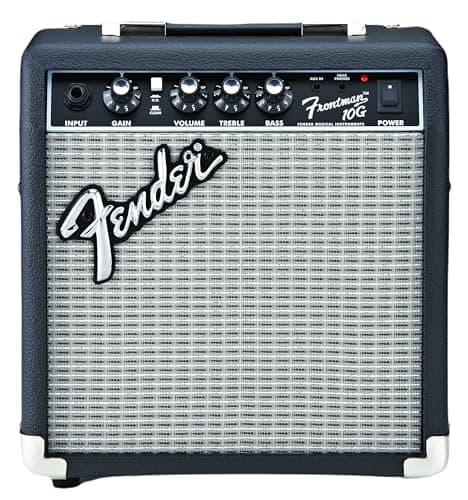
Ten watts, a 6 inch speaker, a headphone socket and an aux input. It is the amplifier almost every first electric guitar gets paired with, and there is no reason to argue with that.
Published specifications
- Power:
- 10 W
- Speaker:
- 6" special design
- Channels:
- Normal and drive, switchable
- EQ:
- 2-band
- Connections:
- 1/8" aux in, 1/8" headphone out
- Cabinet:
- Closed back
- Dimensions:
- 11" H x 10.25" W x 5.75" D
- Weight:
- 8.5 lb
What it gets right
- Headphone output — the single feature that decides whether an electric guitar can be practiced in the evening
- Aux input, so a beginner can play along with a phone without any extra hardware
- Two channels, so clean and distorted are a knob apart rather than a pedal purchase away
Where it gives ground
- The drive channel is fizzy at high gain, which is what you expect from a solid-state amp at this size
- A 6 inch speaker has no low end to speak of
What it is not good at
Playing with a drummer. Ten watts through a 6 inch speaker is a bedroom amplifier, and it will disappear the moment anyone hits a snare. That is fine — it is not what it is for.
How the specs score against a beginner’s needs
Scores are our reading of the published specifications above against what a beginner physically needs. They are not test results — we have not played this instrument.
Specifications from Sweetwater — Fender Frontman 10G specifications.
Boss Katana Mini
BossBest for: Battery power, better tone
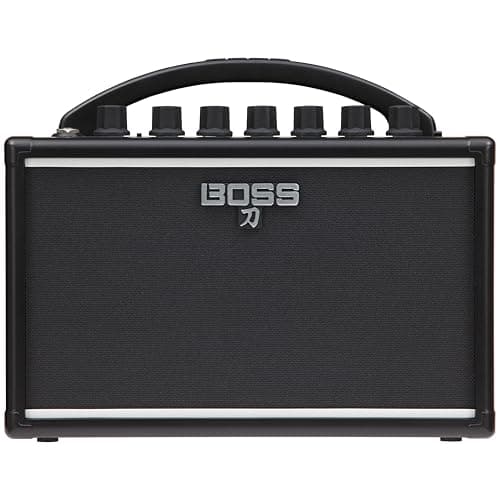
Seven watts, three amp voices and a real analog three-band tone stack, running off AA batteries for around seven hours. It sounds considerably better than its size suggests.
Published specifications
- Power:
- 7 W
- Speaker:
- 4" special design
- Amp types:
- Brown, crunch, clean
- Tone stack:
- Three-band analog
- Effects:
- Built-in tape-style delay
- Power source:
- AC adapter or AA batteries, approx. 7 hours alkaline
- Dimensions:
- 9" x 7" x 5"
- Weight:
- 3 lb
What it gets right
- Battery power and three pounds means it goes to a friend's house, a park, or a bedroom floor without a cable hunt
- A genuine three-band analog tone stack rather than a single tone knob — you can actually shape the sound
- The multi-stage gain circuit is a real step above the fizz of most amps this size
Where it gives ground
- A 4 inch speaker is smaller than the Frontman's 6 inch, and it shows in the low end
- No aux input on the standard model, so playing along to music needs another route
What it is not good at
Being the last amplifier anyone buys. It is excellent for what it is and it is still a 7-watt practice box; a player joining a band will outgrow it fast.
How the specs score against a beginner’s needs
Scores are our reading of the published specifications above against what a beginner physically needs. They are not test results — we have not played this instrument.
Specifications from Sweetwater — Boss Katana Mini specifications.
Audio-Technica ATH-M20x
Audio-TechnicaBest for: Practice headphones
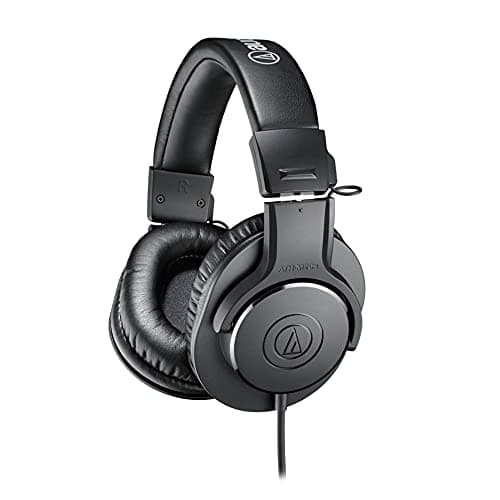
Closed-back 40 mm drivers with a 1/4 inch adapter included, which is the socket most digital pianos actually have. The cheapest headphones we would put on a practicing student.
Published specifications
- Type:
- Closed-back, circumaural (over-ear)
- Drivers:
- 40 mm, copper-clad aluminum voice coils
- Frequency response:
- 15 Hz - 20,000 Hz
- Cable:
- 9.8 ft (3.0 m), single-sided, straight
- Weight:
- 6.7 oz (190 g) without cable
- In the box:
- 6.3 mm (1/4") snap-on adapter
What it gets right
- Closed-back, so the sound stays in and the room stays out — the whole point of practice headphones
- The 1/4 inch adapter is included, and that is the socket most digital pianos have rather than the 1/8 inch a phone uses
- Under 200 grams, which matters over an hour of practice on a child's head
Where it gives ground
- The cable is fixed, not detachable, so a damaged cable means new headphones
- A 3 meter cable is generous at a piano and a trip hazard anywhere else
What it is not good at
Portability. They do not fold flat and there is no case. These live at the instrument.
How the specs score against a beginner’s needs
Scores are our reading of the published specifications above against what a beginner physically needs. They are not test results — we have not played this instrument.
Specifications from Audio-Technica ATH-M20x published specifications.
Questions people actually ask
What is the difference between gain and volume on an amp?
Gain sets how hard the signal is driven into the amplifier, which controls distortion. Volume sets how loud the result comes out of the speaker. High gain at low volume is a distorted sound played quietly; that combination is normal and useful.
What amp settings should a beginner start with?
Everything at halfway, gain low, then adjust one control at a time. Halfway is a deliberately neutral starting point rather than a good sound, and hearing what each knob does is worth more than copying someone else’s numbers.
Why does my amp sound bad?
Most often too much gain, which turns everything into fizz and hides the notes. After that: dead strings, treble set high on a small speaker, or standing directly in front of a speaker that is pointing at your knees rather than your ears.
Should I practice with distortion?
Mostly not, early on. Distortion compresses everything and disguises unclean fretting and unmuted strings. A clean tone tells you the truth about your playing, which is what practice is for.
Sources
Still deciding?
Every recommendation on this site is built the same way, and the method is published in full — including what we do not do and what would get a pick dropped.
Read next
- Best beginner guitar amps
Why the headphone socket outranks wattage, two picks, and the honest limits of a practice amp.
- Do you need an amp to learn electric guitar?
What playing unplugged hides, when an amp becomes necessary, and three silent routes for players who cannot make noise.
- Guitar pickups, explained without the jargon
Single-coils versus humbuckers, what the hum actually is, and how to read SSS, HSS and HH against the music you listen to.
- Are guitar starter packs worth it?
Which pack contents hold up, which get replaced within a month, and the four-item alternative that costs about the same.
- Best beginner electric guitars: what's worth it from $150 to $400
Segmented by player and price band, with the three specs that actually decide whether a first electric survives its first year.