Guitars
Fender Frontman 10G vs Boss Katana Mini
Two small practice amps that cost about the same and solve different problems. One of them has a headphone socket, and for a lot of beginners that settles it.
By Sawyer V. · Published · Last updated
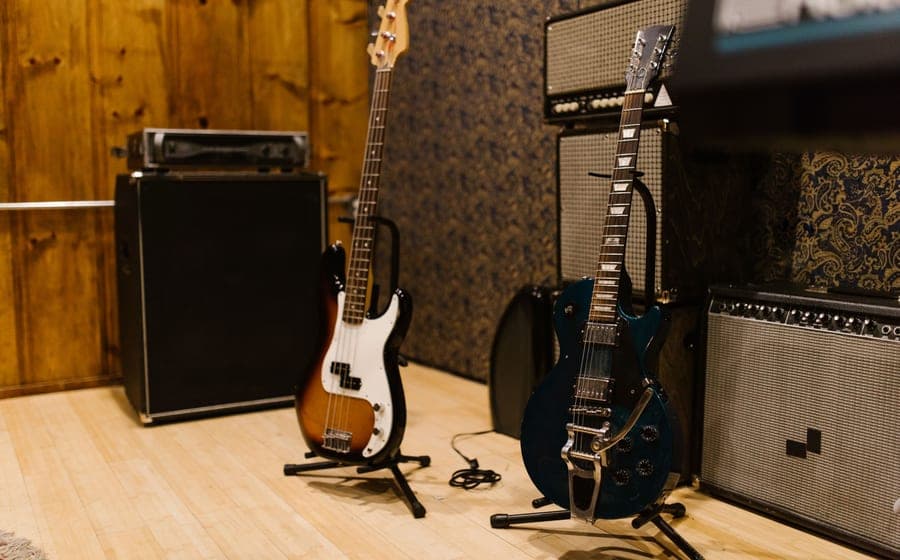
Almost every first electric guitar is sold next to one of these two amps, and they are not interchangeable. One is built to be the cheapest competent practice amp; the other is built to sound good at very low volume and go anywhere.
We have not played either. This is our reading of published specifications; the method is on how we pick.
Buy the Fender Frontman 10G#ad if you share walls or a house: the headphone output means practice can be silent. Buy the Boss Katana Mini#ad if you can make noise and want the better sound, or if the amp needs to run on batteries.
The headphone jack decides most of these
The Frontman publishes a 1/8 inch headphone output and a 1/8 inch aux input. That is two practical wins: you can practice at midnight, and you can play along with a phone.
The Katana Mini has neither in the same form. It is a small combo built to be heard in the room, and Boss’s answer to silent practice is a separate product line — which is why we cover those separately in best headphone amps for guitar.
If the household constraint is real, that single specification outweighs everything else on this page.
Where the Katana Mini wins
Three amp voices rather than two channels. Brown, crunch and clean, which covers more ground than the Frontman’s normal and drive.
A three-band analog tone stack. Bass, middle and treble against the Frontman’s two-band EQ. More control over how the amp sits in a small room.
Built-in delay. A tape-style delay on board, which is a real effect rather than a gimmick and the first one most players want.
Batteries and weight. Roughly seven hours on AAs, and 3 lb against the Frontman’s 8.5 lb. It goes in a bag.
What neither does
Neither is loud enough to play with an acoustic drummer — 10 W through a 6 inch speaker and 7 W through a 4 inch speaker are practice specifications. Neither has a proper effects loop or line out for recording. And neither will make a beginner sound good on its own: the amp settings matter as much as the amp, which is why we wrote guitar amp settings for beginners.
Who should buy which
Frontman 10G: apartments, shared houses, families with sleeping children, and anyone whose realistic practice window is late at night.
Katana Mini: a house with space, a player who cares about tone early, and anyone who wants to carry the amp to a friend’s place or outside.
Pairings with specific guitars are in best guitar and amp pairings, and the wider field is in best beginner guitar amps.
What we would buy
Fender Frontman 10G
FenderBest for: The default first amp
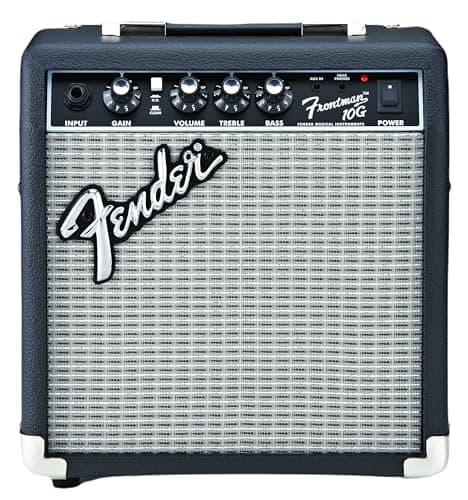
Ten watts, a 6 inch speaker, a headphone socket and an aux input. It is the amplifier almost every first electric guitar gets paired with, and there is no reason to argue with that.
Published specifications
- Power:
- 10 W
- Speaker:
- 6" special design
- Channels:
- Normal and drive, switchable
- EQ:
- 2-band
- Connections:
- 1/8" aux in, 1/8" headphone out
- Cabinet:
- Closed back
- Dimensions:
- 11" H x 10.25" W x 5.75" D
- Weight:
- 8.5 lb
What it gets right
- Headphone output — the single feature that decides whether an electric guitar can be practiced in the evening
- Aux input, so a beginner can play along with a phone without any extra hardware
- Two channels, so clean and distorted are a knob apart rather than a pedal purchase away
Where it gives ground
- The drive channel is fizzy at high gain, which is what you expect from a solid-state amp at this size
- A 6 inch speaker has no low end to speak of
What it is not good at
Playing with a drummer. Ten watts through a 6 inch speaker is a bedroom amplifier, and it will disappear the moment anyone hits a snare. That is fine — it is not what it is for.
How the specs score against a beginner’s needs
Scores are our reading of the published specifications above against what a beginner physically needs. They are not test results — we have not played this instrument.
Specifications from Sweetwater — Fender Frontman 10G specifications.
Boss Katana Mini
BossBest for: Battery power, better tone
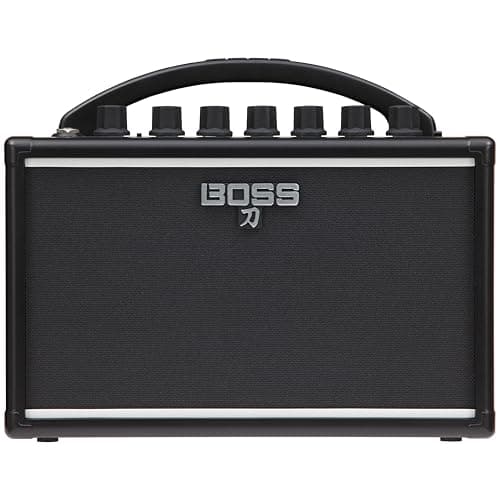
Seven watts, three amp voices and a real analog three-band tone stack, running off AA batteries for around seven hours. It sounds considerably better than its size suggests.
Published specifications
- Power:
- 7 W
- Speaker:
- 4" special design
- Amp types:
- Brown, crunch, clean
- Tone stack:
- Three-band analog
- Effects:
- Built-in tape-style delay
- Power source:
- AC adapter or AA batteries, approx. 7 hours alkaline
- Dimensions:
- 9" x 7" x 5"
- Weight:
- 3 lb
What it gets right
- Battery power and three pounds means it goes to a friend's house, a park, or a bedroom floor without a cable hunt
- A genuine three-band analog tone stack rather than a single tone knob — you can actually shape the sound
- The multi-stage gain circuit is a real step above the fizz of most amps this size
Where it gives ground
- A 4 inch speaker is smaller than the Frontman's 6 inch, and it shows in the low end
- No aux input on the standard model, so playing along to music needs another route
What it is not good at
Being the last amplifier anyone buys. It is excellent for what it is and it is still a 7-watt practice box; a player joining a band will outgrow it fast.
How the specs score against a beginner’s needs
Scores are our reading of the published specifications above against what a beginner physically needs. They are not test results — we have not played this instrument.
Specifications from Sweetwater — Boss Katana Mini specifications.
Questions people actually ask
Which amp is better for an apartment?
The Frontman 10G, for one reason: it has a headphone output and the Katana Mini does not. Silent practice is the single most useful feature a first amp can have in a shared building.
Which one sounds better?
The Katana Mini, by reputation and by design: three amp voices, a three-band analog tone stack and a built-in tape-style delay against the Frontman’s two channels and two-band EQ. It is the more musical amp at low volume.
Can the Katana Mini run on batteries?
Yes, on AA batteries for approximately seven hours on alkalines, or from an AC adapter. The Frontman is mains-powered only.
Are either of these loud enough to play with a drummer?
No. At 10 W through a 6 inch speaker and 7 W through a 4 inch speaker respectively, both are bedroom amps. Playing with an acoustic drummer needs considerably more amp.
Do I need an amp at all to start?
For an electric guitar, you need something. A headphone amp is the cheapest route if silence is the priority — see best headphone amps for guitar.
Still deciding?
Every recommendation on this site is built the same way, and the method is published in full — including what we do not do and what would get a pick dropped.
Read next
- Best beginner guitar amps
Why the headphone socket outranks wattage, two picks, and the honest limits of a practice amp.
- Do you need an amp to learn electric guitar?
What playing unplugged hides, when an amp becomes necessary, and three silent routes for players who cannot make noise.
- Best headphone amps for guitar
How a headphone amp differs from a practice amp, what to check before buying, and three picks for silent practice at home.
- Guitar amp settings, explained
What each control does, a neutral starting point to dial in from, and the three settings that cover most beginner playing.
- Best guitar and amp pairings for beginners
Three complete first rigs matched to what you want to play, plus where to spend first when the budget only stretches to one of them.