Guitars
Best headphone amps for guitar
The device that makes an electric guitar apartment-friendly. It plugs into the guitar, headphones plug into it, and the room stays silent.
By Sawyer V. · Published · Last updated
The most common reason an electric guitar stops being played in a flat or a shared house is not the guitar. It is that practicing means either annoying somebody or turning the amp so low that the instrument sounds like a toy.
A headphone amp solves that completely. It plugs into the guitar’s jack, headphones plug into it, and you get a full, loud, distorted sound that exists only inside your head. It is the single best purchase for an electric player who lives with other people.
We have not played these units. This is our reading of the manufacturers’ published specifications against what a beginner needs; the method, including what we refuse to claim, is on how we pick.
If you learn by playing along with records, buy the Fender Mustang Micro. If you want the most sounds and a screen you can read without a phone, buy the BOSS Katana:GO. If you want the cheapest thing that works, and replaceable batteries rather than a charger, buy the Vox amPlug 3. All three need headphones, which none of them include.
What these actually replace
A small practice amp does three jobs: it makes the guitar audible, it provides amp character, and it lets other people hear you. A headphone amp does the first two and deliberately refuses the third.
For a beginner that trade is usually correct. The first year is spent alone, learning chord changes, and the ability to do that at 11pm without a conversation is worth more than a speaker. The point at which you need real air moving is the point at which you play with a drummer.
If the room is the real constraint across every instrument, not just this one, the wider version of that decision is in best instruments for small apartments.
What to check before buying
1. How backing tracks get in. The single most important question, and the one buyers skip. A wired aux jack accepts any phone or laptop with no pairing and no latency. Bluetooth is tidier and, on the Fender, syncs video as well — which matters if you learn from lesson videos.
2. Whether it records. A USB port that presents the unit as an audio interface turns it into a recording rig. That is not a first-month need, and it is the difference between a device you outgrow and one you keep.
3. Batteries or charging. Rechargeable units publish a runtime and then need a cable. Battery units keep going as long as you have two AAAs. Neither is better; they fail differently.
4. The plug and your guitar. These hang off the output jack, and jack plates vary: flat on a Stratocaster, recessed and angled on others. Rotating plugs exist for exactly this reason.
5. The headphones you already own. A headphone amp is only as good as what follows it. Earbuds will sound thin no matter which unit you buy.
How we ranked these
Sound options first, then how easily you can play along with music, then recording, then battery and charging, then room to grow. All of it from published specifications rather than listening.
The picks
The Fender Mustang Micro#ad is the one we would hand most beginners. Twelve amp models, Bluetooth audio streaming with automatic audio and video sync, and USB-C that records the guitar and that streamed track together. The plug rotates through 270 degrees, so it clears awkward jack plates. It weighs 1.8 ounces.
Two honest costs. There is no aux input at all, so a backing track has to arrive over Bluetooth — fine with a phone, awkward with an old laptop. And Fender publishes four hours of play time on a sealed battery, so when it is flat, practice waits for a charger. Fender’s own page is also inconsistent about whether there are 11 or 12 effects.
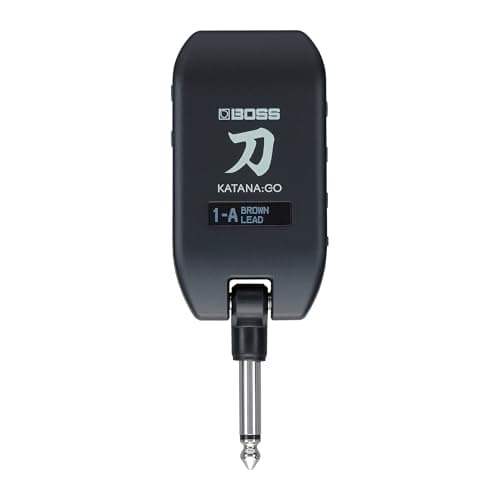
The BOSS Katana:GO#ad is the most capable. Ten guitar amp types and three bass types with thirty memories each, more than sixty effects, Bluetooth audio and MIDI, and a USB-C audio interface running at 32-bit. It is the only one with a display, so tones and the built-in tuner are readable on the unit rather than in an app. BOSS publishes the headphone output in detail, down to the minimum impedance.
The costs: no aux input here either, deeper editing lives in the BOSS Tone Studio app, and it is the most complicated device on the page. A beginner who wanted a volume knob and one good sound has bought a lot of menu.
The Vox amPlug 3 AC30#ad is the cheapest way to stop annoying your neighbors, and for many people it is enough. Two channels, four effects, nine rhythm patterns plus a metronome from 40 to 240 bpm, and — the practical win — a wired 3.5 mm aux jack. Any phone, laptop or old MP3 player feeds it with no pairing.
It runs on two AAA batteries, which Vox publishes at 11 to 17 hours on alkalines in the manual and 10 to 16 on its website. It has no Bluetooth and no USB, so it cannot record. Batteries are not in the box, and neither are headphones.
What you still need
Headphones. Closed-back, over-ear, wired. Wireless headphones add delay, and even a small delay makes playing in time impossible. A monitoring pair such as the Audio-Technica ATH-M20x#ad is the usual answer, and the same headphones serve an electronic drum kit or a digital piano later.
A cable adapter, possibly. Most of these output a 3.5 mm mini jack, so headphones with a quarter-inch plug need an adapter.
Nothing else. No stand, no speaker, no power supply. That is the appeal.
When the time comes for a speaker amp — and for an electric player it eventually does — the small combos worth owning are in best beginner guitar amps.
Quick picks
The most amp for the money
Ten guitar amp types and three bass types, thirty memories each, a screen on the unit and a 32-bit USB audio interface.
| # | Product | Best for | Score | Price |
|---|---|---|---|---|
| 1 | BOSS Katana:GOThe most capable of the three and the only one with a screen. | Guitar and bass in oneEnough | 8.6 | $109.50 · View on Amazon #ad How we’re funded |
Practicing along to records
Bluetooth audio with automatic sync, and USB-C that records your guitar and the streamed track together. The one for learning songs.
| # | Product | Best for | Score | Price |
|---|---|---|---|---|
| 1 | 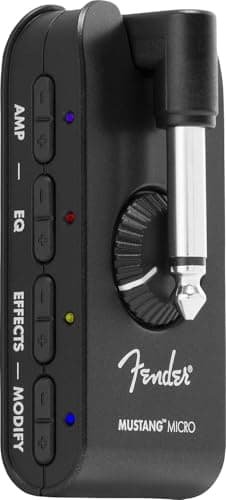 Fender Mustang MicroThe one to buy if you learn by playing along. | Practicing to recordsEnough | 7.8 | $98.99 · View on Amazon #ad How we’re funded |
The cheapest way in
Two channels, built-in rhythms, a wired aux jack and two AAA batteries. No charging, no pairing, no app.
| # | Product | Best for | Score | Price |
|---|---|---|---|---|
| 1 | 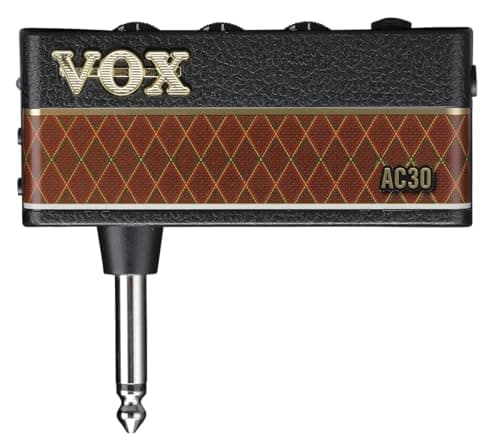 Vox amPlug 3 AC30A plug that turns a guitar into a headphone rig for the price of a couple of sets of strings. | The cheapest way to play silentlyThe honest floor | 7.0 | $39.98 · View on Amazon #ad How we’re funded |
The picks in full
BOSS Katana:GO
BOSSBest for: Guitar and bass in one
The most capable of the three and the only one with a screen. Ten guitar amp types and three bass types, thirty memories per mode, Bluetooth, and a USB-C audio interface at 32-bit.
Published specifications
- Amp types:
- Guitar mode 10 amp types; bass mode 3 types
- Effects / memories:
- 60+ effects, 30 memories per mode
- Bluetooth:
- A2DP audio and MIDI over Bluetooth LE; BOSS Tone Studio app
- USB / recording:
- USB-C audio interface, 48 kHz, 32-bit
- Battery:
- Rechargeable lithium-ion, approx. 5 hours use, approx. 3 hours charge
- Output:
- Stereo mini headphone out, 30 mW + 30 mW, 16 ohms or greater
- Display / size:
- 128 x 32 OLED; 45 x 125 x 29 mm; 65 g
What it gets right
- Covers guitar and bass in one unit, with thirty memories for each
- An OLED display means tones and the tuner are readable on the device instead of only in an app
- Publishes its headphone output in detail (30 mW per side, 16 ohm minimum), so headphone matching is documented
- Longest published runtime of the two rechargeables here at about five hours
Where it gives ground
- No aux input, so wired backing tracks are not an option — audio has to arrive over Bluetooth or USB
- Deep editing and firmware updates run through the BOSS Tone Studio app rather than the unit itself
- Headphones are not included; the box holds the unit, leaflets and a USB-C cable
What it is not good at
Simplicity. It is the most featured device here, and a beginner who wanted a volume knob and a sound has more menu than they asked for.
How the specs score against a beginner’s needs
Scores are our reading of the published specifications above against what a beginner physically needs. They are not test results — we have not played this instrument.
Specifications from BOSS — Katana:GO product page, BOSS — Katana:GO specifications.
Fender Mustang Micro
FenderBest for: Practicing to records
The one to buy if you learn by playing along. Bluetooth audio streams from a phone with automatic sync, USB-C records your guitar and that stream together, and the plug rotates to fit almost any jack angle.
Published specifications
- Amp models:
- 12 amp models; Fender's spec table lists 11 effect models, its feature list says 12 effect combinations
- Bluetooth:
- Audio streaming with automatic audio and video sync
- USB / recording:
- USB-C, records guitar and the Bluetooth stream simultaneously
- Battery:
- Rechargeable lithium-ion, 4 hours continuous play, charges over USB
- Output:
- 1/8 inch stereo headphone out
- Plug:
- 270 degree rotating 1/4 inch plug
- Size / weight:
- 1.5" W x 1.13" D x 3.15" H; 1.8 oz (51 g)
What it gets right
- Bluetooth streaming with automatic audio and video sync, so backing tracks and lesson videos line up
- Records the guitar and the streamed track together over USB-C, which no other pick here does
- The 270 degree rotating plug clears recessed and angled jack plates
- 1.8 oz with the battery inside — nothing to carry but headphones
Where it gives ground
- No aux input at all, so playing along requires a Bluetooth source
- Four hours is Fender's own figure, on a sealed battery with no swap — when it is flat, practice waits for the charger
- Headphones are not included, and the amp is only as good as the headphones you own
What it is not good at
Long sessions away from power. The published runtime is fixed and the cell cannot be swapped.
How the specs score against a beginner’s needs
Scores are our reading of the published specifications above against what a beginner physically needs. They are not test results — we have not played this instrument.
Specifications from Fender — Mustang Micro.
Vox amPlug 3 AC30
VoxBest for: The cheapest way to play silently
A plug that turns a guitar into a headphone rig for the price of a couple of sets of strings. Two channels, built-in rhythms, a wired aux jack, and two AAA batteries you can replace anywhere.
Published specifications
- Voices:
- Two channels — normal and Top Boost
- Effects:
- Tremolo, chorus, delay, reverb (per the amPlug 3 manual)
- Rhythm:
- 9 patterns plus metronome, 40-240 bpm
- Jacks:
- 3.5 mm headphone out, 3.5 mm TRRS aux in
- Power:
- Two AAA batteries; Vox publishes 11 h / 17 h alkaline in the manual and 10 h / 16 h on its site
- Size / weight:
- 87 x 33 x 39 mm folded; 40 g without batteries
- Bluetooth / USB:
- None published
What it gets right
- A wired aux jack means any phone or laptop feeds backing tracks with no pairing and no latency
- The longest published runtime here, and a flat battery is fixed by two AAAs from any shop
- Nine rhythm patterns plus a metronome give a timing reference without opening an app
- 40 g and it folds — it lives in a gig bag pocket
Where it gives ground
- No Bluetooth and no USB, so it cannot record into a computer or stream wirelessly
- Headphones and batteries are both excluded — Vox lists only a quick start guide in the box
- Vox's own site and manual disagree about battery life (10/16 h against 11/17 h)
What it is not good at
Recording. There is no digital output of any kind, so what you play through it stays in the headphones.
How the specs score against a beginner’s needs
Scores are our reading of the published specifications above against what a beginner physically needs. They are not test results — we have not played this instrument.
Specifications from Vox — amPlug 3 product page, Vox UK — amPlug 3 AC30.
Questions people actually ask
What is a headphone amp for guitar?
A small unit that plugs straight into the guitar’s output jack and produces amp sounds into headphones. There is no speaker, so nobody else hears anything. For an electric guitar in a shared home, it replaces the practice amp entirely.
Is a headphone amp enough, or do I still need a real amp?
It is enough for practicing alone, which is most of the first year. You need a speaker amp the moment you play with other people in a room, because headphones cannot do that. The fuller answer is in do you need an amp for electric guitar.
Can you play along with songs through one?
Yes, and the method differs by model. The Fender and the BOSS take audio over Bluetooth; the Vox has a wired aux jack. Wired means no pairing and no delay; Bluetooth means no cable. All three mix the track with your guitar in the headphones.
Do they come with headphones?
None of them do, and the headphones matter as much as the amp. Closed-back monitoring headphones are the sensible pairing, and the same ones work for an electronic drum kit or a digital piano.
Will it work on an acoustic guitar?
Only if the acoustic has a pickup and an output jack. These plug into a jack, so a plain acoustic has nothing to plug into. An acoustic-electric works fine.
Sources
Still deciding?
Every recommendation on this site is built the same way, and the method is published in full — including what we do not do and what would get a pick dropped.
Read next
- Do you need an amp to learn electric guitar?
What playing unplugged hides, when an amp becomes necessary, and three silent routes for players who cannot make noise.
- Best beginner guitar amps
Why the headphone socket outranks wattage, two picks, and the honest limits of a practice amp.
- Best instruments for an apartment
Four instruments that survive a shared wall, ranked by how quiet they are at their loudest, plus the headphones that make the difference.
- Best beginner electric guitars: what's worth it from $150 to $400
Segmented by player and price band, with the three specs that actually decide whether a first electric survives its first year.
- Guitar accessories you actually need
The four accessories that change how a beginner's guitar plays, the ones that can wait, and the ones that are pure margin.