Drums
Acoustic vs electronic drums for beginners
Most comparisons pretend this is about tone. It is about how many hours the instrument can actually be played in the room it will live in.
By Sawyer V. · Published · Last updated
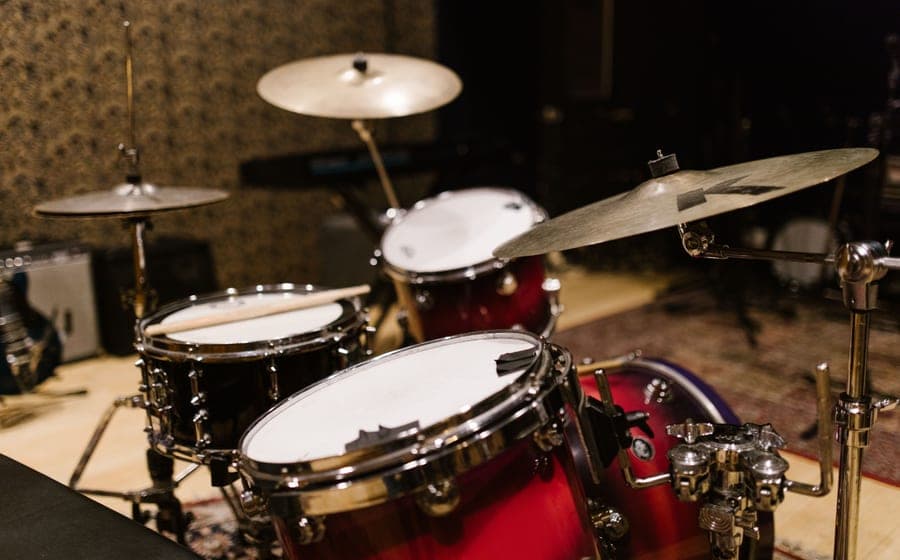
Acoustic drums teach more, particularly cymbal technique, and cannot be played quietly. Electronic drums with mesh heads teach nearly as much and can be played with headphones at any hour. The right answer is whichever one will actually be played in the room it lives in.
Side by side
| Acoustic | Electronic (mesh) | |
|---|---|---|
| Volume | Very loud, unavoidably | Quiet in the room; the kick still thumps the floor |
| Drum feel | The reference | Close on mesh |
| Cymbal feel | The reference | Not close |
| Dynamic range | Complete | Compressed by the sensor |
| Play along to music | Needs loud speakers or in-ears | Built in, often over Bluetooth |
| Floor space | Large | Smaller, and often foldable |
| Running costs | Heads, sticks, cymbal upgrades | Sticks, occasional mesh head |
| Maintenance | Tuning, head changes | Essentially none |
| Resale | Good, and awkward to ship | Good, and easy to move |
The question that decides it
Not which sounds better. This one: how many hours a week can this be played in the room it will live in?
An acoustic kit is well above the level NIOSH treats as safe for prolonged exposure and audible through walls, floors and closed doors. In a detached house with understanding neighbors that is a daytime constraint. In an apartment or a semi-detached it can mean two hours on a Saturday afternoon.
Twenty minutes every evening is roughly two and a half hours a week, spread across seven sessions. Two hours on a Saturday is two hours, in one session, when the player may not feel like it. The first schedule produces a drummer and the second one mostly does not, and no amount of superior cymbal feel closes that gap.
So: answer the building question first, then buy the kit that fits the answer.
What acoustic teaches that electronic does not
Cymbal technique, mainly. A hi-hat can be closed tight, held slightly open, opened wide, or moved through those states while being struck, and each produces a distinct sound. A crash responds differently depending on where along its radius it is hit. This vocabulary is a large part of what makes drumming expressive, and an entry electronic kit’s pads reproduce a fraction of it.
Full dynamic range. A real drum has an enormous range between the quietest and loudest usable stroke. Electronic pads sense velocity in steps and compress that range, so a player learns a narrower expressive palette.
Tuning. An acoustic drummer learns to tune drums, which is a real skill and part of getting a sound they like. Electronic kits remove the task entirely.
What electronic gives that acoustic does not
Practice at any hour, which is the whole argument.
Playing along, easily. Music straight into the headphones at the same level as the kit, which is the single most enjoyable way to practice and is genuinely awkward on an acoustic kit.
Metronome and recording built in, so a player can hear what they actually sound like — which is frequently a revelation and always useful.
No hearing damage risk. Worth stating plainly. An acoustic kit requires hearing protection every session, forever, and hearing damage does not heal.
The middle path
Many drummers own an electronic kit at home and use an acoustic kit at a lesson, rehearsal room or school. That is a genuinely good arrangement: the electronic kit carries the daily practice and the acoustic sessions build the cymbal and dynamic skills the pads cannot.
If there is a teacher involved, ask whether the lessons happen on an acoustic kit before deciding — that alone may settle it.
What we would buy
Pearl Roadshow RS525SC
PearlBest for: Complete acoustic kit, teen and up
A full 22 inch kick, five drums, four stands, a pedal, a throne and cymbals, on 9-ply poplar shells with hand-cut bearing edges. Nothing else needs buying to play it.
Published specifications
- Configuration:
- 5-piece: 22x16 bass, 14x5.5 snare, 10x8 and 12x9 rack toms, 16x16 floor tom
- Shells:
- 9-ply poplar, 7 mm, hand-cut 45-degree bearing edges
- Hoops:
- 1.6 mm triple-flanged steel
- Hardware included:
- H-50 hi-hat, C-50 cymbal, S-50 snare stand, P-50 pedal, D-50 throne
- Cymbals included:
- 16" brass crash/ride, 14" hybrid hi-hats
- Also included:
- Two pairs of maple sticks, stick bag
What it gets right
- Genuinely complete — stands, pedal, throne, cymbals and sticks are all in the box, which almost never happens at this price
- Hand-cut 45-degree bearing edges on poplar shells; the edge is what lets a drum be tuned at all
- Triple-flanged steel hoops rather than the pressed hoops on the tier below
Where it gives ground
- The included brass cymbals are the weak point and the first thing anyone replaces
- A 22 inch kick is a full-size kit and needs the floor space of one
What it is not good at
Being quiet, or fitting a child. This is a loud acoustic kit at adult dimensions — a 22 inch bass drum puts the pedal where an eight-year-old's leg does not reach. For that buyer, see the kids' kits and the electronic options.
How the specs score against a beginner’s needs
Scores are our reading of the published specifications above against what a beginner physically needs. They are not test results — we have not played this instrument.
Specifications from Pearl Roadshow RS525SC published specifications (Percussion Source).
Alesis Nitro Max Kit
AlesisBest for: Apartments and shared walls
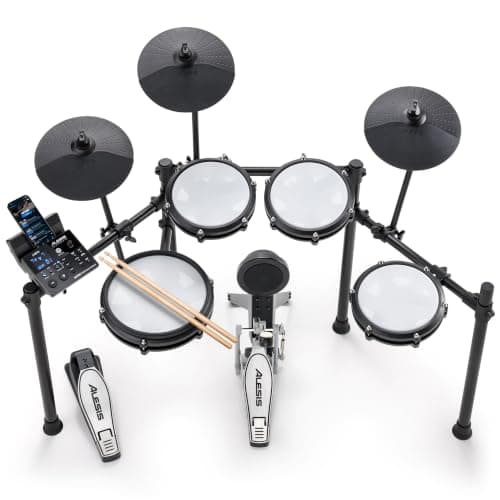
Mesh heads on every pad, a dual-zone snare and Bluetooth audio for playing along. Mesh is the spec that makes an electronic kit tolerable to sit at for an hour.
Published specifications
- Pads:
- 10" dual-zone mesh snare, three 8" mesh toms
- Cymbals:
- Three 10" pads — hi-hat, crash, ride
- Module:
- 440 sounds, 32 kits, 60 play-along songs, performance recorder
- Connectivity:
- Bluetooth audio, USB-MIDI
- Mounting:
- Included four-post rack
- Weight:
- Under 15 kg complete
What it gets right
- Mesh heads on every drum pad — quieter and far closer to a real rebound than the rubber pads a tier down
- Bluetooth audio means playing along to a phone with no cable and no extra mixer
- USB-MIDI, so it doubles as a controller for recording software later
Where it gives ground
- Mesh heads are quiet in the room but the kick pedal thumps through a floor; downstairs neighbors still hear it
- Single-zone toms — no rimshot on anything except the snare
What it is not good at
Teaching cymbal technique. Three 10 inch pads cannot reproduce how a real hi-hat or a crash responds, and a drummer moving to an acoustic kit later has that to learn from scratch.
How the specs score against a beginner’s needs
Scores are our reading of the published specifications above against what a beginner physically needs. They are not test results — we have not played this instrument.
Specifications from Alesis Drums — Nitro Max Kit.
Questions people actually ask
Acoustic or electronic drums for beginners?
Whichever can be played more hours in the room it will live in. If noise is not a constraint, acoustic teaches more, particularly cymbal technique. If noise is a constraint at all, electronic, because practice hours beat authenticity by a wide margin at beginner level.
Do electronic drums feel like real drums?
Mesh pads feel close on the drums themselves — the rebound is genuinely similar. Cymbals do not feel close at all; a rubber pad cannot reproduce how a real cymbal responds to strike position and angle. Rubber drum pads also do not feel close and should be avoided.
Will I struggle on an acoustic kit if I learned on electronic?
Timing, limb independence, rudiments and groove all transfer intact. Cymbal work and the dynamic range of a real drum are the gaps, and they are a few months of adjustment rather than starting over.
Which is cheaper to own?
Long-term, electronic. An acoustic kit consumes drum heads and sticks and most drummers eventually replace the entry cymbals, which is a significant cost. An electronic kit consumes sticks and, occasionally, a mesh head.
Sources
Still deciding?
Every recommendation on this site is built the same way, and the method is published in full — including what we do not do and what would get a pick dropped.
Read next
- Best beginner drum sets: complete kits for teens and adults
Complete acoustic and electronic kits for adult players, with the total-purchase problem and the noise question both addressed.
- Best electronic drum sets for beginners
Mesh versus rubber pads, the kick-thump problem that headphones do not solve, and picks for adults and children.
- How loud are drums?
Measured decibel levels against the NIOSH limit, what travels through walls and floors, and which quieting options actually work.
- Drum kit or practice pad first?
What a pad genuinely teaches, what it cannot, and when starting on one is the right call rather than a compromise.
- How much should a beginner drum set cost?
Four bands defined by completeness and hardware quality, with the shells-only trap and the real running costs.