Drums
Best electronic drum sets for beginners
One specification separates an electronic kit you will practice on from one you will resent. It is the pad material, and it is not subtle.
By Sawyer V. · Published · Last updated
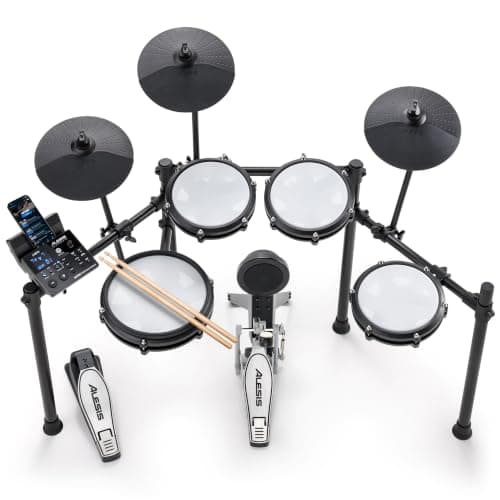
Electronic drum kits exist to solve one problem: an acoustic kit is too loud to practice in most homes. They solve it well, and the entry tier has improved considerably. One specification separates a kit worth owning from one that will be resented, and it is the pad material.
Both picks state their Starter Path band and what they give up. We have not played either — our method is on how we pick.
Mesh or rubber: the whole decision
A rubber pad is a solid slab with a sensor under it. A mesh pad is a woven fabric head stretched over a shell and tensioned with lugs, like a real drum head.
Rebound. Drumming technique depends on the stick bouncing back off the head. A great deal of what a drummer learns is controlling that bounce — a double stroke, for example, is one motion that produces two hits because the stick rebounds. Mesh rebounds like a drum head. Rubber barely rebounds at all, so a drummer who learns on rubber develops a stroke that does not work on a real drum.
Room noise. A wooden stick on hard rubber makes a genuine clack that carries. On mesh it is a soft patter. For an instrument bought specifically to be quiet, this is not a detail.
Fatigue. Without rebound the player lifts the stick manually every time. Over an hour that is tiring in a way playing a real drum is not.
Both kits here use mesh throughout. Below their price you find rubber, and we would rather someone bought a practice pad and saved for mesh than bought a rubber kit.
What an electronic kit will not teach
Being clear about this is the point of the site, so: cymbals.
A real hi-hat is two cymbals that can be pressed tightly together, held slightly apart, opened wide, or moved between those states while being struck. The sounds are completely different from one another and controlling that is a central drumming skill. A crash cymbal responds differently depending on where along its radius it is hit and at what angle.
A 10 inch pad with a sensor approximates a few of those states. A drummer who spends two years on an entry electronic kit and then sits at an acoustic will find their hands and feet perfectly coordinated and their cymbal work starting from close to zero.
That is a real cost and it is smaller than the cost of not practicing. Everything else — timing, limb independence, rudiments, reading, groove, dynamics on the drums themselves — transfers intact.
The kick pedal problem
The thing nobody mentions when recommending electronic drums for apartments.
The pads are quiet. The bass drum pedal is not, in the specific sense that matters to a downstairs neighbor. Every kick stroke sends a physical thump through the pedal frame into the floor, and floors transmit low-frequency impacts extremely well. Headphones do nothing about it because the noise is not sound in the air, it is vibration in the structure.
The fix is a noise-isolation mat — a dense foam or rubber layer under the whole kit — or at minimum a thick rug over a folded blanket. It is worth budgeting for if there is anyone below.
What to skip
Rubber-pad kits, covered above.
Very cheap kits with a flimsy rack. The rack holds everything in position and is hit indirectly thousands of times per session. A rack that drifts means constant re-tightening mid-practice, which is exactly the kind of friction that stops someone sitting down at it.
Kits with no headphone socket. They exist and they defeat the entire purpose.
What you also need
Closed-back headphones. Closed-back rather than open, so the sound stays in and the stick noise stays out. Any decent pair works.
A throne, if not included. The Debut includes one; the Nitro Max does not. A drum throne is height-adjustable and round for a reason — a dining chair puts the player at the wrong height and its back gets in the way of their arms.
A noise-isolation mat, if there is a floor below.
A kick pedal, on some kits. Entry kits often include a simple pedal or a pedal-and-trigger unit. Check which, because a kit whose kick is a foot switch rather than a real pedal will not build any of the technique the real thing needs.
Headphones, and not just any pair. An electronic kit still makes real physical noise when sticks hit pads, so ordinary headphones leave you turning the volume up to compete with it. What to use instead is in best headphones for electronic drums.
Quick picks
Teenagers and adults
Mesh heads throughout, a dual-zone snare and Bluetooth audio for playing along without another cable.
| # | Product | Best for | Score | Price |
|---|---|---|---|---|
| 1 | Alesis Nitro Max KitMesh heads on every pad, a dual-zone snare and Bluetooth audio for playing along. | Apartments and shared wallsEnough | 8.4 | $449.00 · View on Amazon #ad How we’re funded |
Children, roughly ages 5 to 9
Small pads on a small rack, with headphones and a throne in the box. The geometry is built for a child rather than shrunk from an adult kit.
| # | Product | Best for | Score | Price |
|---|---|---|---|---|
| 1 | No image Alesis Debut KitFour 6 inch mesh pads sized and spaced for a small child, with headphones, a throne and sticks in the box. | Ages roughly 5-9The honest floor | 8.0 | Check price on Amazon → #ad How we’re funded |
The picks in full
Alesis Nitro Max Kit
AlesisBest for: Apartments and shared walls
Mesh heads on every pad, a dual-zone snare and Bluetooth audio for playing along. Mesh is the spec that makes an electronic kit tolerable to sit at for an hour.
Published specifications
- Pads:
- 10" dual-zone mesh snare, three 8" mesh toms
- Cymbals:
- Three 10" pads — hi-hat, crash, ride
- Module:
- 440 sounds, 32 kits, 60 play-along songs, performance recorder
- Connectivity:
- Bluetooth audio, USB-MIDI
- Mounting:
- Included four-post rack
- Weight:
- Under 15 kg complete
What it gets right
- Mesh heads on every drum pad — quieter and far closer to a real rebound than the rubber pads a tier down
- Bluetooth audio means playing along to a phone with no cable and no extra mixer
- USB-MIDI, so it doubles as a controller for recording software later
Where it gives ground
- Mesh heads are quiet in the room but the kick pedal thumps through a floor; downstairs neighbors still hear it
- Single-zone toms — no rimshot on anything except the snare
What it is not good at
Teaching cymbal technique. Three 10 inch pads cannot reproduce how a real hi-hat or a crash responds, and a drummer moving to an acoustic kit later has that to learn from scratch.
How the specs score against a beginner’s needs
Scores are our reading of the published specifications above against what a beginner physically needs. They are not test results — we have not played this instrument.
Specifications from Alesis Drums — Nitro Max Kit.
Alesis Debut Kit
AlesisBest for: Ages roughly 5-9
Four 6 inch mesh pads sized and spaced for a small child, with headphones, a throne and sticks in the box. Alesis states it is designed for ages 5 to 9 and the geometry backs that up.
Published specifications
- Pads:
- Four 6" mesh pads (snare and three toms)
- Cymbals:
- Three 10" pads — hi-hat, crash, ride
- Pedals:
- Hi-hat and bass drum pedals included
- Module:
- DM-Lite: 120 sounds, 10 kits, 30 play-along tracks, drum coach
- Age guidance:
- Manufacturer states ages 5-9
- In the box:
- Metal rack, height-adjustable throne, sticks, headphones, cables, Melodics lessons
What it gets right
- Purpose-built small geometry — the pads are within a small child's reach rather than an adult kit with the legs shortened
- Headphones included, which for a kids' drum kit is the difference between practicing and being asked to stop
- Height-adjustable throne, so it tracks a growing child for a couple of years
Where it gives ground
- 6 inch pads are small enough that an older child will feel boxed in quickly
- The DM-Lite module is basic; 120 sounds and no real editing
What it is not good at
Lasting. Alesis's own 5-to-9 guidance is honest, and a 10-year-old should start on the Nitro Max instead. Buying this for an older child to save money buys a kit they will resent in a year.
How the specs score against a beginner’s needs
Scores are our reading of the published specifications above against what a beginner physically needs. They are not test results — we have not played this instrument.
Specifications from Alesis Drums — Debut Kit.
Questions people actually ask
Are electronic drums good for beginners?
Yes, with one caveat. Everything about hand and foot coordination, timing, independence and reading transfers to an acoustic kit. What does not develop is cymbal technique, because a 10 inch rubber pad cannot reproduce how a real cymbal responds to where and how hard it is struck.
Are electronic drums really silent?
Quiet in the room, not silent through a floor. With headphones on, the sticks hitting mesh make a soft patter. What travels is the kick pedal beater, which thumps into the floor, and that goes straight through to a downstairs neighbor. A noise-isolation mat under the kit helps considerably.
What is the difference between mesh and rubber pads?
Mesh is a woven fabric head tensioned like a real drum head; rubber is a solid pad. Mesh rebounds like a drum, which means the stroke you learn is the right one, and it is much quieter in the room. Rubber is louder, has almost no rebound, and is tiring on the wrists over a long session.
Do I need an amplifier for electronic drums?
Not for practice — headphones are the normal way to use them, and every kit here has a headphone socket. An amplifier only becomes relevant for playing with other people in a room, and a small keyboard amp will do.
Sources
Still deciding?
Every recommendation on this site is built the same way, and the method is published in full — including what we do not do and what would get a pick dropped.
Read next
- Acoustic vs electronic drums for beginners
Feel against practice hours, what transfers in each direction, and the building question that settles it. Buy paths for both.
- How loud are drums?
Measured decibel levels against the NIOSH limit, what travels through walls and floors, and which quieting options actually work.
- Best beginner drum sets: complete kits for teens and adults
Complete acoustic and electronic kits for adult players, with the total-purchase problem and the noise question both addressed.
- Best drum sets for kids
Picks by age band with real shell dimensions, plus the electronic option that makes a kids kit possible in an apartment.
- How much should a beginner drum set cost?
Four bands defined by completeness and hardware quality, with the shells-only trap and the real running costs.