Drums
Best hearing protection for drummers
The only purchase on this site protecting something that does not heal. It is required from the first session, not a later upgrade.
By Sawyer V. · Published · Last updated
This is the one page on the site about something that does not heal. Everything else here is a preference, a budget or a trade-off; noise-induced hearing loss is permanent, cumulative, and completely preventable for the cost of a cheap accessory.
Every pick states its Starter Path band, and we have not tested them — the method is on how we pick.
An acoustic drum kit measures roughly 90 to 130 dB. NIOSH treats 85 dB as the safe limit for an eight-hour day, about two hours at 91 dB and about fifteen minutes at 100 dB. A drummer therefore needs hearing protection every session, and filtered earplugs are the right kind because they get worn.
The numbers, briefly
Published measurements put an acoustic kit between about 90 and 130 dB depending on the stroke, with snare rimshots and crash cymbals at the top of that range.
The relevant comparison is the NIOSH exposure guidance: 85 dB(A) for an eight-hour day, then roughly halving the permitted time for every 3 dB above it. About two hours at 91 dB. About fifteen minutes at 100 dB.
An hour of unprotected practice is well outside that, every time, and the damage accumulates silently over years. The full noise picture — including what travels to the neighbors, which is a different problem — is in how loud are drums.
Why foam is the wrong tool
Foam earplugs work, in the narrow sense that they reduce the level. What they do badly is reduce it evenly.
Foam attenuates high frequencies far more than low ones. Behind a pair, a drum kit becomes a dull thud: the cymbals vanish, the snare loses its crack, and the drummer can no longer hear the detail they are trying to control. Playing becomes guesswork.
The practical consequence is not that foam is unsafe. It is that drummers take them out. Protection that is not worn protects nothing, and a filtered plug that gets used every session beats a foam one used twice.
What a filtered plug does instead
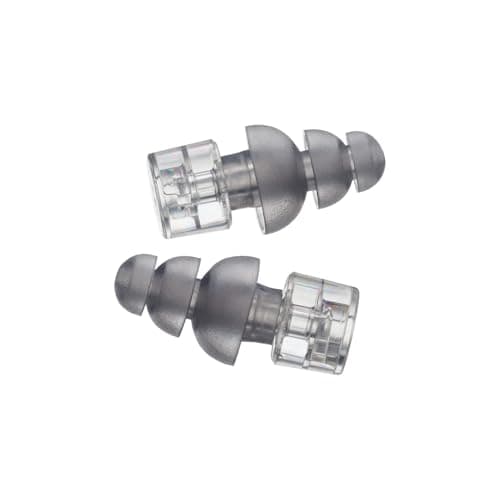
A filtered earplug uses an acoustic element rather than solid material, tuned so that attenuation is roughly even across the frequency range. The Etymotic ER20XS#ad is described by its maker as configured to replicate the natural response of the ear canal, giving up to 20 dB of reduction.
The result is that the kit sounds like the kit, at a lower volume. Cymbals are still cymbals. The snare still cracks. A drummer can hear what they are playing and still be protected, which is the entire design goal.
The Alpine MusicSafe Pro#ad work the same way and add the one thing a fixed-filter plug cannot: three interchangeable filter sets, published at 22, 19 and 16 dB SNR. A drummer can run the heaviest filter behind an acoustic kit and drop to a lighter one for a quiet rehearsal or a lesson, rather than committing to one number. Either is a good answer; the Alpine costs more and buys you the choice.
Two things that decide whether they work
Fit. A plug that does not seal properly delivers a fraction of its rated attenuation, and the rating on the box assumes a good seal. The two picks get there differently: the Etymotic is sold in standard and large sizes, so pick the size, while Alpine publishes a single universal body in a thermoplastic that softens at body temperature and takes the shape of the canal. If the Etymotic feels loose, get the larger size.
The cord. Sounds trivial. A pair on a neck cord stays with the kit and gets worn; a loose pair is lost within a fortnight and never replaced.
When you need headphones instead
There is one job earplugs cannot do: playing along to music on an acoustic kit.
With plugs in, a backing track has to be loud enough to beat both the kit and the attenuation, which means turning it up to a level that is itself damaging. That is a common and genuinely dangerous mistake.
Isolation headphones#ad solve it by blocking the kit acoustically and feeding the track in underneath, so the music can sit at a sane level. They also work as plain hearing protection with nothing plugged in.
On a mesh-head electronic kit none of this applies — the pads are quiet enough that ordinary closed-back headphones do the job and sound better. See our headphones guide.
What to skip
Cheap unfiltered plugs sold as “musicians’ earplugs”. The phrase is unregulated. If the listing does not describe a filter or an even attenuation curve, it is foam with different branding.
Custom-molded plugs, as a first purchase. They are excellent and cost many times the price of a filtered pair. Buy those when drumming is established, not in month one.
Active noise-cancelling headphones. Designed for steady low-frequency noise like an aircraft cabin. They do close to nothing about a snare transient, which is exactly the sound doing the damage.
Quick picks
Filtered earplugs — the default
Attenuate roughly evenly across frequencies, so the kit still sounds like a kit, just quieter. Reusable, with a cord and a case.
| # | Product | Best for | Score | Price |
|---|---|---|---|---|
| 1 | Etymotic ER20XSFiltered earplugs that cut level roughly evenly across the frequency range, so the kit still sounds like a kit — just quieter. | Hearing protection that still sounds rightEnough | 9.3 | Check price on Amazon → #ad How we’re funded |
| 2 | 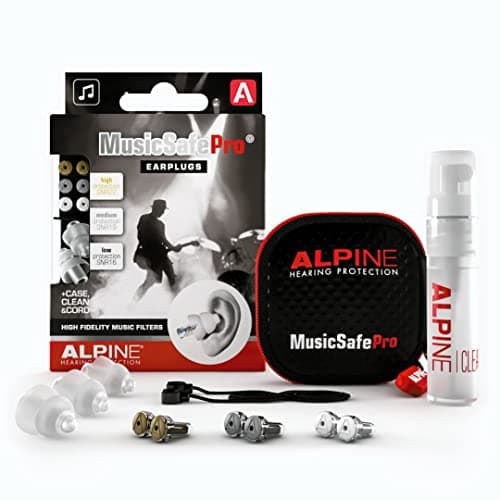 Alpine MusicSafe ProThe filtered plug that ships with three interchangeable filter sets rather than one fixed filter, published at 22, 19 and 16 dB SNR. | Choosing your own attenuationEnough | 8.5 | $29.95 · View on Amazon #ad How we’re funded |
If you play along to music on an acoustic kit
Blocks the kit while feeding a track in, which is the one job earplugs cannot do. Doubles as protection with nothing plugged in.
| # | Product | Best for | Score | Price |
|---|---|---|---|---|
| 1 | No image Vic Firth stereo isolation headphonesOver-ear headphones built to block a drum kit while feeding music in, which is the one job normal headphones cannot do at a live acoustic kit. | Playing along on an acoustic kitEnough | 8.8 | Check price on Amazon → #ad How we’re funded |
The picks in full
Etymotic ER20XS
Etymotic ResearchBest for: Hearing protection that still sounds right
Filtered earplugs that cut level roughly evenly across the frequency range, so the kit still sounds like a kit — just quieter. Reusable, with a cord and a case.
Published specifications
- Type:
- High-fidelity filtered earplug, reusable
- Attenuation:
- Up to 20 dB sound reduction
- Response:
- Configured to replicate the natural response of the ear canal
- In the box:
- Neck cord, carrying case
- Sizes:
- Standard and large
What it gets right
- Even attenuation across frequencies, so cymbals do not disappear the way they do behind foam plugs
- Reusable rather than disposable, which is what makes them actually get worn every session
- The neck cord is the difference between owning them and losing them in week two
Where it gives ground
- Two sizes, and getting the wrong one means a poor seal and much less protection than the rating suggests
- They sit deeper in the ear than foam, which takes some getting used to
What it is not good at
Extremely loud environments on their own. Twenty decibels is right for a drum kit; a loud stage may need more, and no earplug helps if it is not sealed.
How the specs score against a beginner’s needs
Scores are our reading of the published specifications above against what a beginner physically needs. They are not test results — we have not played this instrument.
Specifications from Etymotic ER20XS published specifications.
Alpine MusicSafe Pro
AlpineBest for: Choosing your own attenuation
The filtered plug that ships with three interchangeable filter sets rather than one fixed filter, published at 22, 19 and 16 dB SNR. A drummer can start with the heaviest filter for the kit and drop to a lighter one for a quiet rehearsal.
Published specifications
- Type:
- High-fidelity filtered earplug, reusable
- Filters:
- Three interchangeable sets — Gold 22 dB, Silver 19 dB, White 16 dB (SNR, as published by Alpine)
- Material:
- AlpineThermoShape — silicone-free and hypoallergenic, softens with body heat to the ear canal
- In the kit:
- Three filter sets, storage case, carrying cord, cleaning spray and a spare earplug
- Maximum attenuation:
- 22 dB SNR, against 19 dB on Alpine's non-Pro MusicSafe
What it gets right
- Three filter sets means one purchase covers a loud acoustic kit, a quieter rehearsal and a lesson, instead of committing to a single attenuation figure
- Alpine publishes an SNR number for every filter, so the choice can be made on paper rather than by feel
- The thermoplastic body softens at body temperature and takes the shape of the canal, which is what makes the seal repeatable
- Comes with a case and a cord, which is the difference between plugs that live in the stick bag and plugs that get lost
Where it gives ground
- Half again the price of the fixed-filter Etymotic, for flexibility a drummer who only ever plays their own kit may not use
- Small interchangeable filters are easy to lose, and a lost filter is not individually replaceable
- Same seal-dependence as any plug: fitted badly, they barely work
- Alpine's SNR figures are manufacturer numbers; we found no independent lab testing of them
What it is not good at
Replacing over-ear protection for a child. Small ears and filtered plugs are an awkward combination — children's ear defenders are the better route.
How the specs score against a beginner’s needs
Scores are our reading of the published specifications above against what a beginner physically needs. They are not test results — we have not played this instrument.
Specifications from Alpine Hearing Protection — MusicSafe Pro product page (three interchangeable filter sets at 16, 19 and 22 dB, AlpineThermoShape material, kit contents).
Vic Firth stereo isolation headphones
Vic FirthBest for: Playing along on an acoustic kit
Over-ear headphones built to block a drum kit while feeding music in, which is the one job normal headphones cannot do at a live acoustic kit.
Published specifications
- Type:
- Closed-back stereo isolation headphones
- Purpose:
- Attenuate ambient kit volume while delivering a music feed
- Fits:
- Any 1/8 inch source
What it gets right
- Solves the problem earplugs cannot: hearing a backing track over an acoustic kit without turning the track up to damaging levels
- Doubles as hearing protection when nothing is plugged in
- Built by a drum-hardware company, so the headband survives being thrown in a bag
Where it gives ground
- Bulky and warm over a long session
- Sound quality is functional, not hi-fi — they are a tool, not listening headphones
What it is not good at
Electronic kits. A mesh-head kit is quiet enough that ordinary closed-back headphones do the job better and sound nicer.
How the specs score against a beginner’s needs
Scores are our reading of the published specifications above against what a beginner physically needs. They are not test results — we have not played this instrument.
Specifications from Vic Firth stereo isolation headphones published description.
Questions people actually ask
Do drummers need hearing protection?
Yes, from the first session. Published measurements put an acoustic kit at roughly 90 to 130 dB depending on the stroke, and NIOSH treats 85 dB as the limit for prolonged exposure — allowing about two hours at 91 dB and roughly fifteen minutes a day at 100 dB. A drummer sits within a couple of feet of every source.
Are foam earplugs good enough for drumming?
They protect, and they cut the high frequencies far harder than the low ones, so cymbals disappear and the kit sounds muffled and wrong. Drummers stop wearing them for that reason, which makes them worse in practice than a filtered plug that gets worn every time.
What is the difference between filtered earplugs and normal ones?
A filtered plug uses an acoustic element to attenuate roughly evenly across the frequency range, so the balance of what you hear is preserved and only the level drops. A foam plug blocks high frequencies much more than low ones, which changes the sound as well as the volume.
Should children wear hearing protection at a drum kit?
Yes. A child’s hearing is not more robust than an adult’s and the exposure is at the same close range. Children’s over-ear defenders are often the easier fit, since filtered plugs are sized for adult ear canals.
Sources
Still deciding?
Every recommendation on this site is built the same way, and the method is published in full — including what we do not do and what would get a pick dropped.
Read next
- How loud are drums?
Measured decibel levels against the NIOSH limit, what travels through walls and floors, and which quieting options actually work.
- Best beginner drum sets: complete kits for teens and adults
Complete acoustic and electronic kits for adult players, with the total-purchase problem and the noise question both addressed.
- Acoustic vs electronic drums for beginners
Feel against practice hours, what transfers in each direction, and the building question that settles it. Buy paths for both.
- Best drum practice pads
Gum rubber versus neoprene, why 12 inches is the right size, and the honest limit of what pad practice builds.
- Best drum sets for kids
Picks by age band with real shell dimensions, plus the electronic option that makes a kids kit possible in an apartment.