Band & Orchestra
Best beginner flutes
Rent in year one. When you do buy — year two or three, or because the school has no program — these are the two that matter and here is what separates them.
By Sawyer V. · Published · Last updated
Before anything else: if the school has a rental program, use it for year one. Directors reassign students between sections in the first months, rental covers the pad and cork maintenance that woodwind instruments genuinely need, and buying turns a routine reassignment into an expensive one. That argument is set out in full in renting vs buying.
This page is for the two situations where buying is right: the year-two or year-three step-up on a student who has clearly committed, and a school with no rental program. Both picks state their Starter Path band, and we have not played them — the method is on how we pick.
A beginner flute should be closed-hole (plateau) with an offset G and a C footjoint. Those are the standard student configuration. What separates instruments above that is mechanism quality: key arm design, spring material and how well the pads keep sealing over years of daily use.
The three configuration choices, decided
Closed hole, not open hole. Open-hole flutes have holes in the center of five keys which the fingers must seal precisely. That is a real technique refinement and it is not a beginner’s problem to solve. A student on an open-hole flute produces airy, half-sounding notes for reasons unconnected to their actual playing. Open holes are also not a quality tier — makers offer them alongside covered keys at every price level, which our step-up flutes roundup shows from the published lineup tables.
Offset G, not inline. The G key sits slightly forward of the row, which aligns better with the natural length of the third finger. Inline G looks tidier and asks more of a smaller hand.
C foot, not B foot. A B footjoint adds one low note and length, weight and cost. Both picks here are C foot, which is correct for a student.
What actually separates the two picks
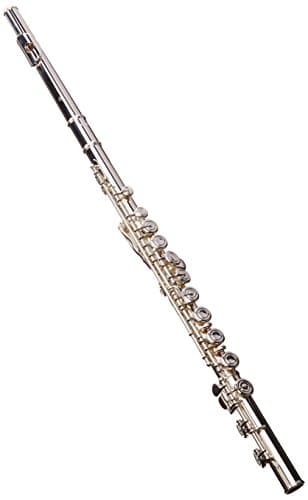
The Yamaha YFL-222#ad is silver-plated nickel silver throughout with hand-assembled keys, and the two details worth paying for are less visible than that.
Pointed key arms. The arm connecting each key to its pad cup is pointed rather than flat, which distributes closing pressure more evenly across the pad. Even pressure means a better seal, and a better seal means fewer leaks as the instrument ages. On a woodwind, leaks are the whole game.
Stainless steel springs. Springs return each key after it is released. Corroded springs get sluggish, and sluggish keys make fast passages feel impossible for reasons a student cannot diagnose. Stainless resists that.
The Jean Paul FL-220#ad answers with something the Yamaha does not advertise at this tier: a split E mechanism. Third-octave E is notoriously difficult to produce cleanly on a flute, and the split E linkage closes an extra key automatically to fix it. At this price that is genuinely unusual, and it removes a frustration that arrives in the first year.
Why leaks decide a flute’s life
Worth understanding because it explains both the price gap and the value of rental maintenance.
A flute works by sealing air columns. Every key has a pad that must close its hole completely; if any pad leaks even slightly, notes below it become breathy, unstable or simply refuse to speak.
Pads compress and dry out over time. This happens gradually, which is the problem: a student never reports it, because there is no moment when it breaks. They simply find the low notes getting harder and conclude they are getting worse.
Better mechanism design — pointed key arms, better springs, tighter tolerances — slows that down. It does not stop it. Every flute eventually needs a repad, which is why a rental program that includes maintenance is worth more than families expect.
What to skip
Very cheap unbranded flutes. Band instruments have a much wider quality spread than guitars, and the bottom of the market includes flutes that cannot be played in tune because the tone holes are misplaced. That is not correctable by skill or setup, and a child on one concludes the problem is them.
Open-hole flutes, covered above.
Buying before the director has met your child. Physical suitability for flute — the embouchure needed to split an air stream across an open hole — varies enormously and is not knowable in advance.
What you also need
A cleaning rod and swab, used after every session, because moisture left inside is what destroys pads fastest. Cork grease for the joints. And a music stand, which every band student needs and nobody remembers to buy.
Quick picks
The step-up standard
Silver-plated nickel silver with pointed key arms and stainless steel springs. The flute most school programs treat as the benchmark once a student commits.
| # | Product | Best for | Score | Price |
|---|---|---|---|---|
| 1 | Yamaha YFL-222Silver-plated nickel silver throughout with pointed key arms and stainless steel springs. | Step-up flute, year two onwardEnough | 8.8 | $725.00 · View on Amazon #ad How we’re funded |
If buying in year one, on a budget
Closed-hole with an offset G and a split E mechanism, which is an unusual inclusion at this price and removes a real early frustration.
| # | Product | Best for | Score | Price |
|---|---|---|---|---|
| 1 | 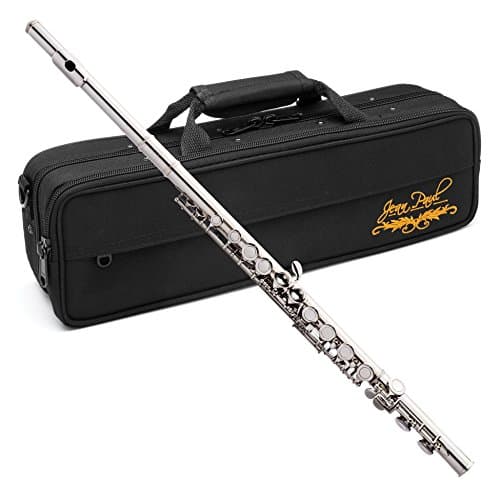 Jean Paul FL-220Closed-hole, offset G with a split E mechanism and power-forged keys. | Budget flute, if buying in year oneThe honest floor | 7.4 | $274.99 · View on Amazon #ad How we’re funded |
The picks in full
Yamaha YFL-222
YamahaBest for: Step-up flute, year two onward
Silver-plated nickel silver throughout with pointed key arms and stainless steel springs. The flute most school programs treat as the standard once a student commits.
Published specifications
- Head / body / footjoint:
- Silver-plated nickel silver
- Keys:
- Hand-assembled silver-plated, offset G, closed hole (plateau)
- Footjoint:
- C foot
- Headjoint:
- CY, double flare taper with undercut embouchure hole
- Key arms:
- Pointed, for even pad-cup pressure
- Springs:
- Stainless steel
What it gets right
- Pointed key arms spread pressure evenly across the pad cup, which means a better seal and fewer leaks as the instrument ages
- Stainless steel springs resist the corrosion that makes cheap flute keys sluggish
- Closed-hole plateau keys give a beginner a solid platform for fingering before open holes are ever a question
Where it gives ground
- Offset G and closed holes are the right beginner choices and are also what a player eventually moves past
- Silver plate wears through at the contact points over years of daily use
What it is not good at
Being a year-one purchase. Rent through the school first — reassignment is common in the first months and this is not a cheap instrument to be stuck with.
How the specs score against a beginner’s needs
Scores are our reading of the published specifications above against what a beginner physically needs. They are not test results — we have not played this instrument.
Specifications from Yamaha YFL-222 published specifications (West Music).
Jean Paul FL-220
Jean Paul USABest for: Budget flute, if buying in year one
Closed-hole, offset G with a split E mechanism and power-forged keys. The split E is the notable inclusion at this price — it makes the third-octave E far easier to hit.
Published specifications
- Keys:
- Power-forged, closed hole (plateau)
- G key:
- Offset, for better hand alignment
- Mechanism:
- Split E, simplifying third-octave E
- Embouchure plate:
- Student-friendly design
- Finish:
- Silver plated
What it gets right
- A split E mechanism at this price is unusual and it removes one of the first real frustrations a flute student hits
- Offset G aligns the left hand more naturally, which matters for a smaller player
- Considerably cheaper than the Yamaha, which is the point
Where it gives ground
- Build tolerances are not the Yamaha's, and pad seating is where that shows over a year
- Resale value is low, so it is not a purchase you get much back from
What it is not good at
Lasting through a school career. It gets a student through the early years; a committed player will want the Yamaha or better by around year three.
How the specs score against a beginner’s needs
Scores are our reading of the published specifications above against what a beginner physically needs. They are not test results — we have not played this instrument.
Specifications from Jean Paul USA FL-220 published description.
Questions people actually ask
What should I look for in a beginner flute?
Closed-hole (plateau) keys, an offset G, and a C footjoint. Those three are the beginner configuration and every student flute worth buying has them. Beyond that, the differences are in mechanism quality: key arms, springs and how well the pads seat over time.
What is a split E mechanism?
An extra linkage that closes one key automatically when playing the third-octave E, which is otherwise one of the hardest notes on the instrument to produce cleanly. It is not standard at the budget end, which makes its presence on the Jean Paul FL-220 worth noting.
Open hole or closed hole for a beginner?
Closed hole, without question. Open-hole (French) flutes require the fingers to seal the holes precisely, which is a technique refinement for later. A beginner on an open-hole flute spends their first months producing airy half-notes for reasons that have nothing to do with their playing.
Should we buy or rent a flute?
Rent in year one. Band directors reassign students between instruments in the first months, rental usually covers pad and cork maintenance, and a meaningful share of students do not continue. The full reasoning is in renting vs buying.
Sources
Still deciding?
Every recommendation on this site is built the same way, and the method is published in full — including what we do not do and what would get a pick dropped.
Read next
- Best flute books for beginners
The band-class method and the specialist tone method do different jobs, and a flute beginner needs the second one more than any other wind player. Three books on published details.
- Renting vs buying a school band instrument
Why year one is a rental year, what programs cover, the maintenance nobody warns you about, and when buying starts to win.
- Choosing a school band instrument
Which instrument suits which child, what school rental covers, and the honest case for not buying in year one.
- The easiest band instruments to learn
Ranked by time to a reliable first note, with what embouchure is and why it decides the ranking.
- Best beginner clarinets
Why resin beats wood for a student, what a 65mm barrel does for intonation, and two picks for the year-two step-up.
- Best beginner saxophones
Why alto is the beginner size, the ergonomic details that matter at eleven, and two picks for when buying is right.