Start Here
Best music stands for beginners
The least interesting purchase on the site, and the one that decides whether music sits at eye level or slides onto the floor mid-piece.
By Sawyer V. · Published · Last updated
Nobody is excited about a music stand. It is bought late, bought cheap, and it is the reason a surprising number of beginners practice hunched over a book on a bed.
The mistake is specific: the folding wire stand sold at every checkout counter cannot hold the one thing a beginner owns, which is a thick method book that wants to be open flat. It bows, the page slides, and the student props the book on a chair instead.
We have not used these stands. What follows is our reading of published dimensions, and the method is on how we pick.
If the stand stays in one room, buy a symphony stand like the Manhasset 48 and never think about it again. If it travels to lessons and rehearsals, buy a folding stand with a real desk: the K&M 10065 publishes its folded length and weight, and the On-Stage SM7211B is the cheaper version of the same idea.
The three specs that matter
1. Desk size and lip depth. The desk has to be wide enough for an open book and the lip deep enough to stop it sliding. The stands here run from a 485 mm desk with a 42 mm lip to a 20 inch desk with a 2.25 inch ledge, which is the difference between holding loose sheets and holding a spiral-bound course open at page 90.
2. Height range. Published as a range for a reason: a seated beginner and a standing one need different heights, and children grow. Ranges here start around 23 to 24 inches and reach 45 to 48 inches, which covers both.
3. Whether and how it packs down. A folding stand collapses the desk as well as the legs. A symphony stand does not fold at all — it comes apart with a bolt, which is a different proposition entirely. Decide this before comparing anything else, because it eliminates half the market.
A fourth thing worth noticing while comparing: weight is frequently unpublished. On-Stage does not publish it, Manhasset’s figure comes from a retailer, and K&M publishes both weight and folded length. If portability is the point, that omission is itself information.
How we ranked these
Whether it holds a heavy book first, because that is the failure mode that sends people shopping. Then height range, then how well it packs down, then stability, then room to grow.
The picks
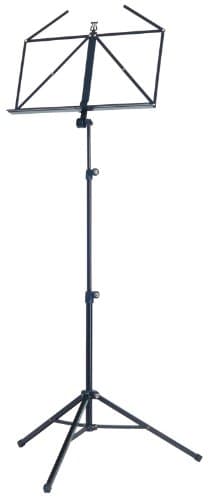
The K&M 10065 music stand#ad is the folding stand we would buy. The desk folds as well as the legs, so the whole thing packs to 490 mm at 1.55 kg, and the desk is 485 mm wide with a 42 mm deep lip — deep enough that a thick book stays put. The legs are cross-braced U-profile on a 690 mm base, and height runs 585 to 1,220 mm.
K&M publishes all of that, which is the main reason it is first: you can confirm it fits your case and your player before ordering. The limits are that it is heavier than K&M’s own lighter 100/1 model, the desk is narrower than a symphony stand and folds at a seam, and the carrying case is a separate purchase.
The Manhasset Model 48 Symphony#ad is the stand in every school band room, and if the stand is staying in a practice corner it is the one to buy. A 20 inch by 12.5 inch aluminum desk with a 2.25 inch ledge, a heavy welded steel base, and a friction clutch that adjusts height one-handed with no wingnut to strip. 26 to 48 inches from ledge to floor.
Its 5.25 lb is exactly why it does not tip when a student knocks it, and exactly why it is the worst stand here to carry anywhere. It does not fold at all — it disassembles with a bolt — and no bag is offered for it.
The On-Stage SM7211B#ad is the value pick and a genuine step up from a wire stand. A steel desk of 13.5 by 19 inches with a 2 inch return lip, on a tripod whose legs fold flat, with a 24 to 45 inch height range that covers a seated child through a standing adult.
The compromise is in the middle: the desk is one solid steel piece that does not fold in half, so the packed package stays about 19 inches wide even with the legs folded. On-Stage publishes no weight, and there is no bag included. It travels, but not in a backpack.
Which one for which player
A beginner practicing at home only. A symphony stand, and you are done for twenty years.
A school band or orchestra student. A folding stand with a real desk, because it goes to lessons, rehearsals and home. Several percussion supply lists require a folding stand explicitly — see best percussion kits for school band.
A guitarist or ukulele player. Either, with one consideration: you are usually seated with the instrument in your lap, so a stand that goes low enough to read without blocking your right arm matters more than maximum height.
A keyboard player. Often neither, because digital pianos have a music rest built in. Check whether yours holds a thick book open before buying anything.
Where the stand goes, and the rest of what makes a practice corner work, is in setting up a home practice space. What all of this adds up to across a first year is in what it costs to start an instrument.
Quick picks
If it has to travel
Folds to 490 mm including the desk, weighs 1.55 kg, and still has a 42 mm lip deep enough for real books. The specs are all published.
| # | Product | Best for | Score | Price |
|---|---|---|---|---|
| 1 | K&M 10065 music standA folding desk deep enough for real books, on cross-braced legs, that packs to 490 mm and 1. | Carrying it everywhereEnough | 8.4 | $72.99 · View on Amazon #ad How we’re funded |
If it stays in one room
The stand in every school band room: a 20 inch aluminum desk, a welded steel base and a friction clutch you set one-handed.
| # | Product | Best for | Score | Price |
|---|---|---|---|---|
| 1 | 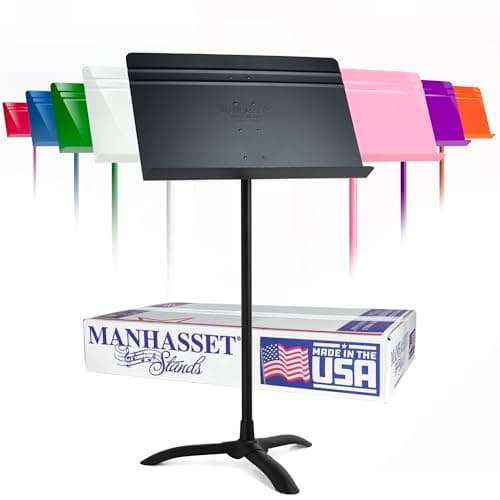 Manhasset Model 48 SymphonyThe stand in every school band room. | The stand that never movesEnough | 8.0 | $63.52 · View on Amazon #ad How we’re funded |
The affordable folding option
A steel desk with a 2 inch lip on a tripod whose legs fold flat, with a height range that covers a seated child to a standing adult.
| # | Product | Best for | Score | Price |
|---|---|---|---|---|
| 1 | 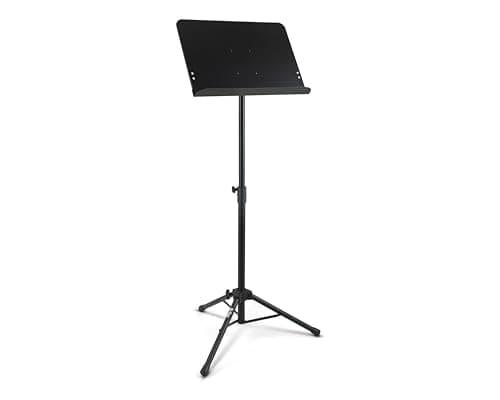 On-Stage SM7211BA steel desk of 13. | A first stand that foldsThe honest floor | 7.4 | $52.35 · View on Amazon #ad How we’re funded |
The picks in full
K&M 10065 music stand
Konig & MeyerBest for: Carrying it everywhere
A folding desk deep enough for real books, on cross-braced legs, that packs to 490 mm and 1.55 kg. K&M publishes the folded length and the weight, which is how you know it will fit.
Published specifications
- Height:
- 585 to 1,220 mm (23 to 48 in)
- Desk:
- 485 x 240 x 42 mm, traditionally foldable
- Adjustment:
- Non-scratching locking screws
- Base:
- U-profile legs with cross braces, 690 mm base diameter
- Material:
- Steel
- Weight / folded:
- 1.55 kg; folds to 490 mm
- Bag:
- Not included — case 10012 is a separate accessory
What it gets right
- Folds to 490 mm including the desk, so unlike a symphony stand it genuinely packs down
- A 42 mm deep desk lip holds thick books rather than only loose sheets
- Cross-braced U-profile legs on a 690 mm base give a folding stand a wide footprint
- K&M publishes weight, folded length and desk depth, so fit can be verified before buying
Where it gives ground
- At 1.55 kg it is heavier than K&M's own lighter 100/1 model
- The desk is narrower than the Manhasset and folds at a seam rather than being one solid plate
- No bag in the box; the carrying case is an extra purchase
What it is not good at
Being the cheapest way to prop up a beginner method book — K&M's own 100/1 is lighter and simpler for that.
How the specs score against a beginner’s needs
Scores are our reading of the published specifications above against what a beginner physically needs. They are not test results — we have not played this instrument.
Specifications from Konig & Meyer — 10065 music stand, Konig & Meyer — 100/1 music stand (lighter alternative).
Manhasset Model 48 Symphony
ManhassetBest for: The stand that never moves
The stand in every school band room. A 20 inch aluminum desk on a welded steel base, with a friction clutch you set one-handed. It does not fold, and that is rather the point.
Published specifications
- Desk:
- 20" w x 12.5" h with a 2.25" ledge
- Height:
- 26" to 48" ledge to floor; 60.5" maximum overall
- Adjustment:
- Chrome inner shaft with friction-grip clutch
- Base:
- Heavy gauge all-steel welded base (retailer spec sheet)
- Desk material:
- All-aluminum desk, powder-coated glare-free black (retailer spec sheet)
- Weight:
- 5.25 lb (retailer spec sheet)
- Folding:
- Does not fold — bolt-together three-piece assembly
What it gets right
- The largest desk here at 20 by 12.5 inches with a 2.25 inch ledge, so scores lie open flat
- The friction clutch adjusts height one-handed with no wingnut to strip or lose
- A welded steel base and 5.25 lb of mass is why it does not tip when a student knocks it
- 26 to 48 inches works for a seated band chair or a standing player
Where it gives ground
- It does not fold — it only comes apart with a bolt, so it is a stay-in-one-room stand
- The heaviest stand here to carry to a lesson
- No bag is offered, and Manhasset publishes no packed dimensions
What it is not good at
Travel. There is no folding mechanism at all, so it does not pack into a gig bag or a school locker.
How the specs score against a beginner’s needs
Scores are our reading of the published specifications above against what a beginner physically needs. They are not test results — we have not played this instrument.
Specifications from Manhasset — Model 48 Symphony stand dimensions and instructions, West Music — Manhasset 48 materials and weight (retailer spec sheet).
On-Stage SM7211B
On-StageBest for: A first stand that folds
A steel desk of 13.5 by 19 inches with a two inch lip, on a tripod whose legs fold flat. It holds a thick method book open and still goes in a car.
Published specifications
- Desk:
- 13.5" x 19" with a 2" return lip
- Desk material:
- Steel
- Height range:
- 24" to 45" (lip to floor 22" to 40")
- Base:
- Tripod, legs fold flat, nonslip feet
- Shafts:
- 1.875" lower, 0.875" upper
- Weight:
- Not published by On-Stage
- Bag:
- Not included
What it gets right
- A steel desk with a 2 inch return lip holds everything from single sheets to heavy score books
- 24 to 45 inches covers a seated child through a standing adult, so it lasts past middle school
- The legs fold flat, so it genuinely stores under a bed or in a trunk
Where it gives ground
- The desk is one solid steel piece and does not fold in half, so the packed width stays about 19 inches
- On-Stage publishes no weight, so portability cannot be confirmed from the spec sheet
- No carrying bag included
What it is not good at
Fitting inside an instrument case or a backpack. The steel desk stays full width however the legs fold.
How the specs score against a beginner’s needs
Scores are our reading of the published specifications above against what a beginner physically needs. They are not test results — we have not played this instrument.
Specifications from On-Stage — SM7211B music stand with tripod base.
Questions people actually ask
Do I really need a music stand?
If you are reading anything, yes. Music on a table means looking down, which wrecks posture on every instrument and is impossible on most. Several school programs require one at home outright, which tells you how basic it is.
What is wrong with the cheap wire stands?
They are fine for a few loose sheets and they fail at the job people buy them for: a thick spiral-bound method book. The desk is narrow, the lip is shallow, and the whole thing tips or folds when a book is opened flat on it.
Folding or symphony stand?
Folding if it leaves the house, symphony if it does not. A folding stand trades rigidity for packing down; a symphony stand does not fold at all and in exchange it never tips, never sags and holds a heavy score open.
How high should a music stand be?
High enough that you read the page without dropping your head, and low enough that it is not between you and a teacher or conductor. Check the published height range against whether the player is seated or standing — a seated cellist and a standing flute player need different stands.
Is a tablet a replacement?
For the music, sometimes. For the stand, no — a tablet still needs holding at eye level, and tablet holders have the same stability questions as any other stand.
Sources
Still deciding?
Every recommendation on this site is built the same way, and the method is published in full — including what we do not do and what would get a pick dropped.
Read next
- Setting up a practice space that gets used
Why the instrument should never live in its case, the seat height that prevents wrist problems, and the two cheap accessories that matter most.
- What it really costs to start an instrument
Complete first-year cost by instrument family, the recurring items nobody quotes, and where the cheapest total actually is.
- Best percussion kits for school band
What a school percussion supply list actually asks for, what 2.5 octaves means, and two kits with published contents.
- Best piano books for beginners
Adult or child, teacher or alone: the two questions that pick the book, plus four current methods with their weaknesses stated.
- Instrument gifts that actually get played
What to give when you cannot ask the recipient first: four instruments that work out of the box, plus the ten-dollar accessory that saves any of them.