Keys
Best easy piano songbooks for beginners
Four series names, four completely different reading experiences, and nothing on the cover explains the difference. Buy the series first and the songs second.
By Sawyer V. · Published · Last updated
The series name on the cover tells you the notation system, and that is the entire decision. The song list is the easy part. Four Hal Leonard series sit in the beginner piano aisle — Super Easy Songbook, Big-Note, Easy Piano and Five-Finger Piano — and they are not four difficulties of the same thing. They are four different reading experiences, one of which does not teach reading at all. Buy the wrong series and the book sits unopened, which is the actual failure mode here and has nothing to do with whether you liked the songs.
Every pick states its Starter Path band, and we have not played through any of them — the method is on how we pick. Series descriptions, page counts, song counts and ISBNs come from Hal Leonard’s own product pages, cited at the bottom, and every book’s ISBN was matched against the listing we link to.
Decide the notation system before the repertoire. Super Easy Songbook prints the letter name inside each notehead, uses oversized notes and gives the left hand chord diagrams instead of notation — fastest route to a recognizable song, teaches no reading, and the right call for an adult with no teacher. Big-Note is real two-hand notation printed large, with no letter names — the right call for a child who is genuinely learning to read. Easy Piano is standard two-hand notation at normal size — the tier everyone is aiming at, and the one to buy a month or two into a method book. Five-Finger Piano is real notation that stays in one hand position. A songbook is not a substitute for a method book; it is the thing that gets you to the piano on a day you do not feel like practicing.
The four series, and what each one actually puts on the page
This is the part no shop and no cover explains, so here is each series in Hal Leonard’s own published terms.
Super Easy Songbook. Sixty arrangements per volume. The right hand gets a melody with the letter name printed inside every notehead, the notes are oversized, and the left hand gets basic chord diagrams rather than written notation. Hal Leonard also publishes that the volumes are laid out with no page turns. The effect is that you can play a tune on day one without being able to read music, because you are reading letters that happen to sit on a staff.
Big-Note. Real staff notation, both hands, printed oversized. No letter names. This is the tier most buyers skip straight past because it looks like a children’s book, and for a child who is actually learning to read it is the correct one — the problem a seven-year-old has is tracking small print across a stave, not comprehension.
Easy Piano. Ordinary two-hand notation at normal print size, with arrangements simplified but not reduced to a melody line. This is what a method book is preparing you for and what every future songbook will assume. “Easy Piano” is the series name worth memorizing, because it is the one that keeps working for years.
Five-Finger Piano. Real notation that never leaves one hand position, so neither hand has to shift. It is a genuine tier and it sits between Big-Note and nothing — useful for a very young student in their first weeks. We have not picked one, for a reason given at the bottom of this page.
The one question that decides which series you want
Is the player learning to read music, or learning to enjoy the piano? Those are both legitimate goals and they point at opposite books.
An adult who bought a keyboard because they always wanted to play, has no teacher and wants to sit down and produce something recognizable, is served well by letter names inside the noteheads. Telling that person to spend four months on note-reading before they are allowed a song is how keyboards end up in cupboards. Our page on how to stop a beginner quitting is built around exactly this.
A child taking lessons is the opposite case. Reading is the skill being built, the teacher is tracking it, and a book that prints the answer inside every note removes the thing they are there to practice. Reading stalls while playing advances, and the gap shows up a year later as a student who can play pieces they cannot read.
If you are buying as a gift and do not know which case applies, Big-Note for a child under about ten and Easy Piano for anyone older are the safe defaults, because both are real notation and neither can do any harm.
The picks
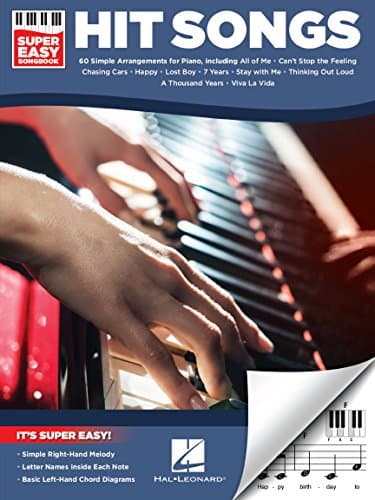
Hit Songs — Super Easy Songbook#ad is the pick for an adult beginner with no teacher. Hal Leonard publishes it at 128 pages in the Super Easy Songbook series, with the series format being 60 arrangements, simple right-hand melodies, letter names inside each note, basic left-hand chord diagrams and no page turns. We picked the Hit Songs volume over the Beatles, Disney or Christmas volumes because the repertoire is broad rather than tied to one artist or season, and the whole series shares the same format. Buy this if the goal is playing something recognizable this week. Skip it if the player is a child learning to read, or has a teacher — and be clear-eyed that the letter names have a ceiling you will eventually have to climb down from.
The Best Songs Ever — Big-Note Piano#ad is the pick for a young child, and the best value per song here despite having the highest sticker price: Hal Leonard publishes the 6th Edition at 242 pages with 70 all-time favorites. Real notation, both hands, printed large, no shortcuts. Broad standards repertoire rather than one film, which matters because a child’s taste changes faster than a songbook does. Buy this if the player is under about ten and their reading is the point. Skip it if they are a teenager or an adult — big-note print reads as babyish and that alone stops it being used.
First 50 Popular Songs You Should Play on the Piano#ad is the tier to aim at, and our overall pick for most readers: 208 pages, 50 songs, in the Easy Piano Songbook series, so standard two-hand notation at normal size with arrangements that still sound like the song rather than a melody with a chord box over it. Hal Leonard also lists a digital edition. Buy this if the player is a month or two into a method book, or can decode a staff slowly. Skip it if they cannot yet find middle C without counting up from the bottom — buying this in week one produces frustration rather than songs, and that is the commonest way this purchase goes wrong in the other direction.
Buy the method book first
Worth saying plainly on the page that is selling songbooks: if you only buy one book, buy a method book instead of any of these.
A songbook gives you repertoire and no instruction. It will not teach you where your hands go, what the rhythm notation means, or how to practice a passage you cannot play. A method book does all three in a deliberate order. The ideal is both — the method for the half hour you practice properly and the songbook for the ten minutes you sit down because you felt like it — and the method is the one to get first. Our best piano books for beginners covers the four that matter and which one suits an adult against a child.
What we did not list, and why
A Five-Finger Piano volume. This is a real tier and an honest omission rather than an oversight. The titles currently in stock are almost entirely licensed film repertoire, and for the one broad-repertoire volume that is in stock we could not retrieve a publisher page to confirm its series details, page count and song list. On a page whose entire argument is that you should buy by published series format, listing a book whose format we cannot confirm would contradict the argument. If a student is in their first weeks and a teacher has asked for Five-Finger specifically, that is the series name to search — it keeps both hands in one position.
Seasonal and single-artist volumes. Christmas, Disney, Beatles, hymns, classic rock and a dozen others exist in every one of these series, and if the player has a strong preference the repertoire volume is the better buy than our generalist pick. We have listed one volume per notation tier because the tier is the decision; once you know your series name, pick whichever song list the player will actually want.
“100 songs” mega-collections. Cheap per song and frequently a false economy at this level: the arrangements are often inconsistent in difficulty within one book, so a beginner hits a wall on page nine and concludes the problem is them.
Piano/Vocal/Guitar editions. The commonest mis-buy in this aisle and worth naming. They look like piano books and are arranged for a singer with piano accompaniment plus guitar chord boxes, so the piano part is harder than Easy Piano and the melody sits in the vocal line rather than the right hand. If a songbook does not say Easy Piano, Big-Note, Super Easy or Five-Finger, check carefully.
Classical collections. Deliberately out of scope here, and the one place where free sheet music is a legitimate answer: the standard beginner classical repertoire is public domain. A method book plus printed public-domain pieces covers it.
Quick picks
An adult who wants to play something tonight
Sixty arrangements with the letter name inside every notehead and chord diagrams for the left hand. For: an adult beginner with no teacher who wants a recognizable song fast. Skip if: the player is a child learning to read music, because this works against that directly.
| # | Product | Best for | Score | Price |
|---|---|---|---|---|
| 1 | Hit Songs — Super Easy SongbookSixty arrangements with the letter name printed inside every notehead, a right-hand melody and left-hand chord diagrams instead of notation. | Playing a recognizable song in week oneThe honest floor | 7.4 | $15.82 · View on Amazon #ad How we’re funded |
A child who is genuinely learning to read
Seventy songs in real two-hand notation, printed oversized. For: a young student whose reading is the point. Skip if: the player is an adult or a teenager, who will not be seen with big-note print.
| # | Product | Best for | Score | Price |
|---|---|---|---|---|
| 1 | 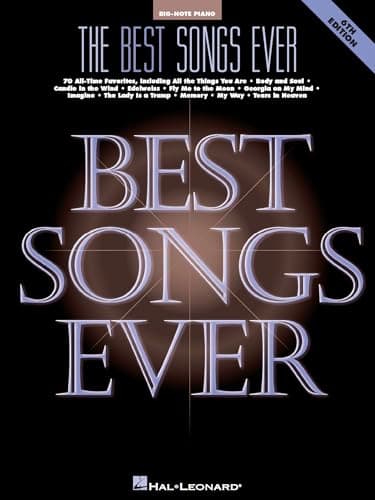 The Best Songs Ever — Big-Note Piano (6th Edition)Seventy songs across 242 pages in Big-Note notation: real staff reading, both hands, printed oversized. | A young child reading real notationEnough | 8.0 | $28.25 · View on Amazon #ad How we’re funded |
The tier everyone is aiming at
Standard two-hand notation at normal size, simplified but still sounding like the song. For: anyone a month or two into a method book. Skip if: they cannot yet find middle C without counting.
| # | Product | Best for | Score | Price |
|---|---|---|---|---|
| 1 | 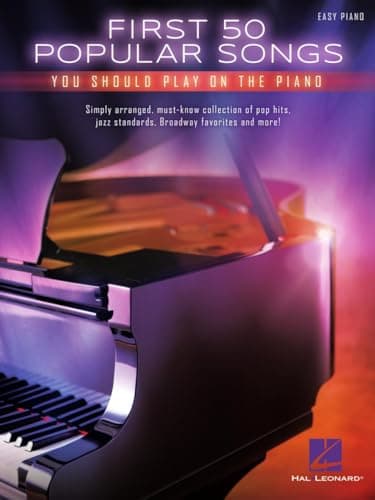 First 50 Popular Songs You Should Play on the PianoFifty songs across 208 pages in Hal Leonard's Easy Piano series: ordinary two-hand notation, simplified but not abridged into something else. | The tier a beginner is aiming atEnough | 8.6 | $16.10 · View on Amazon #ad How we’re funded |
The picks in full
Hit Songs — Super Easy Songbook
Hal LeonardBest for: Playing a recognizable song in week one
Sixty arrangements with the letter name printed inside every notehead, a right-hand melody and left-hand chord diagrams instead of notation. It is the fastest route from nothing to a song you recognize, and the reason to think hard before buying it is in that same sentence.
Published specifications
- Series:
- Super Easy Songbook
- Arrangements:
- 60
- Pages:
- 128
- Notation:
- Letter names printed inside each notehead, with oversized notes
- Left hand:
- Basic chord diagrams rather than written notation
- Layout:
- Published as having no page turns
- Publisher inventory:
- HL 00194367, ISBN 9781495073274
What it gets right
- Genuinely the quickest path to playing something recognizable, which is what keeps an adult beginner going in week one
- Letter names inside the noteheads remove the single biggest early obstacle — decoding the staff while also finding the key
- No page turns is a real convenience nobody thinks about until they are playing with both hands
- Sixty songs at this price is more repertoire per dollar than any method book
Where it gives ground
- The letter names are a crutch with a hard ceiling: a player who leans on them is not learning to read the staff, and leaving them behind later is its own painful stage
- The left hand gets chord diagrams rather than notation, so it teaches nothing about reading bass clef
- Arrangements are simplified enough that some songs are barely recognizable harmonically
- If a teacher is involved they will almost certainly not want this
What it is not good at
Teaching a child to read music. If the player is taking lessons, or is a child whose reading is the point, this works directly against that — the notehead letters mean the eye never has to learn the staff. It is an adult-wants-to-play-now book.
How the specs score against a beginner’s needs
Scores are our reading of the published specifications above against what a beginner physically needs. They are not test results — we have not played this instrument.
The Best Songs Ever — Big-Note Piano (6th Edition)
Hal LeonardBest for: A young child reading real notation
Seventy songs across 242 pages in Big-Note notation: real staff reading, both hands, printed oversized. It is the tier most people skip straight past, and for a child who is genuinely learning to read music it is the right one.
Published specifications
- Series:
- Big Note Songbook
- Songs:
- 70 all-time favorites
- Pages:
- 242
- Notation:
- Real staff notation, both hands, printed oversized — no letter names
- Edition:
- 6th Edition
- Publisher inventory:
- HL 00310425, ISBN 9780793596515
What it gets right
- Real notation, so every hour spent with it also builds reading — unlike the letter-name tier
- Oversized printing solves the actual problem a seven-year-old has, which is eye tracking rather than comprehension
- Seventy songs and 242 pages is the most material of the three books here by a wide margin
- Broad standards repertoire rather than a single film or artist, so it survives a child's changing taste
Where it gives ground
- The most expensive book on this page, roughly double the others
- Big-note printing looks childish to an adult or a teenager, who will not want to be seen with it
- Standards repertoire is the trade for breadth: a child who wants current pop will not find it here
- Oversized notes mean fewer bars per page, so a long song spans more page turns
What it is not good at
An adult beginner. There is nothing pedagogically wrong with it for an adult, and almost no adult will use it — the format signals children loudly enough that it becomes a reason not to practice.
How the specs score against a beginner’s needs
Scores are our reading of the published specifications above against what a beginner physically needs. They are not test results — we have not played this instrument.
Specifications from Hal Leonard — The Best Songs Ever, 6th Edition, Big Note Songbook: 242 pages, 70 all-time favorites, HL 00310425, ISBN 9780793596515.
First 50 Popular Songs You Should Play on the Piano
Hal LeonardBest for: The tier a beginner is aiming at
Fifty songs across 208 pages in Hal Leonard's Easy Piano series: ordinary two-hand notation, simplified but not abridged into something else. This is the destination tier, and buying it slightly too early is a better mistake than buying a crutch book slightly too late.
Published specifications
- Series:
- Easy Piano Songbook
- Songs:
- 50
- Pages:
- 208
- Notation:
- Standard two-hand staff notation, simplified arrangements, normal print size
- Also available as:
- Digital book as well as softcover
- Publisher inventory:
- HL 00131140, ISBN 9781480398023
What it gets right
- Standard notation at standard size, which is what every method book, teacher and future songbook assumes
- Simplified arrangements that still sound like the song, rather than a melody line with a chord box
- 208 pages of popular repertoire, so it stays useful for years rather than months
- Easy Piano is the series name to look for on any future songbook, which makes this a useful calibration purchase
Where it gives ground
- Genuinely harder than the other two books here — a true first-week beginner will stall on it
- No letter names and no oversized print, so it assumes the reader can already decode a staff slowly
- Fifty songs against seventy in the Big-Note book, for a similar page count
- Popular-song licensing means the arrangements vary in quality across the book
What it is not good at
Week one. If the player cannot yet find middle C without counting, this book produces frustration rather than songs. It is the book to grow into, usually a month or two after a method book has started.
How the specs score against a beginner’s needs
Scores are our reading of the published specifications above against what a beginner physically needs. They are not test results — we have not played this instrument.
Specifications from Hal Leonard — First 50 Popular Songs You Should Play on the Piano: Easy Piano Songbook series, 208 pages, softcover with a digital book also available, HL 00131140, ISBN 9781480398023.
Questions people actually ask
What is the best easy piano songbook for a beginner?
It depends on one thing, and it is not the songs. If the player is an adult with no teacher who wants to play something recognizable quickly, a Super Easy Songbook#ad prints the letter name inside every notehead and gets you there fastest. If the player is a child learning to read music, that same feature is a problem, and Big-Note#ad is the right tier. If they are a month or two into a method book, go straight to Easy Piano#ad.
What is the difference between Easy Piano, Big-Note and Super Easy?
They are Hal Leonard series names, and each one is a different notation system rather than a different difficulty of the same thing. Super Easy Songbook prints the letter name inside each notehead, uses oversized notes, and gives the left hand chord diagrams instead of written notation. Big-Note is real two-hand staff notation printed oversized, with no letter names. Easy Piano is ordinary two-hand notation at normal size, with simplified arrangements. Five-Finger Piano is real notation that never moves out of one hand position. Nothing on the front cover explains any of this.
Are the letter names inside the notes a bad thing?
They are a trade, and which side of it you want depends entirely on the player. For an adult who wants to enjoy the instrument and may never read fluently, they remove the single biggest early obstacle and that is a real gift. For a child taking lessons they are a crutch with a ceiling: the eye never has to learn the staff, so reading stalls while playing advances, and unpicking that later is its own frustrating stage. A teacher will almost always say no to them.
Do I need a songbook if I already have a method book?
Not strictly, and most people should get one anyway. A method book teaches technique in a deliberate order; a songbook gives you something you actually want to play, which is what gets a beginner to the piano on a day they do not feel like practicing. The two do different jobs. Our piano method books page covers the teaching side, and it is the better first purchase of the two.
Will these work on a 61-key keyboard?
Mostly yes, for beginner arrangements. Simplified songbooks are generally written within a few octaves either side of middle C, which a 61-key instrument covers. Occasionally a left-hand bass note runs off the bottom. Our page on 61 against 88 keys covers what the key count actually limits.
Why is the children's book the most expensive one here?
Page count. Big-Note printing fits fewer bars on a page, and the volume we picked carries seventy songs across 242 pages — more material than either of the others. You are paying for paper rather than for a premium, which is also why it is the best value per song on the page despite the highest sticker price.
Can I just print free sheet music instead?
For public-domain classical pieces, genuinely yes, and we would not pretend otherwise. The reason to buy a book is popular repertoire, which is licensed and therefore not legitimately free, and the fact that a bound book sits open on the music desk without sliding off. If your repertoire is Bach and Satie rather than pop, buy a method book and print the rest.
Sources
- Hal Leonard — Hit Songs: Super Easy Songbook: Super Easy Songbook series, 128 pages, HL 00194367, ISBN 9781495073274; the series is published as 60 super easy arrangements with simple right-hand melodies, letter names inside each note, basic left-hand chord diagrams and no page turns
- Hal Leonard — Pop Standards: Super Easy Songbook, 120 pages, HL 00233770, ISBN 9781495094354, carrying the same published series description
- Hal Leonard — The Best Songs Ever, 6th Edition, Big Note Songbook: 242 pages, 70 all-time favorites, HL 00310425, ISBN 9780793596515
- Hal Leonard — First 50 Popular Songs You Should Play on the Piano: Easy Piano Songbook series, 208 pages, softcover with a digital book also available, HL 00131140, ISBN 9781480398023
- Hal Leonard — Super Easy Songbook series index, listing the volumes that share the letter-names-inside-each-note format
Still deciding?
Every recommendation on this site is built the same way, and the method is published in full — including what we do not do and what would get a pick dropped.
Read next
- Best piano books for beginners
Adult or child, teacher or alone: the two questions that pick the book, plus four current methods with their weaknesses stated.
- How to practice piano so it actually works
A session structure that fits twenty minutes, why hands-separate practice works, and the equipment that removes excuses.
- Best beginner keyboards: 61 keys that suit real lessons
Touch response over tone count, segmented for children and adult learners, with the 61-key ceiling stated plainly.
- Piano lessons or a learning app?
What apps do well, the two things only a person can catch, and a hybrid approach that costs a fraction of weekly lessons.
- 61 vs 88 key keyboard
When 61 keys stops being enough, what 88 actually costs in money and floor space, and buy paths for both answers.
- Best music theory books for beginners
Workbook or prose, and how much theory you actually need. Four books with published page counts and contents, including the one that costs double for two CDs nobody can play.