Drums
Mesh heads or rubber pads?
Two electronic kits at the same price can be entirely different instruments, and this is usually the specification that separates them.
By Sawyer V. · Published · Last updated
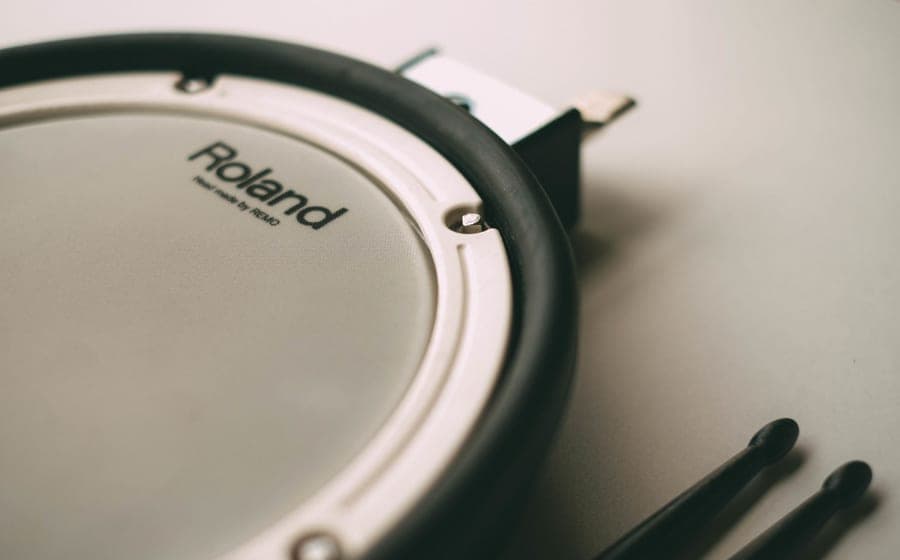
Electronic kits are usually compared on the module — how many sounds, how many preset kits, whether it has Bluetooth. That is the wrong end of the instrument.
The thing your sticks actually hit decides how the kit feels, how loud it is in the room, and whether what you learn on it works on a real drum. That is the pad surface, and at beginner prices it comes in two kinds.
Mesh heads are quieter to strike, rebound much more like a real drumhead, and can be tensioned with a drum key. Rubber pads are cheaper, more compact and louder in the room, with a harder, less realistic bounce. For an adult, and for anyone in a shared building, mesh is worth the difference.
What each one is
A rubber pad is a molded rubber surface over a plastic shell with a trigger sensor underneath. Simple, durable, cheap to make, and unchangeable.
A mesh head is a woven fabric membrane stretched over a real drum hoop with tension rods, exactly like an acoustic drumhead. The sensor sits underneath and reads the fabric moving.
The mesh construction is why it behaves like a drum: it is, structurally, a drum with a fabric head instead of a plastic one.
The comparison
| Mesh | Rubber | |
|---|---|---|
| Struck noise | Soft thud | Sharper slap, carries further |
| Rebound | Close to a real drumhead | Harder and faster than a drum |
| Adjustable | Yes, with a drum key | No |
| Stick wear | Low | Higher — rubber chews tips |
| Arm fatigue | Lower | Higher over long sessions |
| Cost | Higher | Lower |
| Size | Full drum hoops, larger rack | More compact |
The noise argument
This is what decides it for most people, and it is worth being precise about which noise we mean.
An electronic kit produces two entirely separate sounds. The drum sound comes out of headphones or speakers and is fully under your control. The struck sound is the physical noise of a stick hitting a pad in the room, and no volume knob touches it.
Rubber produces a bright, percussive slap. In a quiet house at night it is clearly audible from another room. Mesh under tension produces a much softer thud with far less high-frequency content, which is both quieter and less irritating through a wall.
What neither fixes is the pedals. The kick and hi-hat pedals put repeated impact into the floor and that energy travels through the building structure regardless of what your headphones are doing. An isolation mat is not optional in a shared building, whichever pad type you buy — the full argument is in best instruments for an apartment.
The feel argument
Drumming technique is built on rebound. A great deal of what a drummer learns is controlling how the stick comes back, and a double stroke is one motion producing two notes because the stick returns on its own.
That means the surface has to bounce like a drum, or the stroke you build does not work on one. Rubber bounces harder and faster than a drumhead, so a player who learns entirely on rubber has to adjust when they sit at an acoustic kit.
Mesh is much closer, and it is adjustable. Tighten the rods and you get more rebound and a livelier feel; loosen them for a softer, deader response. That is a real advantage — you can set the kit up to feel the way you want rather than accepting what was molded.
It is the same principle behind gum rubber practice pads like the Evans RealFeel 12" two-sided practice pad#ad, which are chosen specifically because they rebound close to a drumhead.
Which kits use which
The Alesis Nitro Max Kit#ad uses mesh heads, and that is the main reason it is our standard recommendation for adults and for anyone in a shared building — see best drum sets for adult beginners.
The Alesis Debut Kit#ad uses rubber, and that is a deliberate and reasonable choice for its intended player. It is aimed at children of roughly five to nine, where the priorities are a compact footprint, a low price and pads sized for a small player. A five-year-old learning where the drums are is not yet limited by rebound characteristics.
The wider field is in best electronic drum sets for beginners.
Cymbals are rubber either way
Worth knowing so the expectation is right: even on a mesh-head kit, the cymbal pads are rubber. There is no mesh equivalent for a cymbal at this price.
Cymbal pads are consequently the noisiest thing on an electronic kit and the least realistic in feel. That is normal across the category and not a fault of any particular kit.
The recommendation
Buy mesh if the player is a teenager or an adult, if noise matters, or if there is any intention of playing an acoustic kit later. The feel difference is genuine and the noise difference is the one your household will notice.
Buy rubber for a young child, or when the budget genuinely does not stretch. It is a real instrument that will teach real coordination, and a rubber kit that gets played beats a mesh kit that was never bought.
What the module does with the signal once the pad is struck is a separate question, covered in electronic drum modules explained.
What we would buy
Alesis Nitro Max Kit
AlesisBest for: Apartments and shared walls
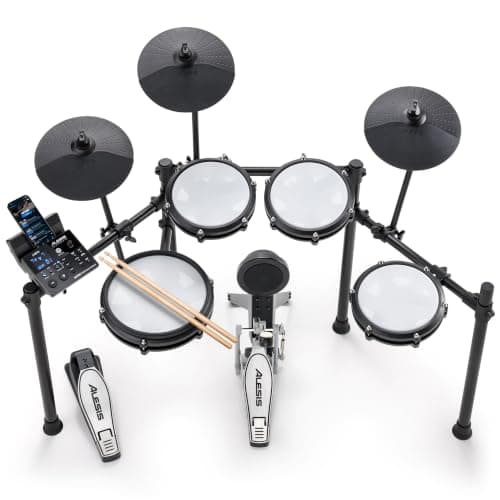
Mesh heads on every pad, a dual-zone snare and Bluetooth audio for playing along. Mesh is the spec that makes an electronic kit tolerable to sit at for an hour.
Published specifications
- Pads:
- 10" dual-zone mesh snare, three 8" mesh toms
- Cymbals:
- Three 10" pads — hi-hat, crash, ride
- Module:
- 440 sounds, 32 kits, 60 play-along songs, performance recorder
- Connectivity:
- Bluetooth audio, USB-MIDI
- Mounting:
- Included four-post rack
- Weight:
- Under 15 kg complete
What it gets right
- Mesh heads on every drum pad — quieter and far closer to a real rebound than the rubber pads a tier down
- Bluetooth audio means playing along to a phone with no cable and no extra mixer
- USB-MIDI, so it doubles as a controller for recording software later
Where it gives ground
- Mesh heads are quiet in the room but the kick pedal thumps through a floor; downstairs neighbors still hear it
- Single-zone toms — no rimshot on anything except the snare
What it is not good at
Teaching cymbal technique. Three 10 inch pads cannot reproduce how a real hi-hat or a crash responds, and a drummer moving to an acoustic kit later has that to learn from scratch.
How the specs score against a beginner’s needs
Scores are our reading of the published specifications above against what a beginner physically needs. They are not test results — we have not played this instrument.
Specifications from Alesis Drums — Nitro Max Kit.
Alesis Debut Kit
AlesisBest for: Ages roughly 5-9
Four 6 inch mesh pads sized and spaced for a small child, with headphones, a throne and sticks in the box. Alesis states it is designed for ages 5 to 9 and the geometry backs that up.
Published specifications
- Pads:
- Four 6" mesh pads (snare and three toms)
- Cymbals:
- Three 10" pads — hi-hat, crash, ride
- Pedals:
- Hi-hat and bass drum pedals included
- Module:
- DM-Lite: 120 sounds, 10 kits, 30 play-along tracks, drum coach
- Age guidance:
- Manufacturer states ages 5-9
- In the box:
- Metal rack, height-adjustable throne, sticks, headphones, cables, Melodics lessons
What it gets right
- Purpose-built small geometry — the pads are within a small child's reach rather than an adult kit with the legs shortened
- Headphones included, which for a kids' drum kit is the difference between practicing and being asked to stop
- Height-adjustable throne, so it tracks a growing child for a couple of years
Where it gives ground
- 6 inch pads are small enough that an older child will feel boxed in quickly
- The DM-Lite module is basic; 120 sounds and no real editing
What it is not good at
Lasting. Alesis's own 5-to-9 guidance is honest, and a 10-year-old should start on the Nitro Max instead. Buying this for an older child to save money buys a kit they will resent in a year.
How the specs score against a beginner’s needs
Scores are our reading of the published specifications above against what a beginner physically needs. They are not test results — we have not played this instrument.
Specifications from Alesis Drums — Debut Kit.
Evans RealFeel 12" two-sided practice pad
EvansBest for: The standard practice pad
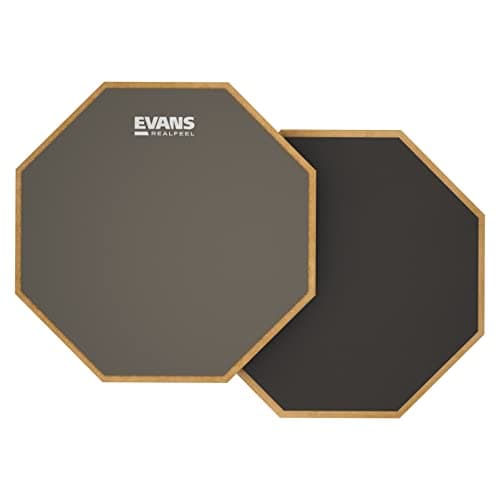
Gum rubber on one side and neoprene on the other, so one pad gives you a realistic rebound surface and a harder, slower one for building control. The default recommendation.
Published specifications
- Diameter:
- 12"
- Surfaces:
- Two — natural gum rubber and neoprene
- Gum side:
- Responds much the way a drumhead does
- Manufacture:
- Designed, engineered and made in the USA
What it gets right
- The gum side rebounds close enough to a real head that the stroke you build on it works on a kit
- The second surface is slower and harder, which is genuinely useful for building hand strength rather than just speed
- 12 inches is snare-sized, so it mounts on a snare stand at the right height
Where it gives ground
- Heavier than a single-sided pad, which matters if it lives in a backpack
- No stand mount on the pad itself in the basic version — check what you are buying
What it is not good at
Teaching anything involving feet. A pad is a hands tool; limb independence needs a kit, and no amount of pad work substitutes.
How the specs score against a beginner’s needs
Scores are our reading of the published specifications above against what a beginner physically needs. They are not test results — we have not played this instrument.
Specifications from Evans RealFeel practice pad published description.
Questions people actually ask
Are mesh heads quieter than rubber pads?
Noticeably, yes. Mesh is a woven fabric under tension and produces a soft thud when struck; rubber produces a sharper slap that carries further through a room. For apartment practice this is the difference that matters.
Do mesh heads feel like real drums?
Closer than rubber, which is the main reason to want them. Mesh rebounds much more like a drumhead, so the stroke you build transfers to an acoustic kit rather than having to be relearned.
Can you adjust mesh heads?
Yes, with a drum key, the same as tuning an acoustic head. Tighter gives more rebound and a livelier feel; looser gives a softer, deader response. Rubber pads have no equivalent adjustment.
Is a rubber pad kit ever the right choice?
For a young child, and for the tightest budgets. Rubber kits are cheaper and more compact, and for a five-year-old learning where the drums are, the feel difference is not yet the limiting factor.
Sources
Still deciding?
Every recommendation on this site is built the same way, and the method is published in full — including what we do not do and what would get a pick dropped.
Read next
- Best electronic drum sets for beginners
Mesh versus rubber pads, the kick-thump problem that headphones do not solve, and picks for adults and children.
- Acoustic vs electronic drums for beginners
Feel against practice hours, what transfers in each direction, and the building question that settles it. Buy paths for both.
- What an electronic drum module actually does
Sounds, sensitivity, inputs and outputs decoded, plus the three module specs that genuinely affect how a kit plays.
- Best drum sets for adult beginners
Full-size acoustic versus mesh-head electronic for an adult in a real house, and the pad-only route that costs almost nothing.
- Best instruments for an apartment
Four instruments that survive a shared wall, ranked by how quiet they are at their loudest, plus the headphones that make the difference.