Keys
Best keyboards with built-in lessons
A lesson mode cannot teach posture, and it cannot tell a child their wrist is collapsing. What it can do is make practice happen on the days nobody feels like it.
By Sawyer V. · Published · Last updated
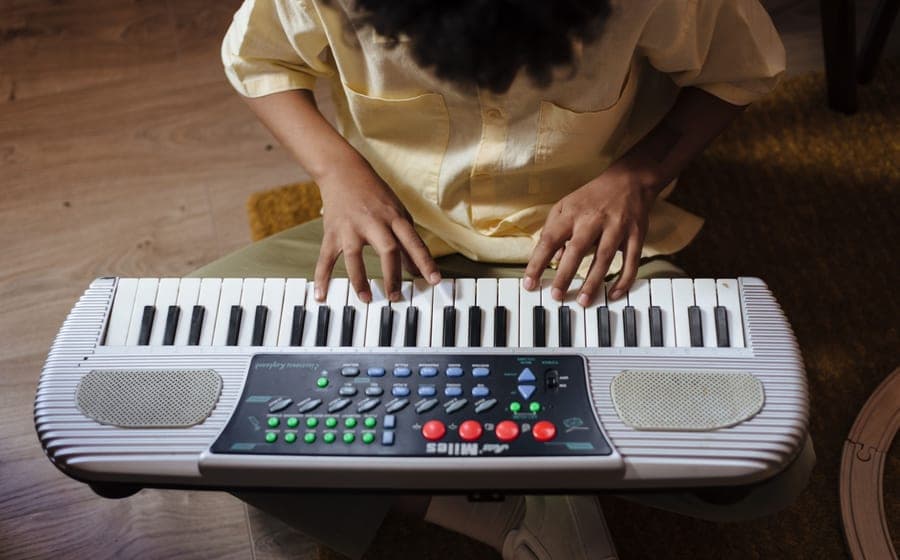
Every keyboard maker has some version of this feature and every one of them oversells it. It is still worth having, as long as you are clear about which part of the job it is doing.
Every pick states its Starter Path band, and we have not physically tested any of them — the method is on how we pick.
The Yamaha PSR-E383 has the best built-in lesson system at the beginner tier: 125 songs with right-hand, left-hand and both-hand practice and an evaluation score. A lesson mode is a practice tool, not a teacher — it can make repetition happen and it cannot see your hands.
What a lesson mode can genuinely do
Enforce hand-separate practice. Right hand alone, left hand alone, then both. This is how piano is taught by people, and a beginner left to their own devices almost never does it, because playing both hands badly feels more like progress than playing one hand well.
Wait for you. The good implementations hold the song until you play the right note, which removes the pressure of keeping up and turns a piece into a puzzle you can solve slowly.
Score you. Crude, and effective. A number at the end of a passage is a reason to try it again, and repetition is most of what early practice is.
Keep time. A built-in metronome and a rhythm track do more for a beginner’s timing than any amount of being told to count.
What it cannot do
It cannot see your hands. It does not know your wrist has collapsed, that you are playing a C with your thumb when the fingering says index, or that you are hunched far enough forward to hurt in a year. Those are the habits that are hardest to unlearn and they are exactly the ones no lesson mode detects.
It also cannot choose what you work on next, which is most of what a teacher actually provides. The honest comparison between the two is in piano lessons versus learning apps.
The pick: Yamaha PSR-E383
The Yamaha PSR-E383#ad carries 125 lesson songs with right-hand, left-hand and both-hand modes and an evaluation at the end. It is the most developed system at this price and it is built around the practice structure a teacher would use.
The specification that matters more than the lesson count is touch sensitivity: on this keyboard, playing harder makes it louder, with soft, medium, hard and off settings. Dynamics are one of the first things a pianist has to learn and an instrument without touch response cannot teach them at all.
Its limits are the limits of the tier. Sixty-one unweighted organ-style keys will not build the finger strength an acoustic piano wants, and 48-note polyphony is the entry figure. See 61 versus 88 keys.
For a younger child
The Casio Casiotone CT-S200#ad is the one we point parents of five- to eight-year-olds at, and the reason is a specification rather than a feature: 61 full-size keys at a price where mini keys are still normal.
Mini keys are the quiet trap in children’s keyboards. A child who learns a hand span on narrow keys has to relearn it on every real instrument they ever touch. Full-size keys on a cheap keyboard are worth more than any lesson feature on a keyboard with narrow ones.
It also ships with a power supply and a music rest, and it is simple enough that a six-year-old can turn it on and use it without an adult, which is the practical difference between an instrument that gets played and one that waits to be set up.
If you want lessons on 88 keys
The Alesis Recital#ad is the cheapest way to get all 88 full-size keys, and it includes a lesson mode that splits the keyboard into two halves with identical pitch ranges — designed for a teacher and a student sitting side by side, and equally useful for a parent following along.
It has 128-note polyphony, double the P-145’s 64, and weighs 15.7 pounds. The compromise is the action: semi-weighted is springs rather than hammers and it is not graded. It is better than unweighted and clearly not a piano.
What actually decides whether practice happens
Not the lesson mode. Three things, in this order: the instrument is out and plugged in rather than in a cupboard, the headphones work so nobody has to ask for quiet, and the practice sessions are short and daily rather than long and weekly.
A lesson mode helps with the third of those and nothing else. The rest of the setup problem is in what you actually need to start piano and how to practice piano effectively.
Quick picks
The best lesson system at this tier
125 lesson songs with right-hand, left-hand and both-hand practice, plus a score at the end. Hand-separate practice is how piano is actually taught.
| # | Product | Best for | Score | Price |
|---|---|---|---|---|
| 1 | No image Yamaha PSR-E38361 touch-sensitive keys and 125 lesson songs with hand-separate practice and scoring. | Learning tools, 61 keysThe honest floor | 7.6 | Check price on Amazon → #ad How we’re funded |
For a younger child
Full-size keys at a price where mini keys are the norm, with a power supply in the box and a simple enough panel for a six-year-old to work alone.
| # | Product | Best for | Score | Price |
|---|---|---|---|---|
| 1 | No image Casio Casiotone CT-S20061 full-size keys, 400 tones and a power supply in the box, at the price where most keyboards still ship with narrow mini keys. | Kids, full-size keysThe honest floor | 7.4 | Check price on Amazon → #ad How we’re funded |
If you want the lesson mode on 88 keys
88 semi-weighted keys, 128-note polyphony and a lesson mode that splits the keyboard into two identical halves for teacher and student.
| # | Product | Best for | Score | Price |
|---|---|---|---|---|
| 1 | No image Alesis Recital88 full-size semi-weighted keys and 128-note polyphony for meaningfully less than a hammer-action piano. | 88 keys on a tight budgetThe honest floor | 7.7 | Check price on Amazon → #ad How we’re funded |
The picks in full
Yamaha PSR-E383
YamahaBest for: Learning tools, 61 keys
61 touch-sensitive keys and 125 lesson songs with hand-separate practice and scoring. The touch response is the spec that matters; the 650 tones are the spec that sells it.
Published specifications
- Keys:
- 61, organ-style (unweighted), touch-sensitive
- Touch response:
- Soft / medium / hard / off
- Polyphony:
- 48 notes
- Tones:
- 650 (258 panel, 25 drum/SFX, 20 arpeggio, 347 XGlite)
- Lessons:
- 125 lesson songs, right/left/both-hand practice with evaluation
- In the box:
- Music rest, PA130 power adapter
What it gets right
- Touch-sensitive keys — playing harder makes it louder, which is the thing a beginner has to learn early and a non-touch keyboard cannot teach
- The lesson mode with hand-separate practice and scoring is genuinely useful, not a gimmick
- Power adapter included, which is not a given at this tier
Where it gives ground
- Unweighted organ-style keys — this will not build the finger strength a piano needs
- 61 keys, so a method book that assumes 88 will eventually run out of instrument
What it is not good at
Preparing anyone for an acoustic piano. If there is a real piano in the child's future, the unweighted action is a habit to unlearn later. Read our 61-versus-88 comparison before deciding.
How the specs score against a beginner’s needs
Scores are our reading of the published specifications above against what a beginner physically needs. They are not test results — we have not played this instrument.
Specifications from Yamaha — PSR-E383 specifications.
Casio Casiotone CT-S200
CasioBest for: Kids, full-size keys
61 full-size keys, 400 tones and a power supply in the box, at the price where most keyboards still ship with narrow mini keys. That one specification is why it is here.
Published specifications
- Keys:
- 61, full-size
- Polyphony:
- 48 notes
- Tones:
- 400
- Rhythms:
- 77
- Display:
- LCD
- Connectivity:
- USB-MIDI
- In the box:
- Power supply, music rest
What it gets right
- Full-size keys at a price where mini keys are the norm — this is the specification that decides whether a child learns a hand span they can keep
- Power supply included, which is not a given and turns a cheap keyboard into an expensive paperweight when it is missing
- Light and simple enough that a child can set it up themselves, which means it gets used
Where it gives ground
- Unweighted keys, so it will not build the finger strength an acoustic piano needs
- 400 tones is a lot of browsing for a child who is meant to be practicing
What it is not good at
Preparing anyone for a real piano. It is a first keyboard for a young child, not a piano substitute — read our weighted-versus-unweighted comparison before assuming otherwise.
How the specs score against a beginner’s needs
Scores are our reading of the published specifications above against what a beginner physically needs. They are not test results — we have not played this instrument.
Specifications from Casio Casiotone CT-S200 published specifications.
Alesis Recital
AlesisBest for: 88 keys on a tight budget
88 full-size semi-weighted keys and 128-note polyphony for meaningfully less than a hammer-action piano. Semi-weighted is a real compromise and the page should say so, so: it is a real compromise.
Published specifications
- Keys:
- 88, full-size, semi-weighted
- Touch response:
- Adjustable — low / medium / high
- Polyphony:
- 128 notes
- Voices:
- 5, layerable and splittable
- Speakers:
- 2 x 20 W
- Weight:
- 15.7 lb
- Extras:
- Lesson mode, metronome, reverb, chorus
What it gets right
- All 88 keys at a price where most instruments give you 61 — the method book never runs out of instrument
- 128-note polyphony, double the Yamaha P-145's 64
- 15.7 pounds, lighter than the P-145's 24 and a genuine consideration if it moves between rooms
Where it gives ground
- Semi-weighted is not hammer action and not graded — the resistance is springs, not weights
- Five voices total, and the piano sample is clearly the entry tier
What it is not good at
Building acoustic-piano technique. Semi-weighted keys let a beginner play faster than their hands have earned, and the habit shows the first time they sit at a real piano. If lessons on an acoustic are coming, spend up to the hammer action.
How the specs score against a beginner’s needs
Scores are our reading of the published specifications above against what a beginner physically needs. They are not test results — we have not played this instrument.
Specifications from Alesis — Recital product page.
Questions people actually ask
Do keyboards with built-in lessons actually work?
They work for one specific job: getting a beginner to repeat something enough times. They cannot see your hands, so they cannot correct posture, fingering or wrist height, which is where a teacher earns their money.
Are light-up keys good for learning piano?
They help a child find the right note faster and they can slow down reading, because the player watches the keyboard instead of the music. Useful early, worth switching off once notation starts.
What is hand-separate practice?
Practicing the right hand alone, then the left alone, then both together. It is standard piano teaching, and a lesson mode that enforces it is doing something genuinely useful rather than decorative.
Do I still need a teacher if the keyboard has lessons?
For anything past the first months, yes. A lesson mode is a practice tool, not a teacher, and the things it cannot detect are exactly the habits that are hardest to unlearn later.
Sources
Still deciding?
Every recommendation on this site is built the same way, and the method is published in full — including what we do not do and what would get a pick dropped.
Read next
- Piano lessons or a learning app?
What apps do well, the two things only a person can catch, and a hybrid approach that costs a fraction of weekly lessons.
- Best beginner keyboards: 61 keys that suit real lessons
Touch response over tone count, segmented for children and adult learners, with the 61-key ceiling stated plainly.
- Best keyboards for kids
Why mini keys are disqualifying, and two picks that keep full-size touch-sensitive keys within a child's budget.
- How to practice piano so it actually works
A session structure that fits twenty minutes, why hands-separate practice works, and the equipment that removes excuses.
- What you actually need to start piano
The complete accessory list in priority order, with what each one is for and which ones can genuinely wait.