Drums
Best bass drum pedals for beginners
Three complaints send people shopping for a kick pedal and two of them are free to fix. Here is how to tell which one you have.
By Sawyer V. · Published · Last updated
A kick pedal is the one piece of a drum kit that most beginners interact with physically more than they interact with the drums. It is also the component most likely to feel wrong for reasons that have nothing to do with its quality, which is why this page spends its first half telling you not to buy anything.
Every pick below states its Starter Path band, and we have not played any of them — the method is on how we pick. Cams, chains, springs and base plates come from published feature lists, cited at the bottom of the page.
Fix the pedal you own first: a squeak is a drop of light machine oil on the spring and hinge, and a beater bouncing back at your foot is spring tension set too high. Neither is a reason to buy anything. If you have done both and still want a better pedal, buy the Tama HP200P Iron Cobra 200 — it carries the Power Glide offset cam from Tama’s flagship series plus adjustable footboard and beater angle, which Tama says most pedals at this price do not have. If your actual complaint is that the pedal slides across the floor, spend slightly more on the DW 2000, the cheapest pick here with a published steel base plate.
The three complaints, and which ones cost money
Nearly everyone who goes looking for a kick pedal is responding to one of three specific sensations. They have different causes and only one of them is a product problem.
“It squeaks.” Free to fix, every time. The noise comes from the spring rubbing in its rocker, the chain running over the cam, or the footboard hinge. A drop of light machine oil at each of those three points silences it in a minute. Use proper oil, not WD-40: WD-40 is a water-displacing solvent, it evaporates, and the joint ends up drier than before. A squeaking pedal is an un-oiled pedal, not a bad one.
“The beater bounces back at my foot.” Free to fix. Spring tension is set too high for the player. Factory settings are tuned for an average adult foot and a beginner — especially a child — needs it looser. Back it off until the beater returns to rest without slapping the footboard into your sole. Every pedal ever made has this adjustment, including the one bundled with the cheapest kit.
“It slides forward while I play.” This one is sometimes free and sometimes not. Free first: make sure the bass drum spurs are extended and dug in, and that the hoop clamp is properly tightened rather than finger-tight. If the kit is on carpet, that is usually enough. If the kit is on bare boards, tile or laminate and the pedal still creeps, that is a hardware problem, and the hardware answer is a steel base plate.
Work through those before reading further. A surprising number of people buy a pedal to solve a problem that a thirty-second spring adjustment would have solved, and then discover the new pedal does the same thing because it shipped at the same default tension.
What separates an eighty-dollar pedal from a bundled one
So you have oiled it, loosened the spring, dug the spurs in, and you still want a better pedal. Fair enough — there is a real difference, and it is worth knowing what it actually consists of, because it is not “build quality” in any vague sense.
The cam. The cam is the curved plate the drive chain wraps around, and its shape determines how leverage changes as your foot travels. A round cam gives a constant, linear pull. An offset cam — Tama’s Power Glide, DW’s Accelerator — shifts the leverage so the beater accelerates into the head. Pedals bundled with budget complete kits are generally round-cam. This is the biggest single feel change available for the money, and it is also a preference rather than an upgrade: plenty of experienced drummers choose round cams deliberately.
Adjustment range. Almost every pedal lets you set spring tension and beater angle. Far fewer let you set the footboard angle independently, and that is the adjustment that matters most for a player whose leg length is not average — a child, or an adult on a tall throne. Tama’s own copy for the Iron Cobra 200 states that you will not find adjustable beater and footboard angles on most pedals in this price range, which is an unusually checkable claim for a manufacturer to make.
The spring, and whether it twists. A coil spring under repeated load tends to rotate in its seat. When it does, the pull goes slightly off-axis, power transmission drops, and the pedal feels different from one session to the next in a way that is almost impossible to diagnose. Tama holds a patent (US 5365824) on a half-moon shaped tension rod it calls Spring Tight, specifically to stop that rotation. It is the least glamorous feature on this page and arguably the most genuinely useful for someone who cannot yet tell their technique from their equipment.
The base plate. A steel platform under the entire pedal, usually with anti-skid rubber underneath. It does one job: it keeps the pedal where you put it. On carpet it contributes almost nothing. On a hard floor it is the difference between a pedal that plays and a pedal that migrates.
The beater. Two-way beaters have felt on one face and hard plastic on the other, so you can change the attack by loosening one bolt. A memory lock holds the height setting through a knock, which is the difference between setting it once and resetting it every week.
Single chain against double chain, honestly
This comes up constantly and the honest answer is less dramatic than the search results suggest.
A single chain pulls the cam from one point. A double chain pulls from two points across the cam’s width, so the load is spread and the drivetrain twists less under a hard stroke. That is a genuine mechanical difference and it becomes audible and feelable at speed.
It is also not where a beginner’s limit is. Three of the four pedals here are single chain, including the one we recommend, and that is not a compromise — it is what the entire beginner and intermediate market uses. The limiting factor on a first-year drummer’s kick foot is ankle control and consistency, and a second chain does nothing for either. The DW 3000#ad is here as the dual-chain option precisely so you can see what the next tier buys, and it sits in the overspend band because of what it does not buy.
The picks, and what each one is for
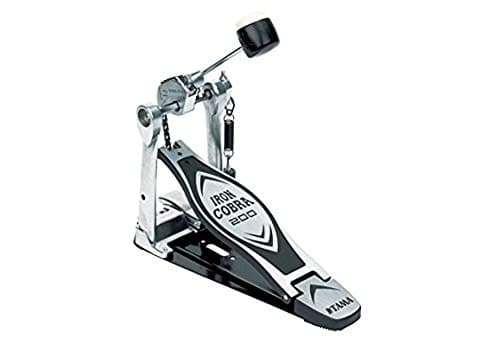
The Tama HP200P Iron Cobra 200#ad is the pick for most people. Tama put the same Power Glide offset cam shape it uses on the flagship Iron Cobra 900 series onto its entry pedal, added adjustable footboard and beater angle, and fitted the patented Spring Tight anti-twist tension rod. The beater is dual-sided, the Para-Clamp grips the hoop firmly, and Tama sells an optional Cobra Coil that speeds the footboard return later. Its one real limitation is published by its absence: Tama does not specify a base plate for the 200 series, so if your complaint is sliding, this is not your pedal.
The DW 2000 Series#ad is the answer to exactly that problem. It is the cheapest pedal here with a published steel base plate and anti-skid rubber mat, and it arrives with a single-chain Accelerator cam, a two-way DW101 beater with a memory lock, a Delta Stroke adjustment on a ball bearing, and a detachable spring — which makes a stretched spring a cheap part rather than a new pedal. The cost is weight and bulk: a steel base plate is steel, and this one does not fold.
The Yamaha FP-7210A#ad goes the other way deliberately. A horizontal frame brace instead of a base plate makes it the lightest pedal here, it folds for transport, and it has adjustable beater angle and spring tension. If the kit lives on carpet, or if the pedal is carried to a teacher every week, that is the right trade. If the floor is bare, it is the wrong one.
The DW 3000 Series#ad is the honest ceiling. Dual chain, the same Accelerator cam and the same steel base plate as the 2000, plus a swivel toe clamp that fits more hoop shapes. All real. None of it is something a first-year drummer can use, and the gap to the DW 2000 is roughly a month of lessons.
What we did not list, and why
Pedals under about thirty dollars are the obvious omission. Several are sold with “single-chain” and “for beginners” in the title and no named manufacturer behind them. They are not listed for the reason this whole page turns on: not one publishes a cam shape, a base plate, or an adjustment range, so there is nothing to compare against the pedal you already own. Buying an unspecified pedal to replace an unspecified pedal is not an upgrade, it is a coin flip.
Pearl’s Demonator and Eliminator pedals and Mapex’s Armory and Falcon are good hardware and largely sit above this page. The genuinely beginner-priced models in both lines were either showing a couple of units in stock or carrying no live price when we checked, and recommending something that may be gone by the time you click is not useful.
Direct-drive pedals replace the chain with a rigid linkage, which removes all the slack and gives an immediate, slightly unforgiving response. It is a legitimate preference and a bad default: the slack in a chain is forgiving, and forgiving is what a developing kick foot needs. The cheapest direct-drive pedals also cost several times the picks here.
Double pedals are out of scope on a beginner page. The left foot on a starter kit is already working the hi-hat, and adding a second beater before single-foot control is reliable produces two unreliable feet. They exist as the twin-pedal version of every model here when the time comes.
Beaters and springs sold separately deserve the mention they are getting rather than a buy row. A new beater costs a small fraction of a new pedal and changes the attack more than a new pedal will. If your complaint is about the sound rather than the feel, buy a beater, not a pedal.
Where this sits in the upgrade order
Our page on drum accessories you actually need ranks the kick pedal second in the order of worthwhile upgrades to a budget complete kit, and that ranking is worth repeating here because this page could otherwise read as an argument for buying one now.
Cymbals come first. On a budget complete kit the cymbals are the weakest component by a wide margin, and replacing the hi-hats alone changes the sound of the whole kit more than any pedal will. Our cymbal pack roundup covers that.
The pedal comes second, and it is a feel upgrade rather than a sound one. That is a real thing to want — a pedal that responds consistently is what makes steady eighth notes on the kick achievable — and it is still second.
Heads come third, shells essentially never. At this level the shells are not the limiting factor, which is why our beginner kit roundup weights hardware and completeness rather than shell material.
One more thing worth saying on a page about the loudest-transmitting part of a drum kit: the kick pedal is also the component that sends sound through the floor rather than through the air, which means no amount of muting fixes it. If the reason you are reading about your pedal is that somebody downstairs has complained, our pages on drum mutes and silencer pads and soundproofing a drum room address that problem, and a new pedal will not.
Setting up whichever one you buy
A new pedal out of the box is set to a factory default that suits nobody in particular. Four adjustments, in this order, and then leave it alone for a month.
Beater height first. The beater should strike near the center of the head. Adjust it on the shaft rather than compensating elsewhere — a beater hitting high or low on the head produces a thinner note and more shell rattle. Our page on setting up a drum set covers this alongside the rest of the kit.
Beater angle second. At rest the beater should sit somewhere around forty-five degrees back from the head. Further back means a longer stroke and more power; closer means faster and lighter.
Spring tension third, and loosen rather than tighten. Set it so the beater returns to rest under its own power without slapping the footboard back at your foot. This is the single adjustment most likely to be wrong on a kit that was set up by whoever sold it.
Footboard angle last, if the pedal has it. Flatter suits a heel-down player, steeper suits heel-up. Most beginners start heel-down and migrate, so start flat.
Then stop adjusting. A pedal that is re-tuned every week never gets learned, and a beginner cannot distinguish a setting problem from a technique problem while both are changing. Set it, write down where the memory locks are, and spend the next month playing it. If you are still deciding whether to buy a kit at all, how to buy your first drum set is the page that comes before this one.
Quick picks
The one to buy
Tama puts the Power Glide offset cam from its flagship Iron Cobra 900 series onto an eighty-dollar pedal, with adjustable footboard and beater angle and a patented anti-twist spring rod. Tama's own copy says most pedals at this price have no angle adjustment at all.
| # | Product | Best for | Score | Price |
|---|---|---|---|---|
| 1 | Tama HP200P Iron Cobra 200Tama puts the same Power Glide offset cam shape from its Iron Cobra 900 series onto an eighty-dollar pedal, and adds adjustable footboard AND beater angle plus a patented anti-twist spring rod. | The pedal to actually buyEnough | 8.6 | $79.99 · View on Amazon #ad How we’re funded |
If the pedal keeps sliding away from you
The cheapest pick here with a published steel base plate and anti-skid rubber. That is the specification that fixes a creeping pedal, and nothing about a cam or a spring will do it instead.
| # | Product | Best for | Score | Price |
|---|---|---|---|---|
| 1 | 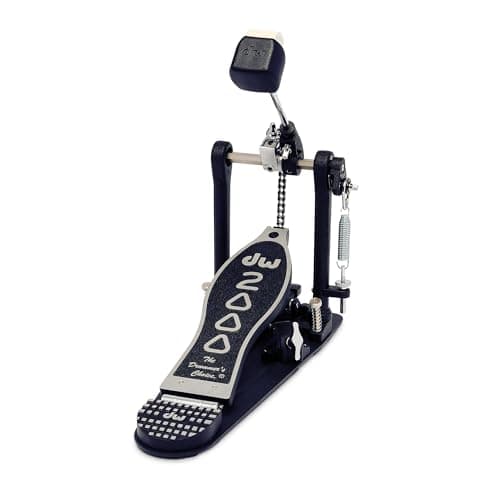 DW 2000 Series (DWCP2000A)The cheapest pedal here with a published steel base plate and an anti-skid rubber mat, which is the one specification that fixes a pedal creeping across the floor. | If the pedal keeps slidingEnough | 8.4 | $89.99 · View on Amazon #ad How we’re funded |
If it has to travel every week
A horizontal frame brace instead of a base plate: lighter, folds flat, goes in a bag. You give up floor stability to get there, which is the right trade only if the pedal is genuinely being carried.
| # | Product | Best for | Score | Price |
|---|---|---|---|---|
| 1 | 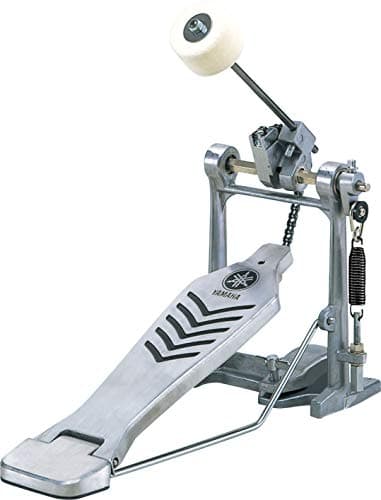 Yamaha FP-7210ASingle chain drive, adjustable beater angle, adjustable spring tension and a horizontal frame brace instead of a base plate. | The plain honest replacementThe honest floor | 7.0 | $79.99 · View on Amazon #ad How we’re funded |
Where overspending starts
A dual chain on the same cam and the same base plate as the 2000. A real engineering difference, measurable at speeds a first-year drummer cannot yet play.
| # | Product | Best for | Score | Price |
|---|---|---|---|---|
| 1 | 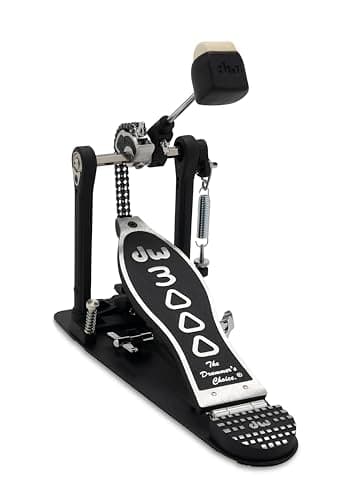 DW 3000 Series (DWCP3000A)A dual chain instead of a single one, on the same Accelerator cam and the same steel base plate as the 2000. | Where overspending startsWhere overspending starts | 8.2 | $129.25 · View on Amazon #ad How we’re funded |
The picks in full
Yamaha FP-7210A
YamahaBest for: The plain honest replacement
Single chain drive, adjustable beater angle, adjustable spring tension and a horizontal frame brace instead of a base plate. It folds, it is light, and it does the job without a single feature you have to learn about first.
Published specifications
- Drive:
- Single chain
- Frame:
- Horizontal frame brace (no base plate published)
- Beater angle:
- Adjustable
- Spring tension:
- Adjustable
- Portability:
- Folds for transport; shipping weight 3.5 lb
- Mounting:
- Hoop clamp
What it gets right
- A horizontal frame brace instead of a base plate makes it the lightest and most packable pedal here, which matters if it travels to a teacher every week
- Adjustable beater angle and spring tension cover the two settings that actually change how a pedal feels
- Folds flat, so it goes in a stick bag rather than needing its own case
- Yamaha hardware is the quietest-failing kind: nothing on it is clever enough to break
Where it gives ground
- No published base plate, so on a bare wooden or tiled floor it will creep forward under a heavy foot
- Footboard angle is not independently adjustable the way the beater angle is
- A round-cam feel rather than an offset cam, so it does not reward fast footwork the way the Tama does
- The included beater is a single-surface felt beater, not a two-way
What it is not good at
Staying still on a hard floor. Without a base plate the pedal relies entirely on the hoop clamp and your bass drum's own spurs, and a kit that already slides will keep sliding.
How the specs score against a beginner’s needs
Scores are our reading of the published specifications above against what a beginner physically needs. They are not test results — we have not played this instrument.
Specifications from Drum Center of Portsmouth — Yamaha FP-7210A published features (single chain drive mechanism, adjustable beater angle, horizontal frame brace, folds for transport, shipping weight).
Tama HP200P Iron Cobra 200
TamaBest for: The pedal to actually buy
Tama puts the same Power Glide offset cam shape from its Iron Cobra 900 series onto an eighty-dollar pedal, and adds adjustable footboard AND beater angle plus a patented anti-twist spring rod. Tama's own copy says you will not find angle adjustment on most pedals at this price, and that is the honest reason this is the pick.
Published specifications
- Drive:
- Single chain
- Cam:
- Power Glide offset cam — the same cam shape as the Iron Cobra 900 series
- Footboard angle:
- Adjustable, linked to the beater angle adjustment
- Beater angle:
- Adjustable
- Spring:
- Spring Tight half-moon shaped tension rod (US Pat. No. 5365824), which stops the spring twisting
- Beater:
- Dual-sided (two striking surfaces)
- Mounting:
- Para-Clamp hoop clamp. Tama publishes no base-plate specification for the 200 series
- Upgrade path:
- Accepts Tama's optional Cobra Coil for faster footboard return
What it gets right
- The offset Power Glide cam is the single biggest feel difference against a bundled kit pedal, and it is the same cam geometry as Tama's flagship
- Adjustable footboard angle as well as beater angle — Tama states plainly that most pedals in this price range have neither
- Spring Tight is a patented fix for a real and specific annoyance: a spring that twists loses power and is the usual cause of a pedal that feels different session to session
- A dual-sided beater means you can change the attack without buying another beater
- The Cobra Coil upgrade path means this pedal can be made faster later rather than replaced
Where it gives ground
- Tama does not publish a base plate for the 200 series, so if your complaint is that the pedal slides, this is not the fix
- The Para-Clamp grips the hoop firmly and there is nothing underneath it holding position on a slick floor
- An offset cam feels faster and also less linear, which some players dislike and cannot un-feel
- The Cobra Coil that unlocks the rest of the footboard return is a separate purchase
What it is not good at
Solving a stability problem. Everything good about this pedal is in the cam, the spring and the adjustment range — nothing about it stops the pedal walking across a bare floor, and that needs a base plate.
How the specs score against a beginner’s needs
Scores are our reading of the published specifications above against what a beginner physically needs. They are not test results — we have not played this instrument.
Specifications from Andertons — Tama Iron Cobra 200 series published features, reproducing Tama's own copy (Power Glide offset cam shared with the Iron Cobra 900 series, beater and footboard angle adjustment, Spring Tight half-moon tension rod US Pat. No. 5365824), Music Arts — Tama Iron Cobra 200 series single bass drum pedal published features (single chain, Power Glide cam, dual-sided beaters, Para-Clamp hoop grip, optional Cobra Coil).
DW 2000 Series (DWCP2000A)
DWBest for: If the pedal keeps sliding
The cheapest pedal here with a published steel base plate and an anti-skid rubber mat, which is the one specification that fixes a pedal creeping across the floor. It also brings DW's single-chain Accelerator cam, a two-way memory-lock beater and a detachable spring, for about ten dollars over the clamp-mount pedals.
Published specifications
- Drive:
- Single-chain Accelerator drive system
- Cam:
- Accelerator cam (offset)
- Base plate:
- Steel base plate with an anti-skid rubber mat
- Beater:
- Two-way DW101 beater with memory lock
- Spring:
- Delta Stroke Adjustment with ball bearing and detachable spring
- Footboard:
- Adjustable angle, with a Footboard InterLock Hinge System
- Frame:
- All-metal frame and drivetrain
What it gets right
- A steel base plate with anti-skid rubber is the actual answer to the commonest beginner complaint about a kick pedal, and this is the cheapest pick here that publishes one
- The memory lock on the DW101 beater means a setting survives being knocked, which is the difference between adjusting once and adjusting every week
- A detachable spring sounds like a minor thing and is the cheapest repair on any pedal — a stretched spring becomes a part rather than a new pedal
- Two-way beater: felt on one face and hard plastic on the other, so the attack is a flip rather than a purchase
Where it gives ground
- Roughly ten per cent more than the Tama for a cam that is good rather than flagship-derived
- Noticeably heavier than the Yamaha, because a steel base plate is steel
- Does not fold the way a brace-frame pedal does, so it needs more room in the car
- The Accelerator cam is a single chain here; the dual-chain version is the 3000, one tier up
What it is not good at
Traveling light. The base plate that makes it stable is the same base plate that makes it the awkward one to carry, and if the pedal goes to a lesson every week on a bus that trade runs the wrong way.
How the specs score against a beginner’s needs
Scores are our reading of the published specifications above against what a beginner physically needs. They are not test results — we have not played this instrument.
DW 3000 Series (DWCP3000A)
DWBest for: Where overspending starts
A dual chain instead of a single one, on the same Accelerator cam and the same steel base plate as the 2000. The second chain spreads the pull across the cam and is a real engineering difference — and it is a difference a first-year drummer has no way to use.
Published specifications
- Drive:
- Dual chain
- Cam:
- Accelerator cam
- Base plate:
- Steel base plate with anti-skid rubber matting
- Footboard:
- Adjustable angle
- Toe clamp:
- Swivel toe clamp
- Frame:
- All-metal construction
- Beater:
- Not published by the cited dealer for this version
What it gets right
- A dual chain pulls the cam evenly across its width, which is the published difference and is genuinely what the tier above buys
- Same steel base plate and anti-skid rubber as the 2000, so nothing about stability is given up
- A swivel toe clamp accommodates more hoop sizes and angles than a fixed clamp, which matters on an odd or thick bass drum hoop
- All-metal and from DW's current line, so parts and beaters stay available for years
Where it gives ground
- Around forty per cent more than the DW 2000 for a second chain and a swivel clamp
- The beater model is not published on the dealer page we cite, so we are not claiming it
- The heaviest pedal on this page, and the least willing to go in a bag
- Nothing here addresses a beginner's actual limiting factor, which is ankle control rather than drivetrain
What it is not good at
Justifying itself in year one. A dual chain is a measurable improvement at speeds a first-year drummer cannot yet play, and the money gap to the DW 2000 is roughly a month of lessons.
How the specs score against a beginner’s needs
Scores are our reading of the published specifications above against what a beginner physically needs. They are not test results — we have not played this instrument.
Questions people actually ask
Do I need to upgrade the bass drum pedal that came with my kit?
Probably not yet. Three complaints send people shopping — it squeaks, it slides forward, the beater bounces back at your foot — and the first and third are nearly always setup rather than the pedal. Fix those for free first. The honest case for buying one is a pedal with a round cam and no angle adjustment that you have already tuned properly and still dislike, which is a real situation and is not the usual one.
Why does my bass drum pedal squeak?
Almost always the spring, and occasionally the chain or the hinge. A drop of light machine oil where the spring meets its rocker, on the chain, and on the footboard hinge pin fixes it in about a minute. Do not use WD-40 as a lubricant — it is a solvent that flashes off and leaves the joint drier than it started. A squeak is never a reason to replace a pedal.
Why does my kick pedal bounce back at my foot?
Spring tension too high for the player, almost every time. A tight spring returns the beater fast and hard, and a beginner who has not yet learned to control the rebound experiences that as the pedal fighting them. Back the spring off until the beater returns without slapping your foot, then leave it. Every pedal on this page has adjustable spring tension, including the one that came with your kit.
What is the difference between a single chain and a double chain pedal?
A double chain pulls the cam from two points across its width rather than one, so the load is spread and the drivetrain flexes less under a hard stroke. It is a real difference and it shows up at speed. Nearly every pedal sold at beginner prices is single chain, including three of the four here, and that is not a compromise at this level — the DW 3000#ad is the dual-chain option and it sits in our overspend band for that reason.
What is an offset cam and does it matter?
The cam is the curved plate the chain wraps around. A round cam gives an even, linear pull through the stroke; an offset cam (Tama calls it Power Glide, DW calls it Accelerator) changes the leverage as the footboard travels, so the beater accelerates into the head. Offset feels faster and less linear. It is the biggest single feel difference between a bundled kit pedal and an eighty-dollar one, and some players genuinely prefer round.
Do I need a pedal with a base plate?
Only if the pedal moves. A base plate is a steel platform under the whole pedal, usually with anti-skid rubber, and it stops the pedal creeping forward on a hard floor. On carpet, with a bass drum whose spurs are properly dug in, a clamp-mount pedal stays put fine and the base plate is just weight. On bare boards, tile or laminate it is the fix, and the DW 2000#ad is the cheapest pick here that publishes one.
Felt or plastic beater?
Felt is rounder and quieter and is the right default for a beginner practicing at home; hard plastic is a sharper attack that cuts through a loud band. Two of the picks here ship a two-way beater with both surfaces, so it is a flip rather than a purchase. If you only have a felt beater and want more attack, a new beater costs a small fraction of a new pedal — try that first.
Should I buy a double pedal instead?
Not as a first purchase. A double pedal adds a second beater worked by the left foot, and the left foot on a beginner kit is already busy with the hi-hat. Learning to use one before single-foot control is solid produces two unreliable feet instead of one reliable one. Every pedal on this page is sold in a double version later if you want it.
Sources
- Andertons — Tama Iron Cobra 200 series published features, reproducing Tama's own copy (Power Glide offset cam shared with the Iron Cobra 900 series, beater and footboard angle adjustment, Spring Tight half-moon tension rod, US Pat. No. 5365824)
- Music Arts — Tama Iron Cobra 200 series single bass drum pedal published features (single chain, Power Glide cam, dual-sided beaters, Para-Clamp hoop grip, optional Cobra Coil)
- Music Arts — DW 2000 Series single bass drum pedal (DWCP2000A) published specifications
- Drum Center of Portsmouth — DW DWCP3000A 3000 Series single bass drum pedal V2 published specifications
- Drum Center of Portsmouth — Yamaha FP-7210A published features (single chain drive mechanism, adjustable beater angle, horizontal frame brace)
Still deciding?
Every recommendation on this site is built the same way, and the method is published in full — including what we do not do and what would get a pick dropped.
Read next
- Drum accessories you actually need
Sticks, a pad, hearing protection and a throne, in priority order, plus the upgrades that genuinely change how a cheap kit sounds.
- Best beginner drum sets: complete kits for teens and adults
Complete acoustic and electronic kits for adult players, with the total-purchase problem and the noise question both addressed.
- How to set up a drum set
Build order from the throne outward, the angles that prevent wrist and back trouble, and how an electronic rack differs.
- Every part of a drum kit, explained
What every drum, cymbal and stand is for, which parts are the weak link on a budget kit, and what a five-piece actually means.
- How to buy your first drum set
The order to decide in, why the room comes before the player, and the parts that are missing from a kit that says it is complete.
- Best drum mutes and silencer pads
Pads sit on the heads, mesh heads replace them, and low-volume cymbals replace the loudest thing on the kit. What each one removes, what none of them touch, and four sets on published specifications.