Keys
Keyboard vs digital piano
Two instruments that share a shape and not much else. The words get used interchangeably in listings, which is how people buy the wrong one.
By Sawyer V. · Published · Last updated
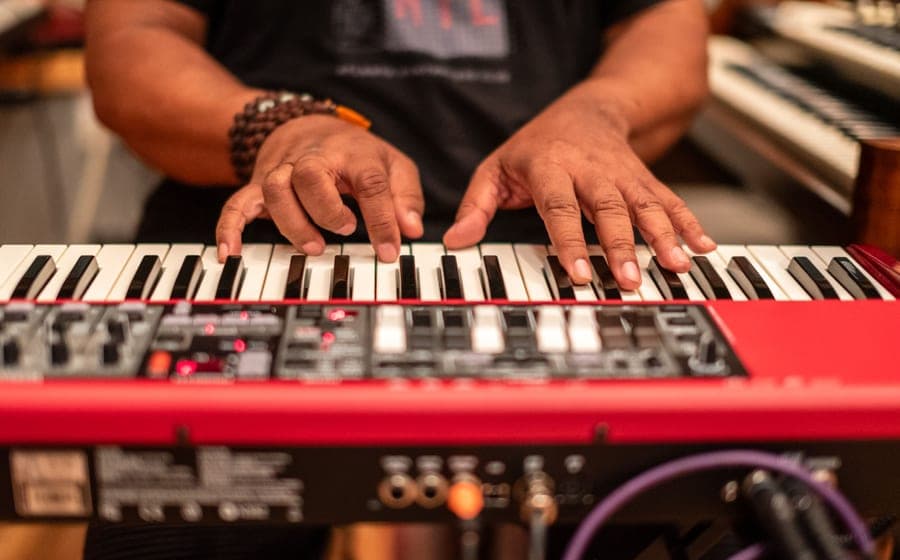
A digital piano has 88 weighted keys and imitates an acoustic piano. A keyboard has around 61 unweighted keys and is portable and versatile. Buy the digital piano if piano lessons are the plan; buy the keyboard if the player is exploring, the budget is tight, or the instrument has to move.
Two instruments, one shape
The confusion is genuine, because retailers use both words for both things. Here is the distinction that actually holds.
| Keyboard | Digital piano | |
|---|---|---|
| Built to | Be versatile and portable | Imitate an acoustic piano |
| Keys | Usually 61, unweighted | 88, weighted |
| Sounds | Hundreds, plus rhythms and accompaniment | A handful, centered on piano |
| Weight | About 10 lb | 25 to 40 lb |
| Learning tools | Often extensive — lesson modes, scoring | Usually none |
| Best for | Exploring, songwriting, accompaniment, young children | Piano study, exams, classical repertoire |
The feature that makes the keyboard look better
Compare a Yamaha PSR-E383 against a digital piano on a spec sheet and the keyboard wins nearly every row. It has 650 tones against a handful. It has a lesson mode with 125 songs, hands-separate practice and automatic scoring. It has accompaniment styles that make one person sound like a band. It costs a fraction as much and weighs a third as much.
The digital piano wins one row: key action. And that one row is the entire product, in the same way that a bicycle with a broken pedal is not compensated by having a nicer bell.
That is not an argument against keyboards. It is an argument for being clear about what you are buying. If key action is not what you need, then the keyboard is genuinely better and the spec sheet is telling the truth.
What each one costs to complete
Keyboard. The instrument, an X-stand, a sustain pedal and headphones. Many keyboards ship with a power adapter and a music rest; some do not, and a keyboard without its adapter is an expensive paperweight, so check.
Digital piano. The instrument, a stand or a table at the right height, an adjustable bench, and headphones. The supplied sustain footswitch is usually a small plastic box rather than a piano-style pedal, and most people replace it within a year. Both lists are in what you actually need to start piano.
What to skip on either side
Mini keys, always. A keyboard with narrower-than-standard keys teaches a hand span that is wrong on every other instrument. This is worst for children, because that is when hand position is being set.
No touch response, always. Playing harder has to make it louder. Without that the instrument cannot teach dynamics at all.
An 88-key unweighted board. The footprint and price of a digital piano with the action of a keyboard. If the action is unweighted there is no reason to pay for 88 keys.
The question that decides it
Is there a teacher, and will lessons happen on an acoustic piano?
Yes: buy the digital piano. No: buy the keyboard, spend less, and put the difference toward lessons, which are the highest-return purchase in the category by a wide margin.
What we would buy
Yamaha PSR-E383
YamahaBest for: Learning tools, 61 keys
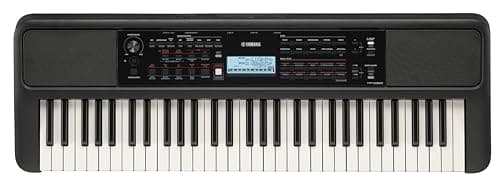
61 touch-sensitive keys and 125 lesson songs with hand-separate practice and scoring. The touch response is the spec that matters; the 650 tones are the spec that sells it.
Published specifications
- Keys:
- 61, organ-style (unweighted), touch-sensitive
- Touch response:
- Soft / medium / hard / off
- Polyphony:
- 48 notes
- Tones:
- 650 (258 panel, 25 drum/SFX, 20 arpeggio, 347 XGlite)
- Lessons:
- 125 lesson songs, right/left/both-hand practice with evaluation
- In the box:
- Music rest, PA130 power adapter
What it gets right
- Touch-sensitive keys — playing harder makes it louder, which is the thing a beginner has to learn early and a non-touch keyboard cannot teach
- The lesson mode with hand-separate practice and scoring is genuinely useful, not a gimmick
- Power adapter included, which is not a given at this tier
Where it gives ground
- Unweighted organ-style keys — this will not build the finger strength a piano needs
- 61 keys, so a method book that assumes 88 will eventually run out of instrument
What it is not good at
Preparing anyone for an acoustic piano. If there is a real piano in the child's future, the unweighted action is a habit to unlearn later. Read our 61-versus-88 comparison before deciding.
How the specs score against a beginner’s needs
Scores are our reading of the published specifications above against what a beginner physically needs. They are not test results — we have not played this instrument.
Specifications from Yamaha — PSR-E383 specifications.
Yamaha P-145
YamahaBest for: Buy once, 88 weighted keys
88 graded hammer keys, a concert grand sample and 24 pounds. If the plan is piano lessons rather than keyboard playing, this is where the shopping actually starts.
Published specifications
- Keys:
- 88, GHC (Graded Hammer Compact), fully weighted and graded
- Polyphony:
- 64 notes
- Sound:
- Yamaha CFIIIS concert grand sample, damper resonance DSP
- Speakers:
- 7 W built-in
- Dimensions:
- 1,326 x 268 x 129 mm (52-3/16" x 10-9/16" x 5-1/16")
- Weight:
- 11.1 kg (24 lb 8 oz)
- In the box:
- Music rest, sustain foot switch
What it gets right
- Graded hammer action — the low keys are heavier than the high ones, which is the thing an unweighted keyboard cannot teach
- All 88 keys, so no method book ever runs off the end of the instrument
- Genuinely portable at 24 pounds and 268 mm deep; it fits on a desk
Where it gives ground
- 64-note polyphony is the entry-tier number; heavy sustain-pedal passages will drop notes eventually
- A single sustain footswitch, not a proper piano-style pedal — most players replace it
What it is not good at
Anything other than piano. There are only a handful of voices and no arranger features, so if the player wants to make beats or layer sounds, a PSR-E383 will make them happier for less money.
How the specs score against a beginner’s needs
Scores are our reading of the published specifications above against what a beginner physically needs. They are not test results — we have not played this instrument.
Specifications from Yamaha USA — P-145 specifications.
Questions people actually ask
What is the best keyboard to learn piano?
Strictly, a digital piano rather than a keyboard: 88 weighted keys built to imitate an acoustic. If the budget will not reach that, a touch-sensitive 61-key keyboard is a genuinely reasonable start and far better than not starting.
Is a digital piano worth the extra money over a keyboard?
If the destination is piano, yes — you are buying key action, which is the thing that cannot be added later. If the destination is playing songs, writing music or accompanying singing, no; the money goes further elsewhere.
Can I use a keyboard for piano lessons?
Yes, and many teachers accept it for the first year with a caveat: they will usually ask for at least 61 full-size touch-sensitive keys and a sustain pedal. Ask the teacher before buying — some have a firm requirement and it is much cheaper to know first.
Which is better for a child?
For a young child, often the keyboard: it is lighter, cheaper, and a light action suits hands that do not yet have the strength for a weighted one. Around nine or ten, when the hands can drive a hammer action, the argument flips.
Sources
Still deciding?
Every recommendation on this site is built the same way, and the method is published in full — including what we do not do and what would get a pick dropped.
Read next
- 61 vs 88 key keyboard
When 61 keys stops being enough, what 88 actually costs in money and floor space, and buy paths for both answers.
- Weighted vs unweighted keys
Hammer, semi-weighted and synth action explained by effect on the hands, with the one question that settles the choice.
- Best beginner keyboards: 61 keys that suit real lessons
Touch response over tone count, segmented for children and adult learners, with the 61-key ceiling stated plainly.
- Best beginner digital pianos: 88 keys, honestly compared
Hammer action versus semi-weighted at the entry price, with the polyphony and weight trade-offs both stated.
- What you actually need to start piano
The complete accessory list in priority order, with what each one is for and which ones can genuinely wait.